

Two kinds of device, two kinds of install
Bolt-on actuators leave your plumbing alone. The YoLink Smart Water Valve Controller clamps a battery-powered manipulator over the handle of an existing quarter-turn ball valve (YoLink's instructions cover 1/2, 3/4 and 1 in valves) and cranks it shut when a paired leak sensor gets wet. Nothing is cut, nothing is threaded, and if you take it off, the valve is exactly as it was. This is a homeowner job.
Inline units become part of the pipe. Moen Flo and Phyn Plus are motorized valves with flow and pressure sensors in one body; the Resideo L5 is a threaded ball valve with a Wi-Fi actuator on top. To install one, the main supply line is cut and a section removed, adapters for your pipe type are fitted to each end, and the device is connected between them with unions so it can come out for service. Moen's instruction sheet and Phyn's product page both recommend a licensed plumber; Phyn quotes one to two hours. In most of the country this is also the kind of work a plumbing permit covers.
A third kind, the flow monitor without a valve (Flume 2 straps to the utility meter), installs in ten minutes and does not shut anything off; it is in our roundup for renters and condo owners.
| Device | Type | Pipe work | Who installs | Power | Hub |
|---|---|---|---|---|---|
| YoLink valve controller kit | Bolt-on actuator on an existing ball valve | None | Homeowner, about an hour | Four AA batteries | YoLink Hub required |
| Moen Flo 900-001 (3/4 in), 900-006 (1 in), 900-002 (1-1/4 in) | Inline monitor and shutoff | Cut the main, four joints, unions supplied | Licensed plumber recommended | Outlet within 10 ft, 100 to 240 VAC | None |
| Phyn Plus (2nd gen) | Inline monitor and shutoff, 1 in NPSM ends | Cut the main, adapters to your pipe size not included | Licensed plumber recommended, 1 to 2 hours | Outlet within about 12 ft, 120 V | None |
| Resideo L5 (1/2 to 1-1/4 in) | NPT ball valve with Wi-Fi actuator | Cut the main, threaded joints and unions | Authorized professional recommended | Per spec sheet | None |
| Flume 2 | Flow sensor strapped to the meter; no valve | None | Homeowner, about ten minutes | Battery sensor, USB bridge | Bridge included |
Where it goes
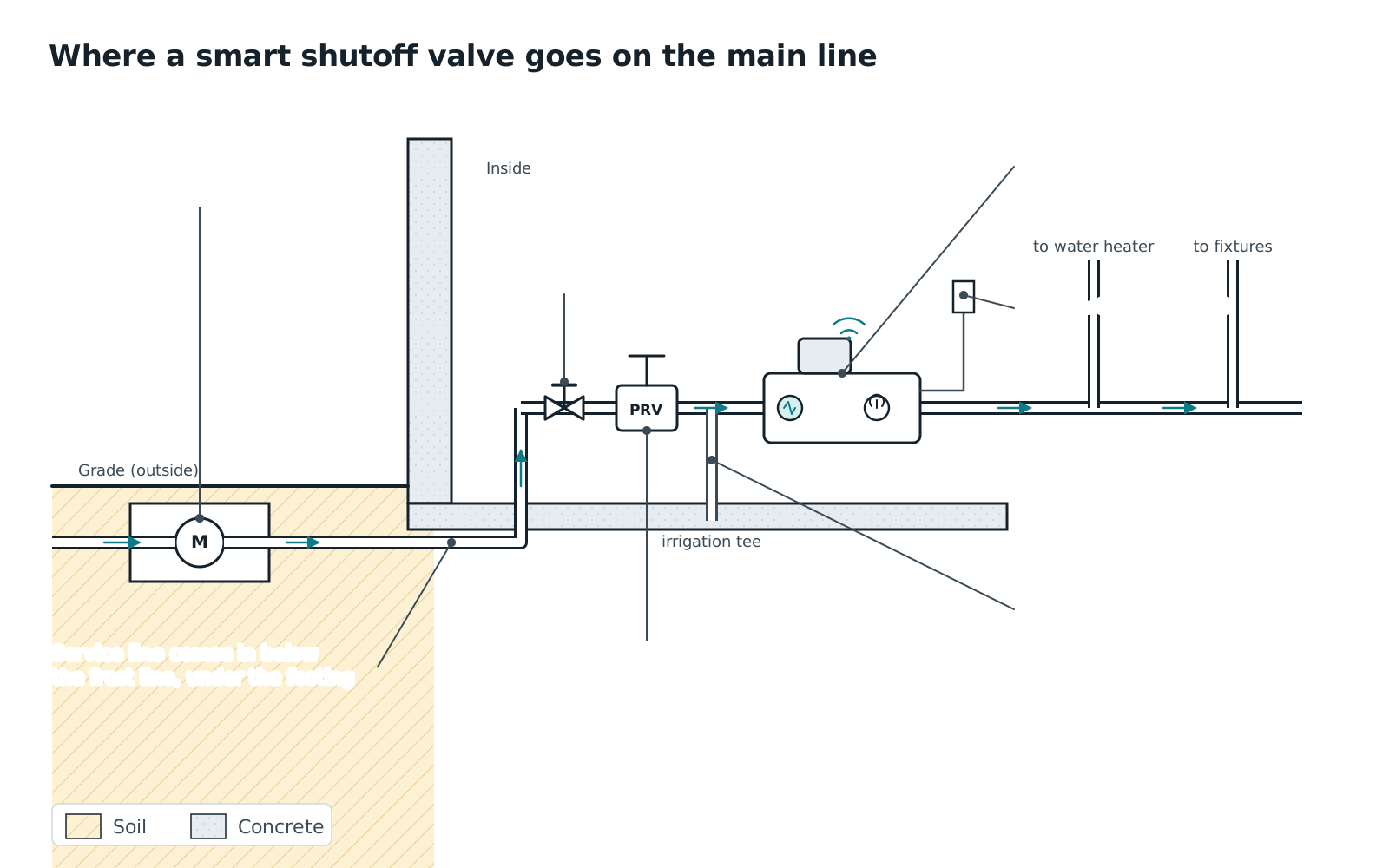
Every manufacturer puts the device in the same place, for the same reason: it has to see all the water the house uses and nothing else.
After the meter, the main shutoff and the pressure regulator, before the first branch. Moen's instruction sheet says the Flo should be placed after the main shutoff and pressure reducing valve, if present, on an accessible, above-ground section of the main cold water supply. Phyn's help center says to install Phyn Plus on the main supply pipe immediately after the main shutoff valve and before any branches, fixtures or devices, and notes that anything upstream of the device, including a water softener, is not monitored. The order along the pipe, in the direction of flow, is: meter, main shutoff valve, pressure reducing valve, the smart device, then everything else. Keeping the manual shutoff upstream means you can still kill the water with a handle if the device ever fails closed or needs to come out.
Irrigation and fire sprinklers. If the irrigation tees off before where you plan to put the device, the device will never see a broken sprinkler line; Moen's sheet tells well and irrigation customers to install after all treatment equipment, the well pump and the storage tank. Fire sprinkler lines are the opposite: Moen says not to install on a sprinkler or distribution line and, where sprinklers are present, to install after the sprinkler branch, so a leak shutoff never starves the sprinklers.
Orientation and clearance. Both Flo and Phyn mount horizontally or vertically, with the arrow on the body pointing in the direction of flow toward the house. Moen's clearance table for the 3/4 and 1 in models asks for 6 in above the device, 3 in at the sides and bottom, 4 in of straight pipe on the inlet and 2 in on the outlet; the 1-1/4 in model needs more. That is why the device so often ends up on the horizontal run just past the shutoff rather than tucked into an elbow.
Indoors or out. Both can be installed outdoors; Moen requires a weatherproof receptacle enclosure at least 12 in above grade and an ambient range of 32 to 140°F, and Phyn asks for the bottom of the enclosure to be at least 12 in above ground. In a climate that freezes, outdoors means a heated enclosure or an indoor location.
Galvanized pipe. Moen's sheet is explicit: do not install if any upstream piping is galvanized, because the scale and rust it sheds foul the turbine. If your main is galvanized, the plumber replaces the run from the shutoff to the device with copper or PEX first.
Pipe types, sizes and fittings
Know your pipe size first. Residential mains are 3/4 in or 1 in, occasionally 1-1/4 in on larger houses, and the device has to match. Copper and PEX are named by nominal size, and the outside diameter is 1/8 in larger: a pipe that measures 7/8 in around is 3/4 in nominal, 1-1/8 in is 1 in. Moen sells the Flo in three sizes (900-001 for 3/4 in, 900-006 for 1 in, 900-002 for 1-1/4 in). Phyn Plus has 1 in NPSM threaded ends regardless of pipe size and is installed with adapters your plumber supplies, on pipes no larger than 1-1/4 in; Phyn's online purchase includes a 3/4 in water meter coupling, and anything else is an extra part.
Copper takes soldered, press or push-to-connect adapters; Moen's sheet warns not to solder with the device in place, because the heat wrecks the O-rings, so adapters go on first and the device connects afterward with its union nuts. PEX takes crimp, clamp or expansion adapters to a male thread, with the pipe supported on both sides so the device does not sag on it. CPVC takes solvent-welded threaded adapters, cured per the cement's label before the device goes on.
Threads and unions. Moen's tips page says to use PTFE tape only on the threaded ends of the house piping, never on the device, the spacers or the union nuts, which seal on O-rings; to grease the O-rings with silicone grease; and to hand-tighten the union nuts and add a quarter turn with a tool, no more. The unions are the point: a device that fails or needs its turbine cleaned comes out in five minutes without cutting anything.
Power and Wi-Fi at the main
The main shutoff in most houses is in a basement corner, a crawl space or a garage wall, which is where outlets and Wi-Fi are weakest, and this is the part of the install that gets underestimated.
Power. Moen specifies a 100 to 240 VAC outlet with continuous power within 10 ft of the device, GFCI recommended, with the power supply mounted off the ground on its bracket; if the outlet is farther, Moen says not to use a high-voltage extension cord and sells 25 ft low-voltage extension kits that chain up to four. Phyn's product page asks for an outlet within 12 ft and includes a 12 ft cord. If there is no outlet, an electrician adds one. YoLink's controller runs on four AA batteries and needs no outlet at all.
Wi-Fi. The Flo requires a 2.4 GHz network (802.11 b/g/n). Stand where the device will be with your phone on the 2.4 GHz band and check the signal before anyone cuts pipe. Moen's sheet notes that a Flo that is powered but cannot reach the internet drops into Local Mode, which it warns causes frequent shutoffs; Phyn suggests a repeater or extender if the signal is weak. A mesh node near the main is a normal part of this install. YoLink uses LoRa radio from the controller to its hub, which is why it reaches crawl spaces Wi-Fi does not.
Power outages. Neither Flo nor Phyn has a battery inside the device. Phyn states the valve remains in whatever state it was in when power is lost, and includes a manual tool on the mounting bracket to turn the valve by hand. Moen sells a separate plug-in Battery Backup accessory for the Flo Shutoff (model 920-008) that keeps the device powered through an outage; it is not in the box, so budget for it if outages are common where you live. Either way, the upstream manual shutoff is your outage plan. YoLink's battery-powered controller and local device-to-device pairing keep working with the power and internet down, which is the one clear advantage of the bolt-on design.
Check the pressure before you start
Screw a pressure gauge onto a hose bib or the laundry faucet downstream of the regulator and read it. Moen's sheet rates the Flo for 125 psi maximum continuous pressure, recommends operating at 80 psi or less, and notes that most plumbing codes require a pressure reducing valve above 80 psi; Phyn rates Phyn Plus to 125 psi. A house reading 90 psi gets a PRV installed or replaced in the same visit, upstream of the device. A PRV also makes the daily micro-leak pressure test both devices run far more meaningful, because the device can close its valve and watch a stable, isolated section of pipe.
DIY: installing a bolt-on actuator on an existing ball valve
- 1
Confirm the valve is a quarter-turn ball valve that moves
The actuator needs a lever-handle ball valve, not a round-handle gate valve, in 1/2, 3/4 or 1 in, with clear space around the handle for the clamp body. Turn the handle fully closed and open by hand first. A valve that is stiff, seized or weeping at the stem is replaced by a plumber before anything is bolted to it; a motor will not free a valve your hand cannot. If the main has a gate valve, YoLink's motorized valve (a cut-in, plumber-installed part) is the answer instead.
- 2
Mount the manipulator over the handle
Follow the kit's instructions for your valve size: the clamp body straps to the pipe on both sides of the valve, the arm captures the handle, and the assembly is squared to the pipe so the arm travels the full quarter turn without binding. Tighten evenly. Insert the batteries and run the controller's manual open and close cycle, watching the handle reach both stops.
- 3
Set up the hub and pair the controller
Plug the hub in near your router, add it in the app, then add the valve controller. Place leak sensors at the water heater, the washer, under sinks and anywhere else from our sensor placement guide, and pair each one.
- 4
Create the shutoff automation and the local pairing
In the app, set each sensor to close the valve when wet. YoLink's device-to-device pairing (Control-D2D) runs locally between the sensor and the controller, which is what keeps the shutoff working when the internet or the hub is down; set it up for every sensor, not just the app automation.
- 5
Test it with water, then with the power out
Touch a wet paper towel to a sensor and watch the valve close; then open a faucet and confirm it drops to a trickle and stops, which proves the valve seats fully rather than closing most of the way. Reopen from the app. Repeat with the hub unplugged to confirm the local pairing works. Then label the valve for the next person: what the device is, that the valve must be closed from the app or the controller's button, and where the manual override is.
What the plumber does for an inline unit, and how to prepare
- 1
Before the visit: outlet, Wi-Fi, permit
Have the outlet and the Wi-Fi signal sorted before the plumber arrives, because neither is their job. Ask the building department whether an inline shutoff needs a plumbing permit; in many jurisdictions any alteration to the water distribution system does, and some states restrict that work to licensed plumbers. Photograph the main and the space around it and send it with the quote request so the plumber brings the right adapters.
- 2
Shut the main and drain the house
Close the main shutoff, then drain the lines the way Moen's sheet describes: open the highest-flow outlet at the highest point of the house first, then open the remaining faucets from the lowest point (a hose bib or laundry sink) up to the highest, so the lines empty and the pressure is relieved. Water left in the line ends up on the floor and in the solder joint.
- 3
Mark and cut
Measure the device's installed length with its tailpieces and the required straight pipe on each side, mark the cut on a straight run after the shutoff and the PRV, and cut cleanly with a tubing cutter. Moen specifies leaving a 1/32 to 1/16 in gap between the module and the tailpieces so the O-rings are not pinched; the unions take up the rest.
- 4
Fit the adapters, then the device
Solder, press or crimp the adapters onto the pipe with the device nowhere near the heat; let solder joints cool. Wrap PTFE on the adapter threads only, thread on the tailpieces, grease and seat the O-rings, orient the arrow toward the house, and connect the device with the union nuts hand-tight plus a quarter turn. Support the device so it does not hang on the pipe.
- 5
Pressurize slowly and check every joint
Open the main shutoff partway and inspect each connection for drips before opening it fully, then run a faucet to purge air and pull the aerators to clear any solder or scale that came loose. Leave the connections accessible for a day before closing up any wall or cover.
- 6
Pair, run the first test, and start the learning period
Plug in the device, pair it in the app (Moen's process is a five-second reset and a QR scan; the device should come online within two to three minutes if the signal is adequate), then close every fixture and run the first micro-leak test. A leak found now is usually a running toilet or a weeping fixture, and worth fixing before the device starts learning. Moen's Flo then enters Learning Mode for about seven consecutive days of normal use, up to ten in some cases, during which alerts and automatic shutoff are off; Phyn says its learning period differs for every home. Automatic shutoff is not protecting you until that period ends.
After the install: commissioning it properly
Pair the point sensors. Both inline brands close the valve when one of their own sensors gets wet (Moen's Smart Water Detector, Phyn's Smart Water Sensor), which covers the failure a flow meter is slowest to catch: a water heater seam weeping into its pan at a trickle. One under the water heater, one behind the washer, one under the kitchen sink at minimum.
Test the shutoff once a month. Close the valve from the app, open a faucet, confirm it stops, reopen. A valve that has not moved in a year is the one that will not move during the leak.
Set away mode when you travel, which tightens the flow thresholds, and keep the manual shutoff working: exercise the upstream valve twice a year and label it. Our shutoff guide covers finding and freeing a stuck one.
Do the insurance paperwork. Moen puts an insurance verification letter in the app; Phyn runs bundle programs with specific insurers; our insurer discount database lists who offers what. The discount usually requires the device to be installed, activated and verified at the policy address, so keep the plumber's invoice and the app's confirmation.
Moen Flo Smart Water Monitor and Shutoff (3/4 in, 900-001)
The whole-house shutoff insurers name by name.
Best for most homes on a 3/4-in main that want insurer-recognized whole-house protection.
Score breakdown
| Detects leaks from flow | true | 10.0 |
| Shuts the main automatically | true | 10.0 |
| Warranty | 1 | 5.0 |
| Micro-leak pressure testing | true | 10.0 |
| No subscription for core protection | false | 10.0 |
| Works in a power outage | false | 0.0 |
| Insurance discounts | true | 10.0 |
| No extra hub | false | 10.0 |
| Expands with point sensors | true | 10.0 |
Stars are DryHomeLab's rating from the published rubric (score ÷ 2, to the half star). Not a customer rating.
- Monitors flow, pressure and temperature on the main and runs daily microleak tests
- Automatic shutoff and the app are free; no subscription required for core protection
- Named on Farmers' leak-detection page; in-app insurance verification letter
- Pairs with Moen Smart Water Detectors to trigger shutoff from a puddle
- 3/4, 1 and 1-1/4 in versions cover almost every residential main
- One-year warranty unless you pay for FloProtect
- No battery backup; needs an outlet and Wi-Fi at the main line
- Licensed-plumber install recommended, which adds a few hundred dollars
- Learning period before fully automatic shutoff is active
The Flo is a motorized ball valve with flow, pressure and temperature sensors built into one body. Moen installs it on the main line right after the meter, shutoff and pressure regulator, and the device learns your household's water habits before it starts closing the valve on its own. Moen states it runs a daily microleak test and can identify leaks as small as a drop per minute; in practice that is the feature that matters most, because a slow drip inside a wall never trips a floor sensor.
It needs Wi-Fi at the main and an AC outlet within reach of the 10-ft power cord. There is no battery backup, so when the power is out the valve stays where it was. Moen recommends a licensed plumber for the install, and on 3/4-in copper or PEX that is a one-to-two-hour job.
The app is free and automatic shutoff does not need a subscription. FloProtect, Moen's optional plan at around $5 a month, adds a five-year extended warranty and a water-damage deductible guarantee of up to $5,000. Without it the warranty is one year, which is short for a device that sits in your supply line for a decade.
Flo is the device we see most on claims where the loss was stopped early, and it is the only one in this group that an insurer (Farmers) names on its own leak-detection page. Moen also puts an insurance verification letter in the app. Pair it with Moen's Smart Water Detectors so a puddle under the water heater closes the main too.
Buy it if you want the widest insurer recognition and the most complete sensor set. Skip it if you have a 1-1/4-in main (get the 900-002) or cannot get power and Wi-Fi to the main line.
Phyn Plus Smart Water Assistant + Shutoff (2nd Gen)
Pressure-wave leak detection with no subscription attached.
Best for homeowners who want micro-leak pressure testing and a longer warranty with no monthly plan.
Score breakdown
| Detects leaks from flow | true | 10.0 |
| Shuts the main automatically | true | 10.0 |
| Warranty | 2 | 10.0 |
| Micro-leak pressure testing | true | 10.0 |
| No subscription for core protection | false | 10.0 |
| Works in a power outage | false | 0.0 |
| Insurance discounts | true | 10.0 |
| No extra hub | false | 10.0 |
| Expands with point sensors | true | 10.0 |
Stars are DryHomeLab's rating from the published rubric (score ÷ 2, to the half star). Not a customer rating.
- Pressure-wave analysis plus a no-moving-parts ultrasonic flow sensor
- Plumbing Check pressure test finds pinhole leaks and weeping seals
- No subscription for automatic shutoff or alerts
- Two-year warranty from delivery
- Insurer bundle pages for Nationwide and Chubb; Amica partnership announced
- No battery backup; valve holds its last state in an outage
- 1-in NPSM threads mean buying adapters for 3/4-in or 1-1/4-in mains
- Among the most expensive in the group, roughly $550-$650 before install
- Needs strong 2.4 GHz Wi-Fi at the main line
Phyn Plus (Phyn now sells it as Phyn Protect) reads the main line differently from Flo. Instead of relying mainly on a flow meter, it analyzes high-definition pressure waves in the pipe, which lets it tell a running toilet from a dishwasher by the signature each fixture leaves. Flow is measured by an ultrasonic sensor built by Badger Meter with no moving parts, so there is no turbine to foul. Its Plumbing Check closes the valve briefly and watches pressure decay to find pinhole leaks and poor seals.
The device is rated to 125 psi and 25 GPM and installs on mains up to 1-1/4 in; the body has 1-in NPSM threads and you buy the adapters for your pipe. Phyn recommends a licensed plumber and quotes one to two hours. Power comes from an included adapter on a 12-ft cord, and the FAQ is explicit that the valve stays in whatever state it was in when power is lost. A manual shutoff tool on the bracket covers an outage.
Automatic shutoff unlocks after a learning period and there is no subscription. Phyn's warranty page sets coverage at two years from delivery, double Moen's base term. A Phyn Smart Water Sensor can be configured to close the valve when it gets wet.
On the insurance side Phyn runs bundle pages for Nationwide (15% off the device, installed at the policy address) and Chubb (15% off), and has announced a program with Amica. Buy Phyn if you want pressure-based micro-leak testing and a longer warranty without a monthly plan. Buy Flo if your insurer names it specifically or you want the broader accessory ecosystem.
YoLink Smart Water Valve Controller Kit (YS4909 + Hub)
Sensor-triggered shutoff that keeps working with the power out.
Best for dIY homeowners who want automatic shutoff triggered by point sensors, or homes already on YoLink.
Score breakdown
| Detects leaks from flow | false | 0.0 |
| Shuts the main automatically | true | 10.0 |
| Warranty | 1 | 5.0 |
| Micro-leak pressure testing | false | 0.0 |
| No subscription for core protection | false | 10.0 |
| Works in a power outage | true | 10.0 |
| Insurance discounts | false | 0.0 |
| No extra hub | true | 6.0 |
| Expands with point sensors | true | 10.0 |
Stars are DryHomeLab's rating from the published rubric (score ÷ 2, to the half star). Not a customer rating.
- Bolts onto the existing ball valve; no pipe cutting
- Battery-powered controller plus local device-to-device pairing works in an outage
- LoRa sensors reach basements, crawl spaces and outbuildings
- No subscription; automations run in the free app
- Roughly a quarter of the price of an inline flow monitor
- No flow or pressure monitoring; it only reacts to sensors that get wet
- YoLink Hub required
- Manipulator needs a clean quarter-turn ball valve with room around it
- One-year limited warranty and no named insurer programs
The YoLink kit solves a different problem from Flo and Phyn. It does not watch flow or pressure. It clamps a battery-powered manipulator over the handle of the ball valve you already have, and when a YoLink leak sensor touches water the hub tells the manipulator to crank the valve shut. YoLink's instructions are explicit: the valve closes immediately and stays closed until you open it from the app or the SET button.
The install is a homeowner job. The manipulator fits 1/2, 3/4 and 1-in quarter-turn ball valves; if your main has a gate valve you need YoLink's motorized valve, which is a plumber install and adds a 1-1/4-in size. The controller runs on four AA batteries rather than a wall adapter, and the device-to-device pairing (Control-D2D) runs locally, so YoLink states the water still shuts off with the power out and the internet down. That is a real advantage over the mains-powered inline units.
The radio is LoRa, which is why these sensors reach crawl spaces and detached garages that Wi-Fi never will. The trade-off is that the YoLink Hub is required, the valve only knows about leaks a sensor can touch, and the one-year electrical warranty is short. YoLink does not name any insurer program; it says only that your insurer may offer discounts.
Buy this if you want automatic shutoff for roughly a quarter of the cost of an inline monitor and you are willing to place sensors at every risk point. Buy Flo or Phyn if you want flow-based detection of leaks you cannot see.
Permits, and when a plumber is not optional
Rules vary by city and state, and the only reliable answer is a phone call to the building department, but the pattern is consistent: a bolt-on actuator alters nothing and needs no permit; cutting the main supply line is plumbing work that most jurisdictions permit and inspect, and some restrict to licensed plumbers. Beyond the legal question, hire the plumber when the main is galvanized or the shutoff is a corroded gate valve (both get replaced), when the only straight run is inside a finished wall, when the house needs a PRV or reads over 80 psi, when the meter is in a pit outside and the device would have to live there, when the supply is a well with treatment equipment, or when the house has fire sprinklers. A plumber's invoice is also the document insurer programs ask for, since most require the device to be installed, activated and verified at the policy address.
When to call a pro
Call a licensed plumber for any inline unit, and for a bolt-on if the existing valve is stiff, leaking or a gate valve. Call an electrician if there is no outlet within reach of the device. Call the building department before either, if only to learn whether a permit is needed. The form below reaches vetted local plumbers and installers through HelpMeNow.com; tell them which device you have and the pipe size, and send a photo of the main.
Frequently asked questions
Do I need a plumber to install a Moen Flo or Phyn Plus?
Moen's instruction sheet and Phyn's product page both recommend a licensed plumber, and in most jurisdictions cutting into the main supply line is permitted plumbing work. A confident DIYer with soldering or PEX skills can do it mechanically; the harder parts are the permit, getting an outlet and a 2.4 GHz signal to the main, and knowing whether the house needs a pressure reducing valve. A bolt-on actuator such as YoLink's is a genuine one-hour homeowner install with no pipe work at all.
Where should a smart water shutoff valve be installed?
On the main cold water supply, after the meter, the main shutoff valve and the pressure reducing valve, and before the first branch to the house, so it sees every gallon the house uses and nothing upstream of it. Both Moen and Phyn specify that location. Install it after a fire sprinkler branch so a shutoff never starves the sprinklers, and before the irrigation tee if you want irrigation breaks caught. It mounts horizontally or vertically with the arrow pointing toward the house, with straight pipe on the inlet side.
Does a smart shutoff valve need Wi-Fi and power?
The inline units do. Moen requires a 2.4 GHz network and an outlet within 10 ft; Phyn asks for Wi-Fi at the install location and an outlet within about 12 ft, with GFCI recommended for both. Neither has a battery inside, so in an outage the valve stays in its last state and you use the manual shutoff or Phyn's manual tool; Moen sells a separate Battery Backup accessory (920-008) for the Flo. YoLink's bolt-on controller runs on four AA batteries and its sensors pair to it locally, so it shuts off with the power and internet down; it needs the YoLink Hub for app control.
How long does it take to install a smart water shutoff?
A bolt-on actuator takes about an hour including pairing sensors and testing. Phyn quotes one to two hours for a plumber to install Phyn Plus, and a Moen Flo on 3/4 in copper or PEX with an outlet nearby is similar; add time for a pressure reducing valve, a galvanized section to replace, or a new outlet. Then allow for the learning period before automatic shutoff is active: about seven to ten days of normal use for Moen Flo, and a period Phyn says varies by home.
What pipe size do I need for Moen Flo or Phyn Plus?
Measure the outside diameter of your main: copper and PEX measure 1/8 in larger than their nominal size, so 7/8 in around is 3/4 in pipe and 1-1/8 in is 1 in. Moen sells the Flo in 3/4 in (900-001), 1 in (900-006) and 1-1/4 in (900-002) versions. Phyn Plus has 1 in NPSM threaded ends for all pipe sizes up to 1-1/4 in and is installed with adapters your plumber supplies; a 3/4 in meter coupling comes with online purchases.
Do I need a permit to install a water shutoff valve?
For a bolt-on actuator that clamps onto an existing valve, no; nothing in the plumbing changes. For an inline unit that replaces a section of the main supply, usually yes: most jurisdictions treat any alteration of the water distribution system as permitted plumbing work and some require a licensed plumber to do it. Rules differ by city and state, so call the building department before buying, and ask about a separate electrical permit if a new outlet is needed at the main.
The seasonal checklist, by email
One email when the season changes — freeze week, spring thaw, hurricane season — with the checklist for that month. No weekly newsletter, no selling your address.
We send one confirmation link first. Every email has a one-click unsubscribe. Privacy.
Check your inbox for the confirmation link; the checklist follows as soon as you click it.
You are on the list. The next email arrives when the season changes.
That did not go through. Check the address and try again.
DryHomeLab is written and reviewed by the team behind HelpMeNow.com, a marketplace that connects homeowners with vetted local contractors for water-damage restoration, plumbing and waterproofing. Before HelpMeNow the same team ran a 24/7 water-damage restoration company in the Seattle area; the equipment on this site is what we specified, bought and ran on real water losses. We publish the rubric behind every score.
- Ran a 24/7 water-damage restoration company, Seattle area
- Operate HelpMeNow.com, a contractor marketplace
- Publishes its scoring rubric