

First: is there any water to collect?
The most common "broken" dehumidifier we found on service calls was a working one in a room that was already dry. A 50-pint unit earns its rating on the Department of Energy test at 65°F and 60 percent relative humidity. Drop the room to 45 percent, or the temperature into the 50s, and the same compressor pulls a fraction of that, because there is simply less water in each cubic foot of air for the cold coil to condense. A bucket that took a day to fill in July and now takes a week in October may be telling you the basement is fine.
So before anything else, put a hygrometer in the room, away from the unit's exhaust, and read it. If the room is at or below the humidity the unit is set to, the compressor is supposed to be off; most units keep the fan running, which is why it sounds like it is working while nothing happens. If the room reads 60 percent or higher and the bucket is dry, keep going down the list. Our basement humidity guide explains what the room should read and how to measure it properly, and the sizing calculator tells you whether the unit was ever big enough for the space.
The setpoint and the mode
Every portable has a humidity setpoint, and the compressor runs only while the room is above it. Midea's manual for the Cube describes it plainly: in Set mode "the dehumidifier runs until the humidity setpoint has been reached," and its troubleshooting table's first entry under "does not dry the air as it should" is "the humidity control may not be set low enough." Frigidaire's manuals list the same cause as "humidity setting too high."
Two things trip people up. Setpoints get bumped by a child, a cleaner or a power blip that reset the unit to a default of 50 or 55 percent. And the unit's own humidity sensor sits inside the cabinet, in the air it is pulling in, which may read differently from a hygrometer across the room; a unit set to 50 that sees 48 at its intake will idle while the far corner reads 58.
The test is to set the unit to its lowest setpoint or to continuous mode (Midea labels it CO; most brands have an equivalent) and give it an hour. If the compressor starts, the coil gets cold, and water begins to drip, the machine is fine and the setpoint was the problem. Set it to 50 percent for a basement and leave it.
Temperature: too cold to condense
A compressor dehumidifier works by cooling air below its dew point on a coil so water condenses. In a cold room the coil has to run below freezing to get there, and frost forms instead of water. Midea rates the Cube for 41°F to 95°F and tells you to place it where the temperature will not fall below 41°F; Frigidaire's manuals give 41°F to 89°F. In practice the output of every consumer portable falls away steeply below the mid-60s, and a basement or garage in the 50s in spring and fall is the single most common reason a dehumidifier "stopped working" after a summer of filling the bucket.
Frost on the coil behind the filter is not itself a fault. Both manuals say so: Midea's entry reads "this is normal, the dehumidifier has Auto defrost feature," and Frigidaire says frost after a recent start will usually disappear within 60 minutes. Auto defrost works by cycling the compressor off while the fan keeps running until the ice melts. What it means for you is that in a cold room the compressor is off for much of each hour, so the bucket fills slowly or not at all, and if the coil is icing continuously the unit is spending its whole life defrosting.
The fixes are to warm the room (close it up and let the unit's own heat help; a space heater used safely if the space stays below the mid-60s), to move the unit to a warmer spot with the door open to the cold one, or, for a crawl space or an unheated basement that will always be cold, to replace it with a unit rated for cold air. AlorAir's Sentinel HD55 and HDi90 are rated down to 33.8°F with automatic defrost, which is why they are in our crawl space roundup and consumer portables are not.
The bucket, the float and the switch
A portable shuts the compressor off when the bucket is full or out of position, by a float in the bucket that trips a switch in the cabinet. Frigidaire's manual: "when the bucket is full, the unit will shut down and the BUCKET FULL indicator will illuminate." Midea's unit shows P2 for a full bucket and, on pump models, Eb for a bucket that is removed or not seated. Both manuals list "bucket is not in the proper position" as a reason the unit does not start.
So: pull the bucket, empty it, look at the float (a plastic paddle or cup on one side) and make sure it swings freely and sits at the bottom; a float that is stuck up from a sticky residue or a jammed hinge tells the unit the bucket is full when it is empty. Wipe the bucket and the float, check that the bucket's handle is folded down the way the manual shows, and slide it home until it clicks. A unit that shows the full-bucket light with an empty, correctly seated bucket has a failed switch or float, which is a cheap part on some models and a reason to replace on others.
The drain hose: when the water is going somewhere else
If the unit is in continuous drain mode, an empty bucket is the point, and the question is whether the water is actually reaching the drain. Three things go wrong.
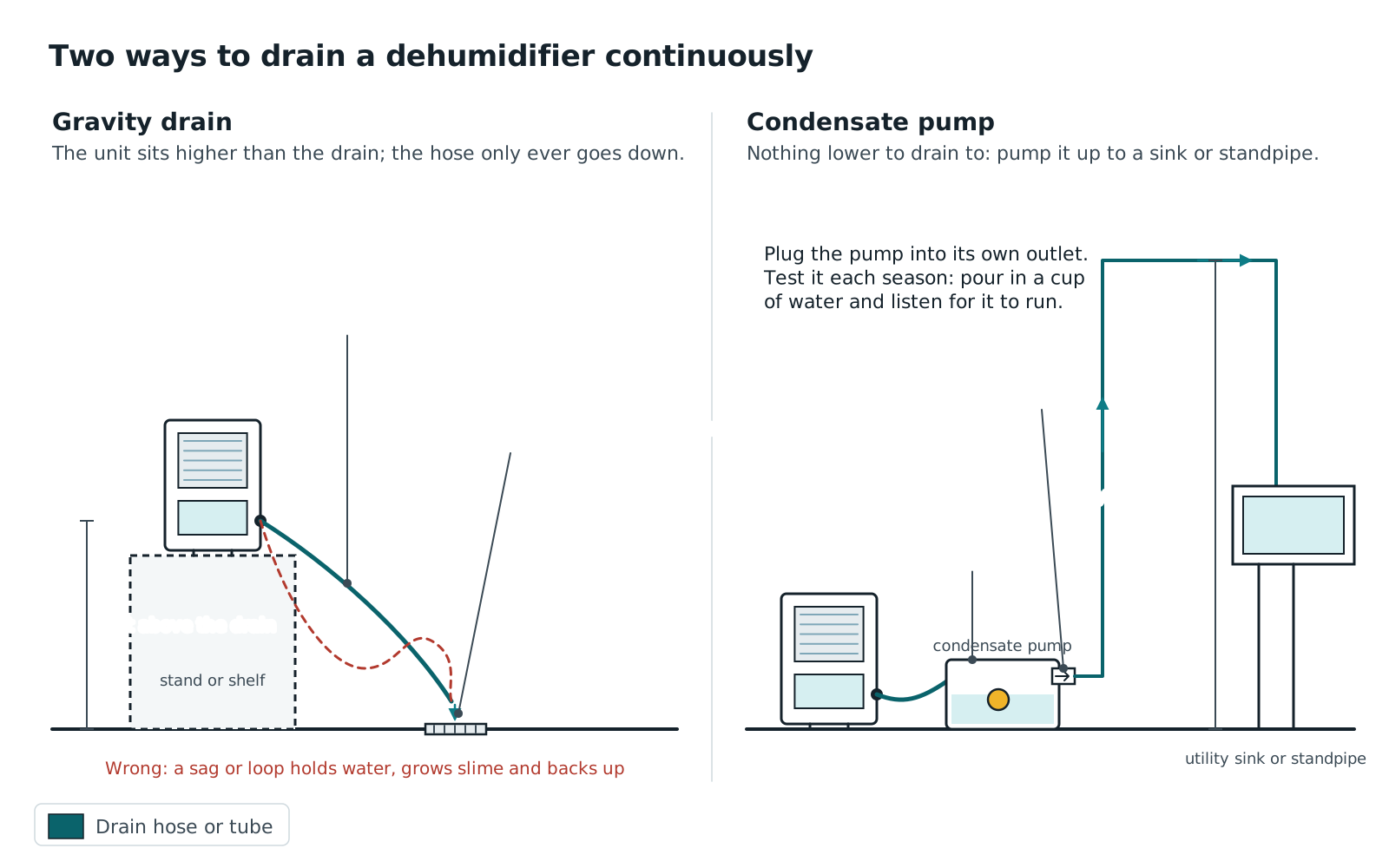
The hose runs uphill or has a belly. A gravity drain has to fall the whole way. Frigidaire's instruction is to make sure there are no kinks or elevations in the hose; Midea's is to check the hose connection and that it is properly seated in the outlet. A hose that rises to clear a step, or sags between two supports and fills with a plug of water, stops flowing. On some units the water then backs up into the bucket and trips the full-bucket switch; on others it finds the floor. Shorten the hose, raise the unit on a stand so the outlet is above the drain, and give the hose a continuous slope of about 1/4 in per foot. Our continuous drain setup guide covers the whole install, including a condensate pump for a drain that is uphill.
The drain plug or cap. Midea's "water on floor" entry includes a unit that was meant to use the bucket but had the back drain plug removed, and the reverse happens too: a hose attached with the cap still in place, or the plastic cover over the drain outlet missing after a cleaning so water leaks behind the unit. Check both ends.
The pump, on pump models. A built-in pump has its own filter, reservoir and float. Midea's manual sends you to the pump filter and the pump hose when the pump light blinks; Frigidaire's pump units push water upward to a sink or window with no lift height stated, and a hose longer or higher than the pump can manage stalls it. Clean the pump filter, check the pump hose for kinks and blockages, and test the pump with the bucket in place.
The drawing shows the gravity path the hose has to follow.
The filter and the coil
A dehumidifier moves two to three hundred cubic feet of air a minute across its coil, and the washable filter on the intake catches what is in it: lint, pet hair, drywall dust, the fine grit a basement produces. A clogged filter cuts the airflow, the coil runs colder than designed with less air to warm it, and it ices over. The unit then spends its time in defrost and collects almost nothing. Frigidaire's manuals say to clean the filter every two weeks under normal conditions and light a CLEAN FILTER indicator after 250 hours; Midea's troubleshooting table lists a dirty filter under loud operation, which is the sound of a fan straining against a blocked intake.
Pull the filter (it slides out of the back or the side on most portables), wash it in warm water with a little dish soap, let it dry completely, and put it back. Then look at the coil behind it with a flashlight. Fins packed with dust get a gentle vacuum with a brush attachment, in the direction of the fins; bent fins get a fin comb, not a screwdriver. A coil that is clean, with a clean filter, in a warm room, and still ices solid within an hour points to the next section.
The compressor and the refrigerant: the failures that end it
If the room is humid and warm, the setpoint is low, the bucket is seated, the filter is clean and the bucket is still dry after an hour of running, the problem is in the sealed system, and this is where it stops being a homeowner repair.
The compressor never starts. Set the unit to continuous and listen at the back. Within a few minutes you should hear a click from a relay and then a deeper hum join the fan noise; the back of the cabinet should start blowing slightly warm air. Both Midea's and Frigidaire's units have a three-minute protection delay after any stop before the compressor will restart, so give it that long. No click, no hum, no warm exhaust means a failed relay, start capacitor, control board or compressor. On a portable, a service visit typically costs a large fraction of a new unit.
The compressor runs but the coil never gets cold. Hum and warm exhaust, but the coil behind the filter stays at room temperature and nothing condenses: the refrigerant has leaked out. Midea's units may show an EC code, which the manual identifies as refrigerant leakage detection and tells you to contact service. Portables are built as sealed systems, not serviceable ones; recharging requires a technician with recovery equipment and the leak is rarely found and fixed economically. If the unit is inside its warranty (one year of parts and labor on the Midea Cube and the Frigidaire FHDD5033Y1 per their published terms), start the claim; outside it, this is a replacement.
The sensors. Midea's AS code is a humidity sensor fault and ES is the evaporator temperature sensor; the manual's first step for both is to unplug the unit and plug it back in, and then to call service. A failed humidity sensor can read the room as dry and never start the compressor, which looks exactly like the first problem on this page.
The 30-minute diagnosis, in order
- 1
Read the room
Place a hygrometer across the room from the unit and read humidity and temperature. Below about 50 percent, the unit may simply be done; above 60, it should be running. Below 65°F, expect reduced output; below 41°F, expect none. Write both numbers down.
- 2
Set it to continuous and the lowest setpoint
Take the setpoint out of the equation. Switch to continuous mode, or set the target to the lowest value it allows, and note the time. Make sure the unit is upright, on a level floor, with a foot or more of clearance at the intake and the exhaust and nothing draped over it.
- 3
Reseat the bucket and check the float
Pull the bucket, empty it, make sure the float swings freely and rests at the bottom, wipe both, fold the handle the way the manual shows and slide the bucket back until the full-bucket light goes out. If the light stays on with an empty, seated bucket, the switch or float has failed; stop here and decide on repair versus replacement.
- 4
Check the drain path, if you use one
Follow the hose from the port to the drain. Any rise, kink, belly or coil of hose on the floor stops the flow. Confirm the drain cap is off at the hose end and on at the bucket end as the manual describes. On a pump model, clean the pump filter and check its hose. If in doubt, disconnect the hose, replace the plug, and run on the bucket for the test.
- 5
Wash the filter and look at the coil
Pull the filter, wash it, dry it, and replace it. With the filter out, shine a light on the coil: it should be clean metal fins, not gray felt. Vacuum gently if needed. Note whether the coil is iced; if it is, turn the unit off, let it thaw completely with the fan running or the unit unplugged, and restart.
- 6
Listen for the compressor and feel the exhaust
With the unit running on continuous, wait at least three minutes (the compressor restart delay), then listen for the relay click and the compressor hum under the fan, and hold a hand at the exhaust: it should be warmer than the room within ten minutes. Then check the coil: it should be cold and starting to bead with water within fifteen to twenty minutes in a humid room.
- 7
Decide
Water dripping into the bucket: it was the setpoint, the bucket, the hose or the filter, and you are done. Compressor humming, exhaust warm, coil never cold: refrigerant loss, replace or claim warranty. No compressor sound at all after several minutes: electrical failure, same decision. Compressor running, coil cold, but the room reads 65 percent a day later: the unit works and is undersized or the room is open; see the sizing calculator.
Symptoms and what they usually mean
| What you see | Most likely cause | What to do |
|---|---|---|
| Fan runs, compressor never starts, room reads under 50 percent | Room is at or below the setpoint | Nothing; or lower the setpoint if you want it drier |
| Fan runs, compressor never starts, room reads over 60 percent | Setpoint too high, bucket not seated, failed sensor or compressor circuit | Continuous mode test, reseat bucket, then listen for the compressor |
| Compressor cycles on and off every few minutes, little water | Cold room; auto defrost cycling | Warm the room or move the unit; a cold-rated unit for a crawl space |
| Coil iced solid, fan straining | Dirty filter or blocked airflow; very cold room | Wash filter, clear the coil, thaw, restart |
| Full-bucket light on with an empty bucket | Float stuck or switch failed | Clean and free the float; replace the switch or the unit |
| Bucket empty, water on the floor behind the unit | Loose hose, missing drain cap or cover, hose rising or kinked | Fix the drain path; see the drain setup guide |
| Compressor hums, exhaust warm, coil never cold | Refrigerant leak | Warranty claim or replacement |
| Error code on the display | Sensor, bucket or refrigerant fault per the manual | Power-cycle once; if it returns, service or replace |
Work from the top down. The first five rows are fixes you can make in half an hour; the last two are the end of the road for most portables.
Repair or replace
A portable dehumidifier is a sealed refrigeration system wrapped in plastic, and the economics of repairing one are poor once the problem is inside the sealed system. Fix it yourself when the cause is the setpoint, the bucket, the float, the hose or the filter. Claim the warranty for anything else within the first year, which is the standard term on the units we recommend. Outside the warranty, a compressor, control board or refrigerant failure on a consumer portable is a replacement, and a unit that has given five to eight summers has done its job.
When you replace it, buy for the problem you actually had. If it froze every spring, the room is cold and the answer is a unit rated for cold air or a sealed, warmer space. If the bucket was the recurring failure, buy one with a continuous drain port and run the hose, or a built-in pump if the drain is uphill. If it ran all summer and never got the basement below 60 percent, it was too small, and the sizing calculator will say so. Our basement dehumidifier roundup is built around exactly those three questions; the two below are the ones we point most people to.
Midea Cube 50-Pint (MAD50S1QWT)
The basement portable with a bucket you can actually live with.
Best for damp basements up to about 1,500 sq ft of real floor area with a floor drain or a homeowner willing to empty one big bucket a day.
Score breakdown
| Right-sized moisture removal | 50 | 10.0 |
| Efficiency | 2.01 | 7.9 |
| Bucket size | 4.25 | 9.3 |
| Quietness | n/a | — |
| Continuous drain port | true | 10.0 |
| Built-in pump | false | 0.0 |
| ENERGY STAR certified | true | 10.0 |
| Warranty | 1 | 5.0 |
| Cold-room operation | 41 | 7.5 |
| App control | true | 10.0 |
Stars are DryHomeLab's rating from the published rubric (score ÷ 2, to the half star). Not a customer rating.
- Extended bucket holds about 4.25 gal per the manual's fill table; roughly double a standard 50-pint tank
- ENERGY STAR certified; 2.01 L/kWh integrated energy factor on the current R-32 revision
- Continuous-drain hose included; cabinet nests to half height for storage
- App and voice control with humidity readout; 41.5 lb, lighter than most 50-pint boxes
- No pump on this SKU (the MAD50PS1QWT has one)
- 1-year warranty
- 41°F minimum operating temperature, like every compressor portable
- Midea does not publish a sound level for this model
The Cube is the portable we recommend first for basements, and the reason is not the compressor; every 50-pint unit on this page pulls about the same water. It is the bucket. Midea's lift-and-twist cabinet nests for storage and extends for use, and the owner's manual's fill table puts the extended bucket at roughly 4.25 gallons at its top mark, about double a conventional 50-pint's 1.9-gallon tank. If you have to run on the bucket, that is one trip a day in a damp basement instead of two or three. For everyone else, the continuous-drain hose is in the box: run it to a floor drain or sump and forget the bucket entirely.
Midea rates it at 50 pints per day (the DOE 2019 rating, the number on the box since 2019) for spaces up to 4,500 sq ft, with app and voice control, a 1-year warranty, and 41.5 lb. ENERGY STAR lists the current revision, MAD50S1QWT-A with R-32 refrigerant, at 49.67 pints per day and an integrated energy factor of 2.01 L/kWh, 515 kWh a year on the federal test; that is the same efficiency as the Frigidaire 50-pints and the common figure for the class. The manual gives the operating range as 41°F to 95°F, which is standard for a compressor portable and the reason a basement that sits below 50°F needs a different class of machine. There is no pump on this SKU; the MAD50PS1QWT adds one with up to 14 ft of lift per the manual.
What we have not verified: Midea does not publish a sound level for the 50-pint Cube on its US or Canadian pages, so that cell stays empty. Buy the Cube for a basement up to about 1,500 sq ft of real, damp floor area (manufacturer coverage numbers assume a sealed room; size with our calculator) where you can drain by gravity or do not mind the bucket. Skip it if you need to pump uphill, or if the space runs cold.
Customer reviews: read them on Amazon (paid link). We link to them and never copy or score them.
Frigidaire FHDD5033Y1 50-Pint with Wi-Fi
The current Frigidaire 50-pint: a conventional box with a published spec sheet and a Wi-Fi app.
Best for damp basements with a floor drain or sump within hose reach, for buyers who want a conventional box with an app.
Score breakdown
| Right-sized moisture removal | 50 | 10.0 |
| Efficiency | 2.01 | 7.9 |
| Bucket size | 1.9 | 2.6 |
| Quietness | 51.5 | 7.1 |
| Continuous drain port | true | 10.0 |
| Built-in pump | false | 0.0 |
| ENERGY STAR certified | true | 10.0 |
| Warranty | 1 | 5.0 |
| Cold-room operation | 41 | 7.5 |
| App control | true | 10.0 |
Stars are DryHomeLab's rating from the published rubric (score ÷ 2, to the half star). Not a customer rating.
- Full manufacturer spec table: 50 pints/day, 49–51.5 dBA, 8.8 A, 41.45 lb
- ENERGY STAR certified; 2.01 L/kWh integrated energy factor
- Wi-Fi app with schedules and setpoint; Alexa and Google Home
- Conventional front bucket and rear continuous-drain port; washable filter
- 1.9-gallon bucket fills twice a day in a wet basement; run it on a hose
- 1-year warranty
- No pump on this SKU (buy the FHDP5033Y1)
- Frigidaire does not publish a coverage figure
The FHDD5033Y1 is Frigidaire's current 50-pint, the direct replacement for the FFAD5033W1 that spent a decade as the default basement dehumidifier, and it is the conventional box we recommend when the Midea Cube's nesting bucket does not appeal. Frigidaire publishes a real specification table for it: 50 pints per day (DOE), a 1.9-gallon bucket, 197 CFM on low and 218 on high, 49 dBA on low fan and 51.5 on high, 8.8 A and 470 W, a 72-in. cord, 41.45 lb, and a 19.1 by 18.9 by 9.9 in. cabinet. ENERGY STAR lists it at 49.95 pints per day and an integrated energy factor of 2.01 L/kWh, 520 kWh a year on the federal test, with R-32 refrigerant. Frigidaire rates it to run down to 41°F, which is the floor for every compressor portable.
It is a front-bucket, rear-drain design: the continuous-drain port takes a standard hose, the washable filter pulls out of the back, and the controls are on top. The Frigidaire app adds remote on/off, setpoint, schedules and fan speed, and it works with Alexa and Google Home. There is no pump; the FHDP5033Y1 is the same machine with one.
The weaknesses are the ones the whole class shares. The 1.9-gallon bucket fills twice a day in a wet basement, so run it on the hose. The warranty is 1 year of labor coverage. Frigidaire does not publish a coverage figure, which we count as honesty rather than a gap; size it with our calculator. Buy it for any damp basement up to about 1,500 sq ft of real floor area with a floor drain or sump within hose reach. Buy the Cube instead if you will run on the bucket, and the FHDP5033Y1 if the drain is uphill.
When the dehumidifier works and the basement is still damp
If you have run every test above, the unit collects water, and the room still reads above 60 percent a week later, the dehumidifier is not the problem. Either the space is open to a source that outruns it (a vented crawl space, an open window, a dryer vent leaking indoors, a shower without an exhaust fan) or water is coming in through the slab or walls faster than any machine can remove it. The plastic-sheet test in our basement humidity guide tells the two apart in a day. Standing water, efflorescence, a sump that runs constantly or a musty smell that returns within hours of closing the door are water problems, and a bigger dehumidifier only raises the electric bill.
When to call a pro
Call an appliance technician if the unit is under warranty and the manufacturer directs you to one. Call a waterproofing or crawl space contractor, not a dehumidifier, if the basement stays damp with a working unit: that is grading, downspouts, a failed vapor barrier under the house, a cracked foundation or a high water table, and each has a fix that a dehumidifier is not. If a leak is the source, a restoration contractor dries what it wet. The form below reaches vetted local contractors through HelpMeNow.com.
Frequently asked questions
Why is my dehumidifier running but not collecting water?
In order of likelihood: the room is already at or below the humidity setpoint, so the compressor is off and only the fan runs; the room is too cold (consumer units are rated to 41°F and lose most of their output below the mid-60s); the bucket is not seated or its float is stuck; the drain hose is routing water elsewhere or backing up; or a dirty filter has iced the coil. If a hygrometer reads over 60 percent, the unit is on continuous mode, the bucket is seated and the filter is clean, and it still collects nothing in an hour, the compressor or the refrigerant has failed.
Why does my dehumidifier have frost or ice on the coils?
The coil is running below freezing, which happens in a cold room, with a dirty filter or blocked airflow, or occasionally with low refrigerant. Both Midea and Frigidaire describe frost at start-up as normal and rely on an auto-defrost cycle that stops the compressor while the fan melts the ice. If the coil ices solid repeatedly, wash the filter, clear anything blocking the intake, warm the room above the mid-60s, and let it thaw fully before restarting. A clean unit in a warm room that still ices has a sealed-system fault.
How cold is too cold for a dehumidifier to work?
Consumer portables are rated to operate down to 41°F (Midea's Cube manual gives 41°F to 95°F, Frigidaire's manuals 41°F to 89°F), but output falls steeply below about 65°F because cold air holds little water and the coil frosts. A basement or garage in the 50s will see the bucket fill slowly or not at all. For a crawl space or an unheated space that stays cold, use a unit rated for it: AlorAir's Sentinel line is rated to 33.8°F with automatic defrost.
Why does my dehumidifier say the bucket is full when it is empty?
The float inside the bucket is stuck in the up position or the switch it presses in the cabinet has failed. Pull the bucket, make sure the float paddle swings freely and sits at the bottom, clean any residue, fold the handle the way the manual shows, and slide the bucket in until it clicks. If the full-bucket light stays on with an empty, seated bucket, the float or switch needs replacing, which is a warranty claim in the first year and often a replacement after it.
Why is the bucket empty but there is water on the floor behind the dehumidifier?
The water is leaving by the drain port instead of the bucket. Either a hose is attached but loose, kinked or running uphill so it overflows at the connection, or the drain plug or cover was removed and not replaced when you went back to using the bucket. Check both ends of the hose, make sure it falls continuously to the drain with no bellies, and replace the plug or cover if you are not using a hose. Our continuous drain guide covers routing and a condensate pump for an uphill drain.
Is it worth repairing a dehumidifier?
If the cause is the setpoint, the bucket, the float, the hose or the filter, yes, and it costs nothing. If the unit is in its warranty period, claim it. Outside the warranty, a compressor, relay, control board or refrigerant failure on a consumer portable usually costs a large fraction of a new unit to repair, because the refrigeration circuit is sealed and the parts and labor are not cheap. Replace it, and choose the replacement for the failure you had: cold-rated for a cold space, a drain port or pump if the bucket was the recurring problem, and larger if it never caught up.
The seasonal checklist, by email
One email when the season changes — freeze week, spring thaw, hurricane season — with the checklist for that month. No weekly newsletter, no selling your address.
We send one confirmation link first. Every email has a one-click unsubscribe. Privacy.
Check your inbox for the confirmation link; the checklist follows as soon as you click it.
You are on the list. The next email arrives when the season changes.
That did not go through. Check the address and try again.
DryHomeLab is written and reviewed by the team behind HelpMeNow.com, a marketplace that connects homeowners with vetted local contractors for water-damage restoration, plumbing and waterproofing. Before HelpMeNow the same team ran a 24/7 water-damage restoration company in the Seattle area; the equipment on this site is what we specified, bought and ran on real water losses. We publish the rubric behind every score.
- Ran a 24/7 water-damage restoration company, Seattle area
- Operate HelpMeNow.com, a contractor marketplace
- Publishes its scoring rubric