

The decision in one table
When we ran restoration jobs, the first fifteen minutes on site were spent answering five questions, and the answers decided everything that happened for the next week: what came out, what got dried, how much equipment, and whether the homeowner could have done it alone. Nothing in those questions requires a contractor to answer. Here they are, with the answer that means you can do this yourself on the left and the answer that means you should call on the right. One answer in the right-hand column is enough.
| Question | Dry it yourself if | Call a restoration contractor if |
|---|---|---|
| What kind of water? (IICRC S500 category) | Category 1: supply line, water heater, tub or sink overflow with nothing in it, rain through a window | Category 2 or 3: washer, dishwasher or toilet overflow, sump backup, sewage, ground water, storm water, anything from a floor drain |
| How much got wet? (S500 class) | One room; a wet floor and the bottom foot or two of the walls | Several rooms; water from above through a ceiling; more than about 40 percent of the room's surfaces |
| Which materials? | Carpet (pad to be replaced), drywall with an empty cavity, plywood or OSB subfloor, concrete, tile | Hardwood, laminate or engineered flooring; plaster; wet insulation in exterior walls; cabinets; any ceiling; HVAC ducts or the air handler |
| How long has it been wet? | Found and equipment running within 48 hours | More than about 72 hours; any visible growth or musty smell; a slow leak discovered by a stain |
| Insurance and people | No claim, or a small one you can document yourself; healthy adults doing the work | A claim the adjuster will scrutinize; occupants with asthma, allergies or immune conditions (the EPA says consult a health professional before cleanup) |
The rest of this guide is the reasoning behind each row, what a contractor actually does that you cannot, and a fifteen-minute assessment to run before you decide.
Question 1: what kind of water is it?
The IICRC S500 standard, which restoration contractors and insurers both work from, sorts water by contamination.
Category 1 is clean at the source: a burst supply line, a failed water heater tank, a tub left running, an ice maker line, a refrigerator water line. Materials it wets can be dried and kept, and this is the only category where drying it yourself is the plan.
Category 2 is significantly contaminated: washing machine and dishwasher discharge, a toilet overflow with urine but no feces, sump pit water, an aquarium, and clean water that has sat long enough in a warm room to start growing things. Carpet pad, insulation and other soft porous materials it touched come out. Carpet and drywall can sometimes be cleaned and saved by a contractor with the right chemistry; it is not a homeowner job.
Category 3 is grossly contaminated: sewage, any toilet overflow with feces, water that rose from outside (storm water, river water, ground water through a foundation), and anything that came up a floor drain. Everything porous it touched is removed under containment, the structure is cleaned and treated, and then it is dried. Category 3 is never a do-it-yourself job, and crews wore respirators, gloves and eye protection to do it.
Category moves in one direction over time. Clean water that sits for a few days in a warm basement is treated as Category 2; water that sits for a week or soaks into contaminated materials is treated as Category 3. The category you have is the category at the time drying starts, not at the time the pipe broke.
Question 2: how much got wet?
The S500 also sorts losses by how much water the materials are holding, which decides how much equipment is needed.
- Class 1: a small part of the room, under about 5 percent of the floor, wall and ceiling area, in materials that do not hold much water. A sink leak caught the same day.
- Class 2: a significant part of the room, roughly 5 to 40 percent of surfaces. Typically a wet floor with water wicked less than about 2 ft up the walls. Most supply-line and water-heater losses in a basement are Class 2, and this is the upper limit of what one person with rented gear can handle.
- Class 3: more than about 40 percent of surfaces, usually because the water came from above and soaked the ceiling, the walls, the insulation and the floor. An upstairs tub overflow that came through the kitchen ceiling. A crew job because of the equipment count and because ceilings and wet insulation are involved.
- Class 4: water bound in dense, slow-drying materials: hardwood, plaster, concrete, brick, a subfloor under finished flooring. Needs specialty drying (mat systems, heat, desiccants) regardless of size.
The drying planner turns the class and the room dimensions into an equipment count. If it tells you that you need eight air movers and a 130-pint dehumidifier, that number is also telling you something about who should be doing the job.
Question 3: which materials got wet?
Some materials forgive a homeowner's drying setup. Others do not.
Forgiving: carpet (the pad comes out and is replaced; the carpet floats on an air mover), drywall with nothing but air behind it, plywood and OSB subfloor, concrete, ceramic tile on a slab, painted block. These dry in place with air movers and a dehumidifier in three to five days, and a moisture meter tells you when they are done. The wet carpet guide and the drywall guide cover the two most common.
Unforgiving: solid hardwood (dries over one to three weeks on a mat system that pulls air through the boards; dried wrong it cups, crowns or cracks), laminate and most engineered floors (the core swells and they are replaced), plaster (holds water, cracks as it dries), cabinets (water wicks into the particleboard toe-kick and back panel and the cabinet looks fine until it smells), fiberglass or cellulose insulation in a wall or ceiling (comes out, which means the drywall in front of it comes out), any ceiling (sagging board is replaced, and what is above it has to be opened and dried), and the HVAC system (the EPA's guidance is not to run a system you suspect is contaminated, and wet duct liner or a wet air handler is a specialist cleaning job).
Two things in the unforgiving list make the call by themselves: insulation behind the wet drywall of an exterior wall, because the demolition and the drying both get bigger than one person's weekend, and a ceiling, because the water came from somewhere above and the extent is hidden.
Question 4: how long has it been wet?
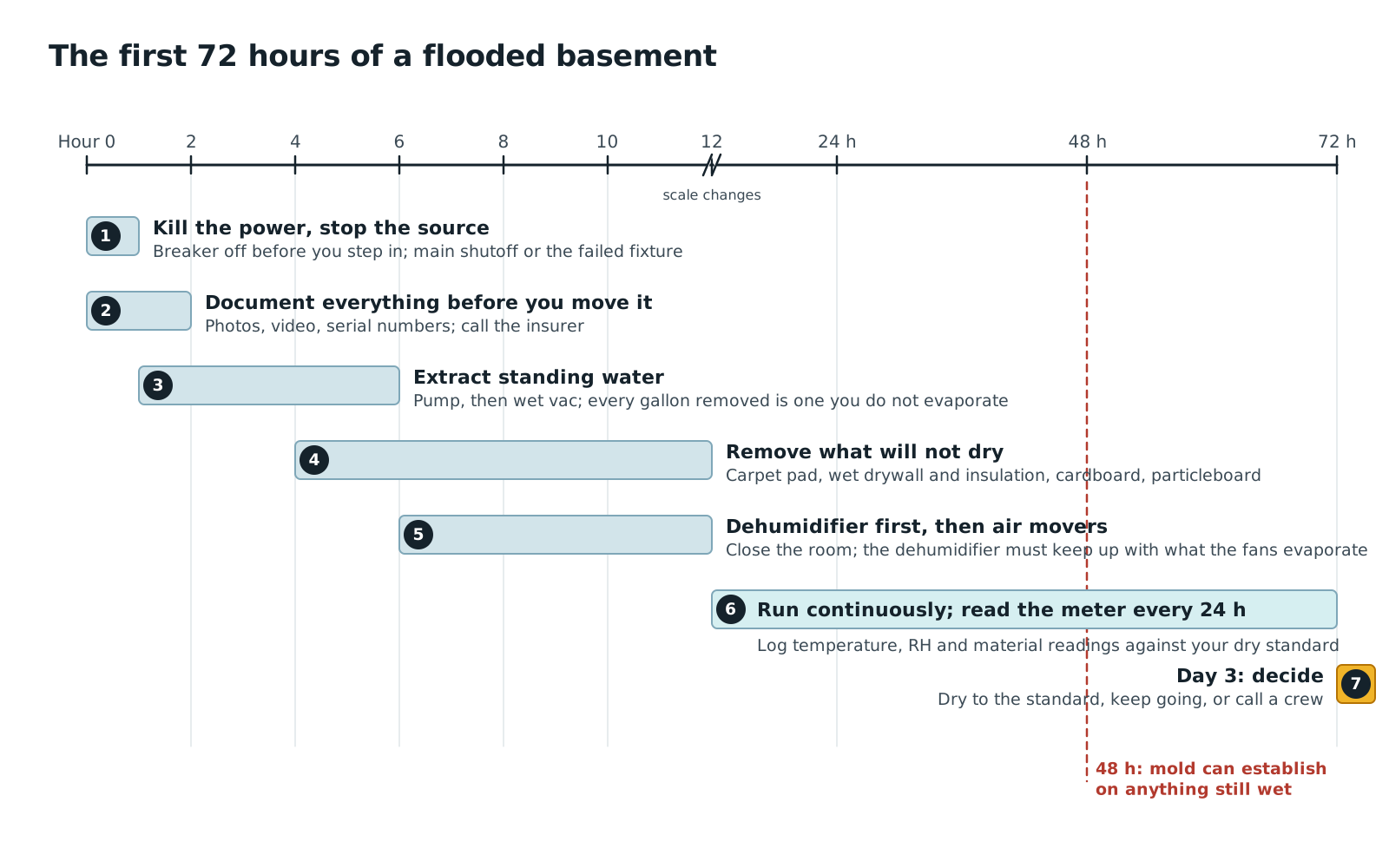
The EPA's guidance on mold in homes is that wet materials dried within 24 to 48 hours will usually not grow mold. Restoration practice treats 72 hours as the point where a wet building becomes a mold question as well as a drying question. That clock starts when the material got wet, not when you found it. A supply line that burst this morning is a drying job. A stain that appeared on a ceiling this week from a leak that has been running for a month is a removal job, and probably a remediation job, no matter how small the stain looks.
The timeline below is the sequence crews worked a basement loss to, and the first two days are where a homeowner either keeps up or does not. If you cannot have the water extracted and equipment running within about 48 hours of the loss, because you cannot rent it, cannot get the time, or cannot physically do the work, that alone is a reason to call.
Question 5: insurance, and who lives there
Insurance. Sudden, accidental water from inside the house is usually covered by a homeowners policy; ground water, surface flooding and sewer backup usually are not without an endorsement. If you are filing a claim, two things change. First, the policy requires you to mitigate, which means stopping the water and starting drying promptly, and keeping receipts; renting equipment yourself satisfies that. Second, the adjuster will want documentation: photographs before anything was moved, a moisture map, daily readings, and a list of what was removed and why. Contractors produce that in the format adjusters expect, bill the insurer directly in most cases, and know what the policy will and will not pay for. On a large claim, that alone is worth the call. On a small one, our claim documentation checklist covers what to record yourself.
People. The EPA's mold guidance is that anyone with health concerns should consult a health professional before starting cleanup, and the CDC notes that people with asthma, allergies and respiratory conditions, and those with compromised immune systems, are more sensitive to mold. If someone like that lives in the house, or an infant or an elderly relative does, the margin for a slow or incomplete dry-out is smaller, and a crew that finishes in four days with containment and air scrubbers is a different proposition from a homeowner finishing in ten.
What a restoration contractor actually brings
It is worth being specific, because the difference is not that a crew works harder. It is equipment and sequence.
- Extraction. A truck-mounted or large portable extractor pulls water out of carpet, pad and subfloor at a rate a shop vacuum does not approach. Every gallon extracted is a gallon the dehumidifiers do not have to remove from the air over three days.
- Low-grain refrigerant (LGR) dehumidifiers, rated 80 to 140 pints a day at the AHAM condition and still pulling water when the room is below 40 percent humidity, where a consumer unit has stopped. Two or three of them on a basement.
- Air movers by the dozen, placed per the S500 at one per 10 to 16 linear feet of wet wall, which is how a wall dries in three days instead of a week.
- Moisture mapping. Pin and pinless meters, a thermal camera to find the wet area behind finished surfaces, and a documented grid read daily.
- Containment and air filtration. Plastic barriers, negative air machines and HEPA air scrubbers for Category 2 and 3 work and for any demolition.
- Removal and treatment. Flood cuts, insulation removal, pad removal, antimicrobial application per the product label on contaminated losses, and disposal.
- Documentation in the format the adjuster expects, and the experience to know what the policy covers.
What a contractor does not bring is magic. A clean-water, one-room, caught-today loss dried by a homeowner with a rented LGR, two air movers and a meter ends up in the same place a crew would leave it. The question is only whether your loss is that loss.
The fifteen-minute assessment before you decide
- 1
Make it safe
If water is near outlets, the furnace, the water heater or any cord, do not step in it until the circuits are off at the panel; if the panel is in the wet area, call the utility or an electrician. If you smell gas, leave and call from outside. If a ceiling is bulging or a floor feels soft, stay out from under and off of it. If the water is sewage or came from outside, stop here: gloves, respirator and eye protection are the minimum, and the job is a crew's.
- 2
Stop the source and name the category
Close the fixture valve, the appliance valve or the main; our shutoff guide covers finding it. Then answer the first question honestly: where did this water come from, and how long ago? Supply line this morning is Category 1. Anything that went through a drain, an appliance or the ground is not.
- 3
Photograph everything before you move anything
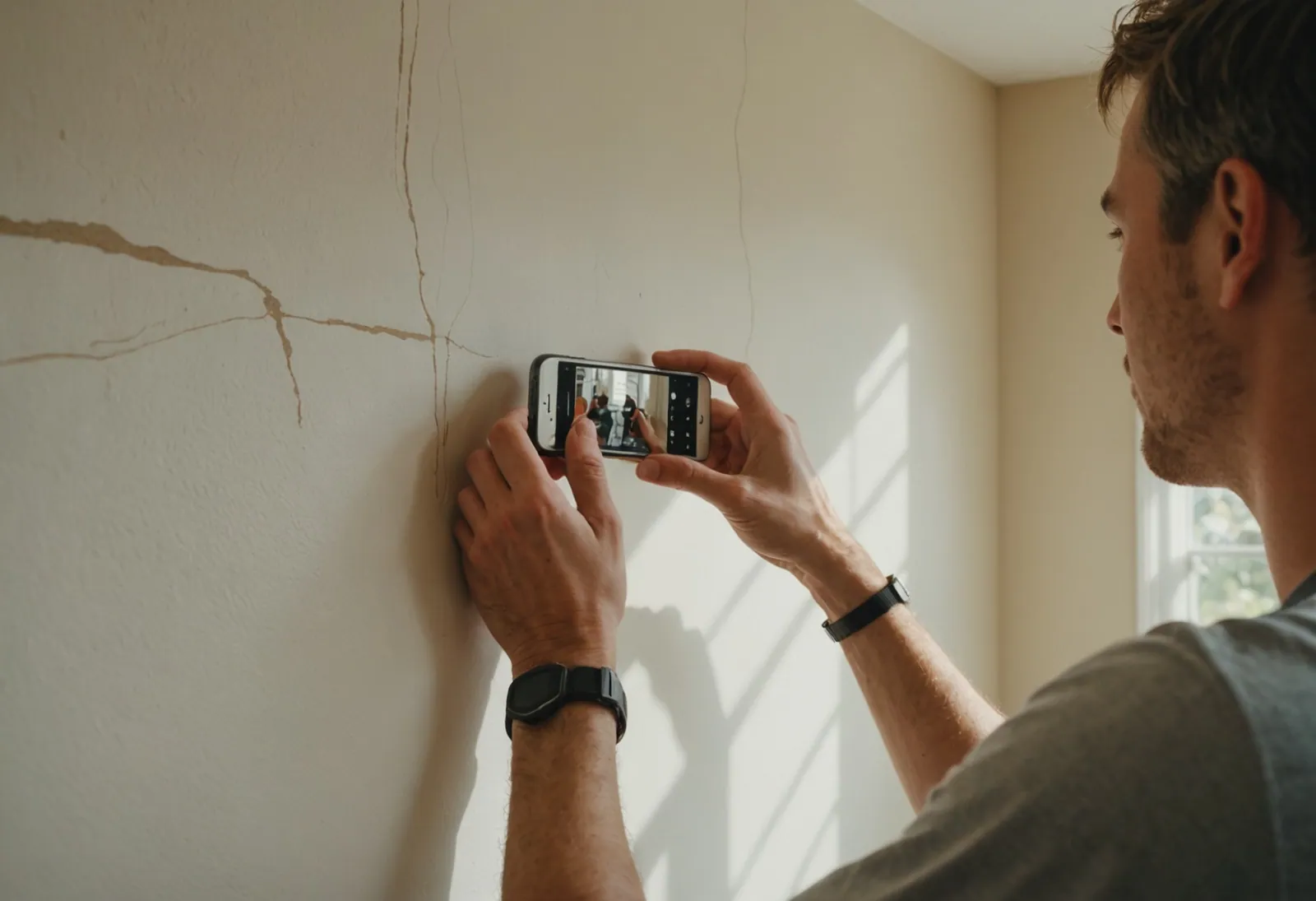
Each corner of each wet room, the water line on the walls, the source, the undersides of furniture, serial numbers of wet appliances, and a wide shot of the whole space. Video with narration is faster than stills. Note the time. These photographs are worth more to a claim than anything you do afterward.
- 4
Find the edges
Water travels farther than the wet spot. Walk the adjoining rooms and the room below in socks; a wet sock finds water a shoe misses. With a moisture meter, read the walls 2 in above the floor every few feet and mark the wet run with tape; without one, press a paper towel against the base of the wall and the floor at the edges of the stain. Pull an outlet cover on the wet wall and look for water in the box. Lift a corner of the carpet and look at the pad.
- 5
Look up and look behind
If the water came from a floor above, the ceiling and the joist bay are wet, and the insulation in it probably is. If a wet wall is an exterior wall, there is insulation behind it. If cabinets sit in the wet area, pull the toe-kick and look under them. Each of these moves the loss toward the right-hand column of the table.
- 6
Call the insurer, then decide
Call the same day if there is any chance of a claim; many policies require prompt notice, and the adjuster may have a preferred process. Then make the call with the five questions: Category 1, one room, forgiving materials, under 48 hours, a claim you can document yourself, and you can have equipment running today. All yes, start the 72-hour guide. Any no, use the form below.
If you decide to do it yourself
The sequence is the one a crew follows, and the equipment is rentable: make it safe, stop the water, document, extract, remove the pad and anything saturated, set the dehumidifier and then the air movers, close the room, and read a moisture meter every 24 hours until every point is back to a dry standard taken from an unaffected part of the house. The 72-hour basement guide walks every step, the drying planner sizes the equipment, and the air mover roundup covers what to rent. Budget three to five days of equipment and a meter you trust.
One honest test partway through: if on day two the readings are not falling, the room still feels damp, or you have found wet insulation, a wet ceiling or water under a floor you did not expect, that is the moment to call, not day five.
When to call a pro
Call a restoration contractor for any Category 2 or 3 water; for anything wet more than about 72 hours or already smelling musty; for water that came through a ceiling; for wet hardwood, laminate, plaster, cabinets or insulation; for more than one room; for a wet furnace, air handler or ductwork; if someone in the house has asthma, allergies or an immune condition; or if the claim is large enough that you want it documented by someone who does this daily. Call an electrician before anything else if the panel or any outlet box got wet. The form below reaches vetted local restoration contractors through HelpMeNow.com, and on a water loss the same-day call is the one that saves the walls.
Frequently asked questions
Can I dry out water damage myself?
Yes, when the water is clean (Category 1 under IICRC S500), it is confined to one room, the wet materials are carpet, drywall with an empty cavity, plywood subfloor or concrete, and you can have the water extracted and a dehumidifier and air movers running within about 48 hours. Rent the equipment, pull the carpet pad, open the bottom of wet walls, and read a moisture meter daily until the materials match a dry area of the house. Anything contaminated, overhead, multi-room or more than three days old is a contractor job.
When should you call a water damage restoration company?
When the water came from a drain, an appliance, a toilet or outside; when it has been wet more than about 72 hours or smells musty; when it came through a ceiling; when hardwood, laminate, plaster, cabinets or insulation are wet; when more than one room is involved; when the furnace or ducts got wet; when someone in the home has asthma, allergies or a compromised immune system; or when the insurance claim is large enough to need professional documentation. Any one of those is enough.
What is the difference between Category 1, 2 and 3 water damage?
The IICRC S500 standard sorts water by contamination. Category 1 is clean at the source, such as a supply line or water heater; materials can be dried and kept. Category 2 is significantly contaminated, such as washer or dishwasher discharge or a toilet overflow with urine; soft porous materials come out. Category 3 is grossly contaminated, such as sewage or water that rose from outside; everything porous it touched is removed under containment. Clean water that sits for days degrades to Category 2 or 3.
How long do you have before water damage turns into mold?
The EPA's guidance is that wet materials dried within 24 to 48 hours will usually not grow mold, and restoration practice treats 72 hours as the point where a wet building becomes a mold problem as well as a drying problem. The clock starts when the material got wet, not when you noticed, which is why a slow leak found by a stain is handled as a removal job even when the stain is small.
Does homeowners insurance pay for professional water damage restoration?
For sudden, accidental water from inside the house, such as a burst pipe or a failed water heater, usually yes, less your deductible; for ground water, surface flooding and sewer backup, usually not without a separate endorsement. Policies also require you to mitigate promptly, and the insurer pays for reasonable mitigation whether a contractor or you did it. Call the insurer the same day, photograph everything before moving it, and keep every receipt and every moisture reading.
What does a water damage restoration company do that I cannot?
Extract water with truck-mounted equipment far faster than a shop vacuum, run commercial LGR dehumidifiers and a dozen or more air movers placed to the S500 standard, map moisture with meters and a thermal camera, set up containment and HEPA air scrubbers for contaminated water or demolition, remove and treat materials correctly, and document all of it for the adjuster. On a clean-water, one-room loss caught the same day, none of that is essential; on anything larger or dirtier, all of it is.
The seasonal checklist, by email
One email when the season changes — freeze week, spring thaw, hurricane season — with the checklist for that month. No weekly newsletter, no selling your address.
We send one confirmation link first. Every email has a one-click unsubscribe. Privacy.
Check your inbox for the confirmation link; the checklist follows as soon as you click it.
You are on the list. The next email arrives when the season changes.
That did not go through. Check the address and try again.
DryHomeLab is written and reviewed by the team behind HelpMeNow.com, a marketplace that connects homeowners with vetted local contractors for water-damage restoration, plumbing and waterproofing. Before HelpMeNow the same team ran a 24/7 water-damage restoration company in the Seattle area; the equipment on this site is what we specified, bought and ran on real water losses. We publish the rubric behind every score.
- Ran a 24/7 water-damage restoration company, Seattle area
- Operate HelpMeNow.com, a contractor marketplace
- Publishes its scoring rubric