

The short answer, and why it is not a number of days
When we ran restoration jobs, the question homeowners asked most on day one was "how long will all this be here?" The honest answer was always the same: usually three days, sometimes five, occasionally more, and we will know when the meter tells us. A drying job ends when every wet material has returned to the moisture level of the same material in a dry part of the house. Equipment still running after that point is wasting electricity; equipment shut off before it is leaving water in a wall where the EPA says mold can start growing within 24 to 48 hours of wetting.
So the rule is: run continuously, meter daily, stop when the readings say dry and stay dry. Here is what that typically works out to for a Category 1 (clean water) loss, with equipment set up within the first day, in a closed room at normal indoor temperatures.
| Material | Typical time with air movers and a dehumidifier | What usually makes it longer |
|---|---|---|
| Carpet, pad removed and carpet floated | 1 to 2 days | Pad left in; carpet laid flat with a fan on top |
| Drywall dried in place, empty cavity, wet under 2 ft | 3 to 5 days | Insulation behind it; semi-gloss or oil paint; vinyl wallpaper |
| Framing and sole plates behind a flood cut | 3 to 7 days | Plates on a slab; doubled studs; water trapped under the plate |
| Plywood or OSB subfloor | 3 to 5 days | Vinyl or laminate still on top; water between layers |
| Solid hardwood floor | 1 to 3 weeks, with a mat system | Cupping already visible; finish sealing the surface |
| Concrete slab | Days to weeks; it does not rot | Flooring glued on top; a vapor barrier underneath |
The table assumes the water is out of the room first: standing water extracted, wet pad and saturated insulation removed, the room closed. If you are still at that stage, the 72-hour basement guide covers the sequence.
What "dry" means: the dry standard and the drying goal
The IICRC S500 standard that restoration contractors and insurers work from does not define dry as a feeling or a fixed number. It defines it against the building itself. Before drying starts, you take a dry standard: a reading, with your meter on the setting you will use throughout, from the same material in a part of the house the water did not reach. Drywall in an upstairs closet; a sole plate behind the baseboard in a dry room; the subfloor under a dry closet. Then you set a drying goal for each wet material, which is that dry standard or a point or two above it, and you dry until every reading point reaches the goal and holds there on the next day's reading.
The reason to do it this way is that "dry" differs by house, region and season. Framing in a Phoenix house in June and framing in a Seattle house in November sit at different moisture contents, and both are dry. A published number is a sanity check; your own dry standard is the target. With that said, these are the numbers restoration meters typically show when materials are at their normal indoor moisture content:
- Framing lumber, plywood, OSB on a pin meter's wood scale: about 8 to 14 percent when dry. Above 16 percent is still wet for drying purposes, and the USDA Forest Products Laboratory's rule of thumb is that wood above about 19 percent moisture content can support mold growth.
- Drywall on a pin meter with a gypsum scale: Delmhorst's BD-2100 manual puts the green band at 0 to 0.5 percent, yellow at 0.5 to 1 and red above 1 percent. On the wood-moisture-equivalent (WME) scale Protimeter meters use, dry is the green band under 17 percent WME, 17 to 19.9 is "at risk" and 20 and above is wet. On a pinless meter, drywall readings are relative, so only the comparison with your dry standard means anything.
- Concrete on a handheld meter is a relative reading. If flooring is going back down on a slab, flooring manufacturers specify an in-situ relative humidity test (ASTM F2170) or a calcium chloride test (ASTM F1869) instead.
Our moisture meter roundup covers the scales and which meters can be verified.
What changes the timeline
Six things decide whether a room dries in three days or ten. You control most of them.
1. The material and what is behind it. Water evaporates from a surface, and the farther it sits from a surface dry air can reach, the slower it leaves. Carpet dries fast once the pad is out and air moves across its back. Drywall with an empty cavity dries from both faces once the baseboard is off and there are holes at the plate. The same drywall with a wet fiberglass batt behind it, a polyethylene vapor barrier, or three coats of semi-gloss on the room side barely dries at all, which is why the cut-or-dry decision gets made before the fans go on. Plaster, hardwood, concrete and a sole plate on a slab are the slow end of every job.
2. The category of water. The S500 sorts water as Category 1 (clean: supply lines, water heaters, tub overflows), Category 2 (significantly contaminated: washer and dishwasher discharge, toilet overflows with urine, sump water) and Category 3 (grossly contaminated: sewage, ground water from outside, anything standing for days). Drying time only applies to Category 1. Porous materials touched by Category 2 or 3 water are removed, not dried, and the equipment runs afterward to dry the framing that is left.
3. How long it was wet before you started. Water that ran behind a wall for a week has soaked farther into the framing than a burst hose found the same afternoon, and it started the mold clock a week ago. Expect longer drying and wet material farther from the visible stain than you expected.
4. Temperature. Refrigerant dehumidifiers pull far more water out of warm air than cold. Crews kept drying spaces in roughly the 70 to 90°F range and closed the HVAC supply to the room so the furnace or air conditioner was not fighting the equipment. Consumer dehumidifiers are rated to run down to 41°F (Midea's Cube and Frigidaire's 50-pint manuals both give 41°F as the floor), but output drops steeply below the mid-60s and the coils start frosting. A 55°F basement in March dries slowly no matter how many fans you add; a space heater, used safely and away from anything that can burn, is often the cheapest way to shorten the job.
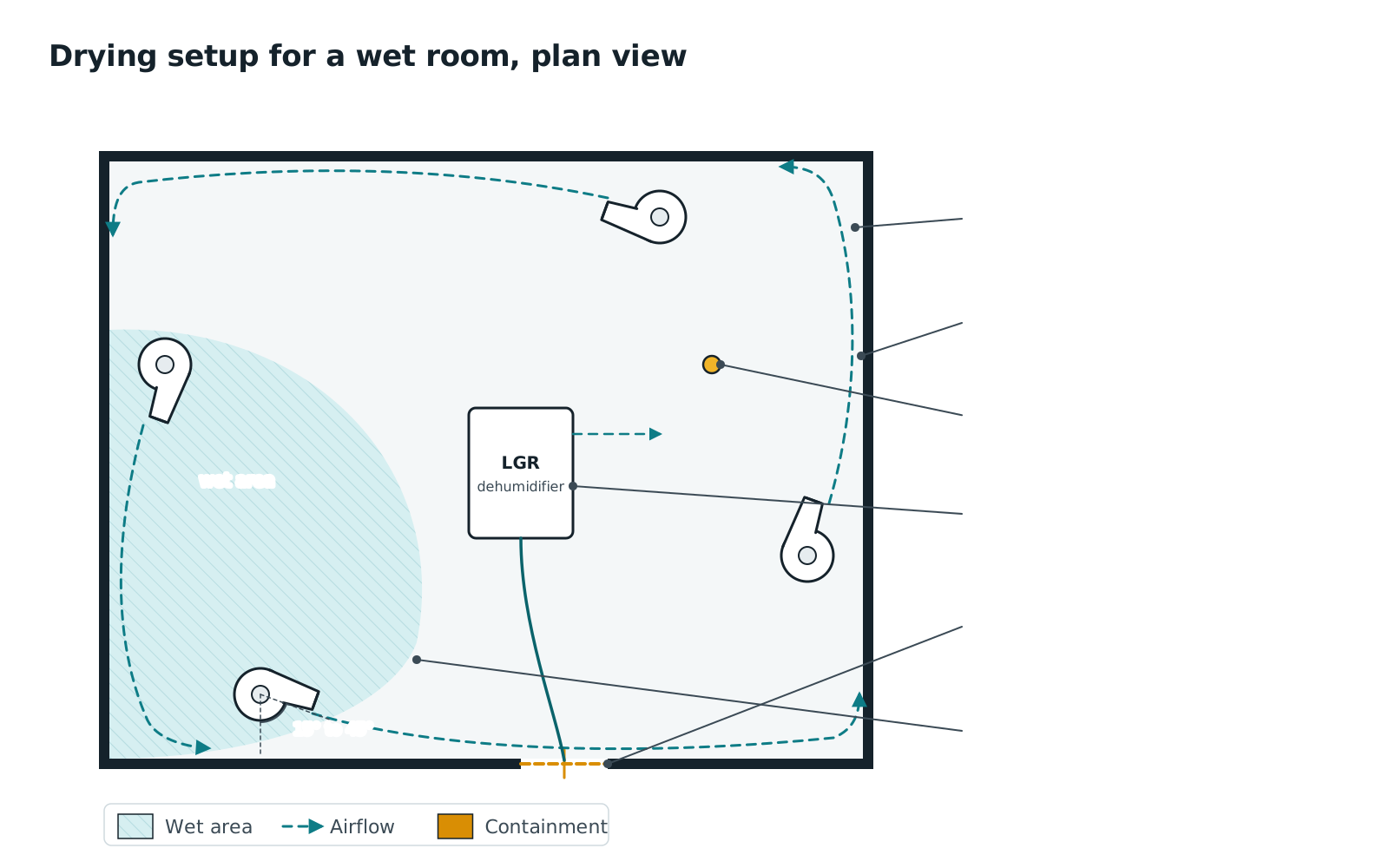
5. Airflow and placement. Air movers do not dry anything by themselves. They strip the layer of saturated air off a wet surface so the dehumidifier can take it away, and only for surfaces the airstream touches. The S500 places one air mover per 10 to 16 linear feet of wet wall, set at 15 to 45 degrees to the wall and all pointing the same direction around the room, plus one for each closet or offset the main flow will not turn into. A fan pointed straight at a wall stalls; a fan in the middle of the room dries air you already dried.
6. Dehumidifier capacity and a closed room. The dehumidifier sets the pace. If it cannot remove water as fast as the fans evaporate it, the room humidity climbs toward the point where evaporation stops, and you will notice: the room feels cold and clammy, the windows fog, the readings stall. A 50-pint consumer unit is enough for a bedroom or bathroom. A basement room with wet walls on three sides wants a commercial low-grain refrigerant (LGR) unit rated at 80 pints a day or more at the AHAM condition. And the room has to be closed: doors shut, registers taped, no windows open on a humid day.
Sizing the equipment
The planner below is the arithmetic restoration crews start with: room dimensions, linear feet of wet wall and the class of the loss, returning an air mover count and a dehumidifier capacity. Treat the result as day-one numbers. If the readings are not falling by day two, the usual fix is more dehumidification, not more fans.
Drying planner: how many fans and how much dehumidifier
The same math our crews use on a water loss. It also tells you when to stop and call someone.
- Run 5 air movers aimed along the walls at 15–45°, one every 10–16 ft of wet wall, with a large dehumidifier rated at least 48 pints/day in the closed room.
- Pull the carpet pad if it is wet; pad does not dry in place. Lift carpet edges and float air under it.
- Check with a moisture meter daily; you are done when readings match an unaffected area, usually 3–5 days.
Air mover picks are on the drying guide.
See our dehumidifier picks.
Tools and materials
- A moisture meter. A pin meter such as the General Tools MMD4E reads the subfloor, the framing and the bottom of the drywall; a pinless meter sweeps for the boundary. Without one you are guessing, and the surface of a wall dries a day or two before the back of it.
- A hygrometer that reads temperature and relative humidity, placed away from the dehumidifier's exhaust.
- Air movers, one per 10 to 16 ft of wet wall. Low-profile units such as the Dri-Eaz Velo Pro sit at the base of a wall and feed vent holes; a centrifugal unit such as the XPOWER P-230AT floats carpet. The air mover roundup covers what to rent and what to own.
- A dehumidifier with a drain hose, so it never stops on a full bucket at 2 a.m. A 50-pint consumer unit for one small room; an LGR for anything larger.
- Painter's tape and a marker for reading points; a notebook or phone for the log; a camera for the display
- Plastic sheeting and tape to close the doorway and the registers
- A drill with a 1/2 in bit and a pry bar if drywall is being dried in place
- A GFCI-protected outlet or adapter for every cord; no cords lying in water
The daily routine until it is dry
- 1
Day 0: take the dry standard and mark the grid
Before any fan runs, read an unaffected area of each wet material with the meter on the setting you will use for the whole job, and write the numbers down. Then mark the wet area with tape at reading points: the wettest spot, the visible edge of the stain, and a point a foot or two beyond it, because water spreads farther inside a wall or under a floor than the stain shows. On a wall, read every 2 ft at 6, 18 and 30 in up. Photograph each point with the meter display in frame; those photos are the record an adjuster will ask for.
- 2
Day 0: set the dehumidifier first, then the fans
Close the room, tape the registers, run the drain hose to a floor drain, sink or sump, and start the dehumidifier on its lowest setpoint or continuous mode. Then place the air movers along the wet surfaces at 15 to 45 degrees, all pointing the same way around the room. Starting the fans first just moves water from the wall into the air and onto the cold windows. Note the time, temperature and humidity.
- 3
Every 24 hours: same points, same meter, same setting
Read the grid once a day at about the same time and log it, along with the hygrometer. The pattern you want: every point lower than yesterday, room humidity settling into the 40s or low 50s, temperature holding in the 70s. Within a few hours of setup the room should feel warm and dry rather than cold and damp; if it does not, the dehumidifier is undersized or the room is not closed.
- 4
Day 2: adjust what is not working
A point that has not moved in 48 hours has something between it and the airflow: wet insulation, a vapor barrier, blocking, a cabinet toe-kick, a second layer of drywall. Open it up or move a fan to it. If every point is falling slowly, add dehumidification before you add fans; if the room is above 60 percent humidity with the equipment running, the dehumidifier is losing. If the room is below about 65°F, warm it. Move fans off surfaces that already read dry.
- 5
Day 3 to 5: call it dry when the readings say so
A material is dry when every reading point on it is at or within a point or two of the dry standard and the next day's reading is the same or lower. Drywall and carpet usually get there first; framing, sole plates and subfloor last. Do not stop at the first dry reading. Moisture deeper inside a material migrates back to the surface overnight, and a point that reads 11 percent at 5 p.m. and 15 the next morning was not done.
- 6
Shutting down and closing up
Turn the fans off material by material as each reaches goal. Leave the dehumidifier running one to two more days after the last point reads dry, through the repair work if you are patching drywall and relaying carpet, because joint compound and new pad bring water back into the room. Keep the log and photos with your insurance file. Clean the filter and bucket on anything you own before it goes on the shelf.
Can you run them too long?
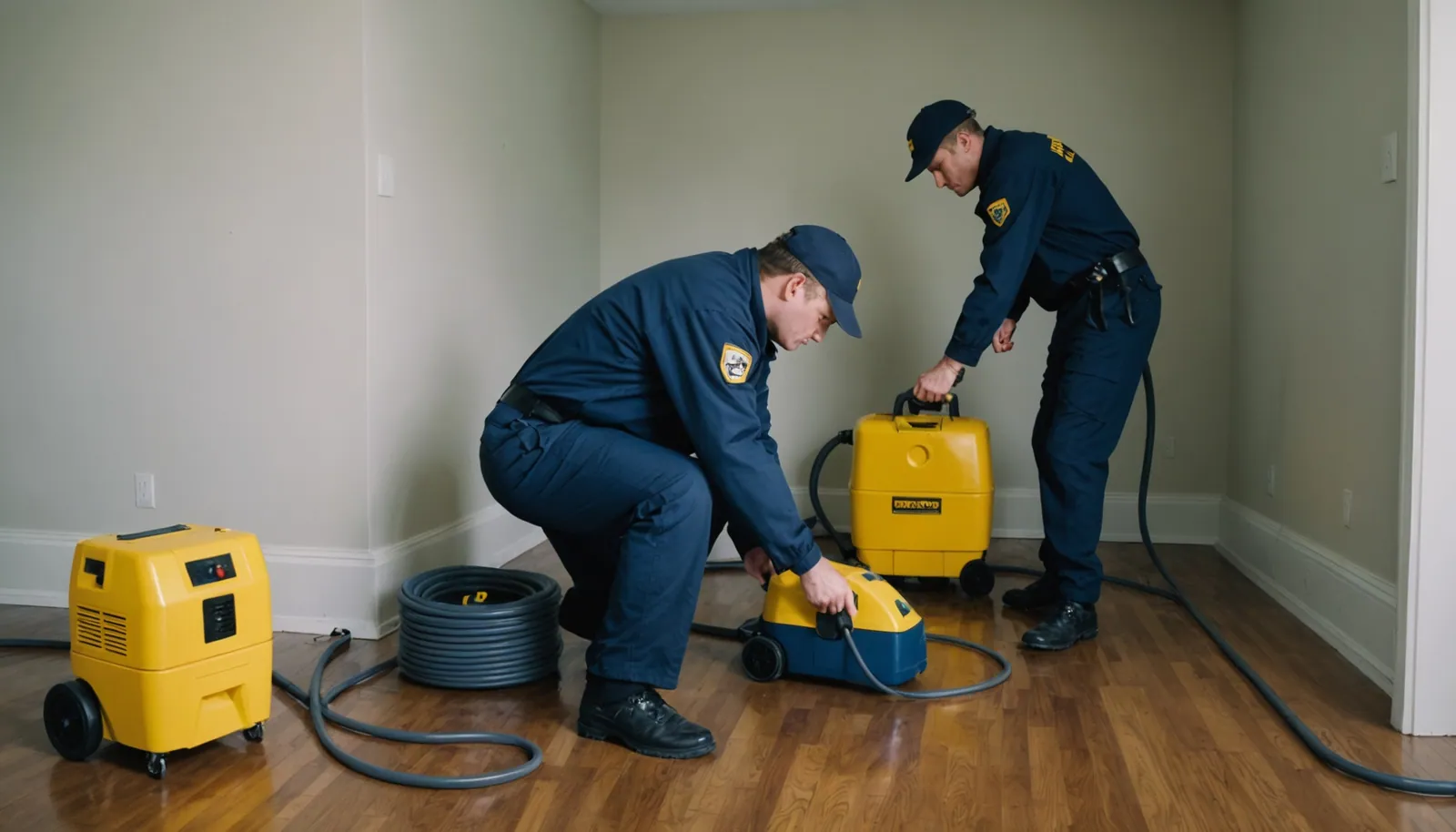
Not in any way that damages a house, with one exception. Solid hardwood dried too fast or too far can over-dry and crack, which is why floor drying uses mat systems and daily readings; if you have hardwood, let a flooring or restoration contractor set the pace. For drywall, framing, subfloor and concrete, an extra day or two costs electricity and nothing else. A 50-pint consumer dehumidifier draws about 470 W by Frigidaire's spec table and a low-profile air mover about 185 W, so a dehumidifier and two fans use roughly 20 kWh a day, a few dollars at typical residential rates. Rental equipment is billed by the day, which is the real reason to meter carefully: return it the day it is no longer needed, not a week later.
What you cannot do is make up for a missing dehumidifier with time. Fans alone in a closed room raise the humidity until evaporation slows to a crawl; a week of fans accomplishes less than two days of fans with a dehumidifier.
Signs you stopped too early
A musty smell in the room a week or two later. Baseboard that feels soft or shows a dark line at the bottom. Paint bubbling or the tape joint lifting along the bottom of the wall. A reading that was dry at shutdown and wet again a week later, which means a source you did not find or a cavity that was never opened. Any of these means opening the wall or lifting the carpet, re-metering and starting again. If growth has started, the EPA's guidance is that a homeowner can clean an area under about 10 square feet; anything larger, or anything from contaminated water, is a remediation job.
When to call a pro
Call a restoration contractor if the water is Category 2 or 3; if readings have not fallen for two days and you cannot find why; if hardwood, laminate or an engineered floor is wet; if more than one room or any ceiling is involved; if there is insulation behind wet drywall on an exterior wall; if the loss happened more than 72 hours before equipment went on; or if the claim is going through insurance and the adjuster wants a moisture map and drying logs from a contractor. A crew brings LGR dehumidifiers and a dozen air movers, which turns a ten-day homeowner job into a four-day one, and documents the readings in the format the adjuster expects. The form below reaches vetted local restoration contractors through HelpMeNow.com.
Frequently asked questions
How long should I run a dehumidifier after a water leak?
Continuously, for as long as a moisture meter shows the wet materials above the dry standard you took from an unaffected part of the house, plus one or two days after the last reading comes back to normal. For a clean-water leak caught within a day, that is typically three to five days for drywall, framing and a wood subfloor, and one to two days for carpet with the pad removed. Dense materials such as hardwood, plaster and concrete take longer.
Is 24 hours of fans enough to dry a wet floor or wall?
Almost never for anything beyond a surface spill. The face of drywall and the top of a carpet dry in a day; the back of the drywall, the sole plate behind it, the carpet pad and the subfloor do not. The EPA's guidance that wet materials should be dried within 24 to 48 hours is the deadline for having the water out and the equipment running, not for finishing. Expect three to five days with a dehumidifier, and confirm with a meter.
Do I need a dehumidifier, or will fans alone dry it out?
You need both. Fans move the wet air off the surface; the dehumidifier removes the water from the room. Fans alone in a closed room raise the humidity until evaporation nearly stops, so the surfaces feel dry while the cavities stay wet. Fans with the windows open work only on a dry, warm day. A 50-pint consumer dehumidifier handles one small room; a flooded basement room needs a commercial LGR unit.
How do I know when water damage is completely dry?
When a moisture meter reads the wet materials at or within a point or two of a dry standard taken from the same material in an unaffected part of the house, at every marked reading point, on two consecutive days. Typical dry readings are 8 to 14 percent on a pin meter's wood scale for framing and subfloor, under 1 percent on a gypsum scale for drywall, and the green band on a wood-moisture-equivalent scale. Touch and smell do not tell you; the back of a wall dries days after the front.
Does temperature matter when drying out a room?
A great deal. Refrigerant dehumidifiers remove far more water from warm air than cold, and consumer units are rated to run only down to 41°F with output falling sharply below the mid-60s. Restoration crews kept drying rooms in roughly the 70 to 90°F range. If the space is a cool basement, close it off, let the equipment warm it, and add a space heater used safely if it stays below the mid-60s.
Can running fans and a dehumidifier too long cause damage?
For drywall, framing, subfloor and concrete, no; an extra day or two costs electricity and rental fees and nothing else. Solid hardwood is the exception: dried too fast or too far it can over-dry and crack, which is why wood floor drying uses mat systems and daily readings rather than heat and time. The more common mistake is the opposite, stopping too soon because the surface reads dry while a sole plate or subfloor behind it is still wet.
The seasonal checklist, by email
One email when the season changes — freeze week, spring thaw, hurricane season — with the checklist for that month. No weekly newsletter, no selling your address.
We send one confirmation link first. Every email has a one-click unsubscribe. Privacy.
Check your inbox for the confirmation link; the checklist follows as soon as you click it.
You are on the list. The next email arrives when the season changes.
That did not go through. Check the address and try again.
DryHomeLab is written and reviewed by the team behind HelpMeNow.com, a marketplace that connects homeowners with vetted local contractors for water-damage restoration, plumbing and waterproofing. Before HelpMeNow the same team ran a 24/7 water-damage restoration company in the Seattle area; the equipment on this site is what we specified, bought and ran on real water losses. We publish the rubric behind every score.
- Ran a 24/7 water-damage restoration company, Seattle area
- Operate HelpMeNow.com, a contractor marketplace
- Publishes its scoring rubric