

What the two kinds of meter actually measure
Neither kind measures water directly. Both measure an electrical property that water changes, and each has a blind spot on drywall.
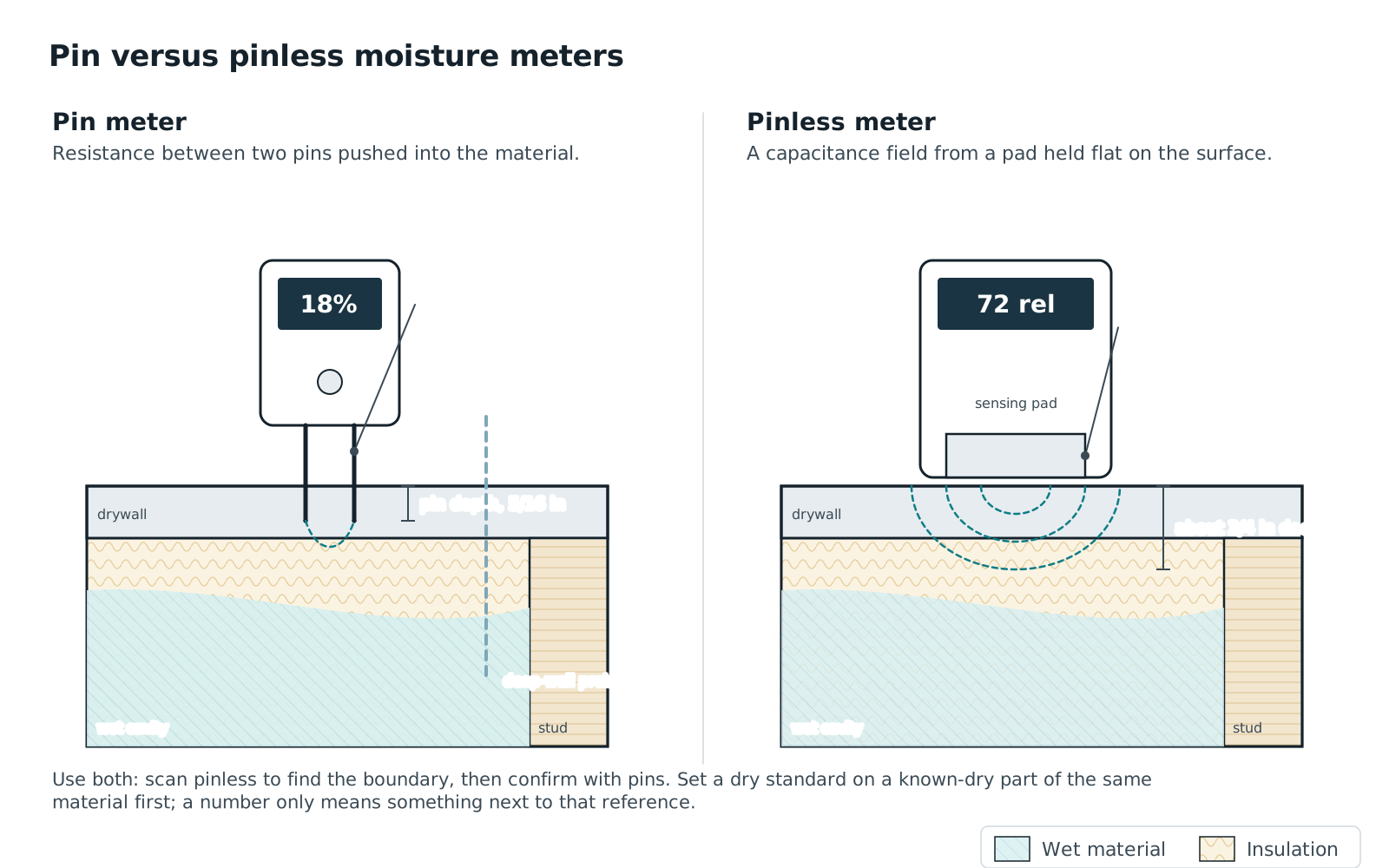
Pin meters push two steel pins into the surface and read the electrical resistance between them. Water conducts; dry gypsum and dry wood barely do. The reading comes only from the material between the pin tips, so a pin meter tells you about the depth the pins reach and nothing more. On drywall that is usually the paint and the face paper unless you push the pins through into the core, which is where the water is. The upside is that pins are hard to fool: a reading at one spot is a reading of that spot.
Pinless meters press a flat pad against the surface and send a weak electromagnetic field into the material, typically 3/4 in to 1 1/4 in deep depending on the model, and read how much the field is disturbed. Water disturbs it a lot; so do dense materials and anything conductive. On a 1/2 in sheet of drywall the field passes through the board and into whatever is behind it: air, insulation, a stud, a screw, a pipe. The upside is speed and no holes; you can sweep a whole room in minutes and find exactly where the wet stops.
The scales are different instruments in disguise. A pin meter in wood mode reports percent moisture content, calibrated for wood. Switched to a gypsum scale (Delmhorst's BD-2100 has one) it reports percent moisture of the board itself, and dry drywall lives below 1 percent. Many professional meters report wood moisture equivalent, or WME: the moisture a piece of wood would hold if it sat in equilibrium with whatever you are touching, so one green-yellow-red band works across drywall, plaster and framing. Pinless meters on drywall almost always report a relative number, 0 to 100 on the Tramex and Klein, 70 to 999 on the Protimeter's search mode, that has no meaning on its own and full meaning next to the reading from a dry wall.
The method that follows works for every scale because it never trusts an absolute number alone.
Set a dry standard before you read anything wet
The IICRC S500 standard that restoration crews work from has a name for the first reading you should take: the dry standard, a reading from the same kind of material in a part of the house the water never reached. The target you dry back to, called the drying goal, is set from it, usually within a few points. Everything else in this guide compares against that number.
Pick a wall of the same construction as the wet one: same drywall thickness, same paint, same side of the house if you can, and an interior wall if the wet wall is interior. A hallway or a bedroom closet two rooms away is typical. Read it at the same heights you will use on the wet wall, with the meter on the setting you will use for the whole job, and write the numbers down with the date and the room temperature. Take three or four points and use the typical value. If your meter has a reference mode (the Protimeter does), store it there too.
Do this before you touch the wet wall, because a dry standard taken after the room has been humid for two days is already contaminated, and because the adjuster will ask what dry looks like in your house, not in a chart.
Tools and materials
- A moisture meter. A pin meter alone works. A pinless meter alone finds the edge but cannot confirm depth or give a defensible number on drywall. Both together is how crews do it; the moisture meter roundup sorts them.
- A hygrometer for the room, so the log has temperature and humidity next to every reading.
- Painter's tape and a fine marker to label each grid point on the wall.
- A tape measure for the 6, 18 and 30 in heights and the 2 ft spacing.
- A phone with the camera date stamp on, for a photo of every reading.
- A stud finder, or a magnet to find the screws, so you know where the metal is before it fools you.
- A notebook or a spreadsheet with one row per point per day.
- Spare pins for the pin meter; they bend in paint.
Reading a wet wall, step by step
- 1
Choose one setting and keep it for the whole job
Put the pin meter on its gypsum or building-materials scale if it has one, or on WME; put a pinless meter on its drywall or relative mode. Write the setting in the log. A number taken in wood mode on Tuesday and gypsum mode on Wednesday is two numbers, not a trend, and a trend is what you are building.
- 2
Take the dry standard
Three or four readings on an unaffected wall of the same construction, at 6, 18 and 30 in off the floor, logged with temperature and humidity. If you have both meters, take a dry standard with each. If you are using a General Tools MMD4E, press the pins into the two calibration holes in the cap first; the manual says it should read 18.3 percent plus or minus 1 in wood mode, and if it does not, change the battery before you trust anything.
- 3
Find the edge with the pinless meter
Starting at the obvious wet spot, slide outward along the base of the wall and up, watching for the reading to fall back to the dry standard. Hold the pad flat and still at each point rather than dragging it; Protimeter's manual notes that sliding wears the pad and that readings should be taken at discrete spots. Keep your fingers off the pad and the meter away from your body. When the reading drops to the dry standard, go 4 ft farther and confirm it is still dry. Mark the boundary with tape. If you only have a pin meter, skip ahead and let the grid find the edge.
- 4
Lay out the grid
Along every wet wall, a strip of tape every 2 ft, with points at 6, 18 and 30 in above the floor; add 42 in if the readings at 30 in are still elevated. Continue the grid 4 ft past the last wet reading in each direction. Number each strip and write the height next to each point. Check the stud finder or magnet as you go and keep the points between studs, away from screws; note where the studs are so a high reading over one is not a surprise. Corners get their own points on both walls, 6 in from the corner, because corner bead is metal.
- 5
Read every point with the pins
At each point, push the pins through the paint and paper until they seat in the core, with the same pressure every time, and hold for two or three seconds until the number settles. Two small holes per point are the price of a reading you can defend; they fill with a dab of spackle at the end. If the pin meter cannot penetrate (vinyl wallpaper, several coats of enamel), score the spot with a utility knife first. Write the number on the tape and in the log.
- 6
Photograph each reading
One photo per point with the meter display and the tape label both readable, and a wide shot of each wall showing the grid. This is the moisture map an adjuster asks for, and it is the record that proves what was wet and when it stopped being wet. The claim documentation checklist covers the rest of the file.
- 7
Repeat at the same time every day until the numbers hold
Same points, same meter, same setting, same heights, same time of day, with the drying equipment running between readings. Readings should fall every day. A point that has not moved in 48 hours has something behind it the air is not reaching. The wall is dry when every point is within a point or two of the dry standard and still there the next morning. Run the dehumidifier one more day after that; how long to run the fans and the dehumidifier covers the schedule.
What the numbers mean, scale by scale
The only universal rule is the comparison with your dry standard. Within that, the manufacturers publish thresholds for their own scales, and these are the ones worth knowing.
Gypsum percent scale (Delmhorst BD-2100 and similar). Delmhorst's own guidance puts normal drywall at 1 percent or lower on its gypsum scale. Between 1 and 2 percent, drywall may be saved if it is dried quickly; over 2 percent at any point, Delmhorst's advice is that replacement is the safer call. This is the most precise scale for drywall because it was built for it; a wood scale that starts at 5 or 6 percent cannot see the difference between dry drywall and drywall that has been wet.
Wood moisture equivalent (Protimeter SurveyMaster and most pro meters). Protimeter's manual defines the bands: 7 to 16.9 is dry and green, 17 to 19.9 is at risk and yellow, 20 and above is wet and red. Dry drywall sits at the bottom of the green band; a drywall reading in the yellow is wet drywall, because gypsum in equilibrium with a normal house does not read anywhere near 17.
Building-materials scale on a consumer pin meter (General Tools MMD4E). The MMD4E reads building materials from 1.5 to 33 percent and its alarm trips at 20 percent in that mode (16 percent in wood mode). General Tools does not publish a dry value for drywall on this scale, so use the dry standard: a dry wall in most houses reads at or near the bottom of the range, and anything that reads several points above your dry wall is wet.
Relative scales on pinless meters (Tramex, Klein, Extech pinless mode, Protimeter search mode). There is no dry number. A Tramex ME5 reading of 30 or a Protimeter search reading of 300 means nothing until you know the same meter read 15 or 150 on the dry wall. The pattern is what you read: the wet area is a plateau of high numbers with a gradient at its edge, and the edge is where the number returns to the dry standard.
Framing behind the wall (any pin meter in wood mode). When the baseboard is off or the wall is open, read the sole plate and the bottom of each stud. Framing in a dry house typically reads in the single digits to low teens; restoration practice treats 16 percent as the wet line, and the MMD4E's wood alarm and Protimeter's yellow band both start near there for a reason. Plates against a slab are the last thing to dry.
Dry, borderline and wet by scale
| Scale and meter | Dry | Borderline | Wet | Source |
|---|---|---|---|---|
| Gypsum % (Delmhorst BD-2100) | 1% or lower | 1–2%: may dry in place if done quickly | Over 2% at any point: replace | Delmhorst, optimal moisture content of drywall |
| Wood moisture equivalent (Protimeter SurveyMaster) | 7–16.9 (green) | 17–19.9 (yellow, at risk) | 20–99.9 (red) | Protimeter BLD5365 manual |
| Building materials % (General Tools MMD4E) | Matches your dry standard | Several points above it | Alarm at 20% (16% in wood mode) | MMD4E manual; dry value not published |
| Relative pinless (Tramex ME5 0–100, Klein ET140 0–100, Protimeter search 70–999) | Equal to the dry standard | Rising gradient at the edge of the wet area | Plateau well above the dry standard | Manufacturer manuals; comparative scales only |
| Framing, wood % (any pin meter) | Matches dry framing elsewhere; typically single digits to low teens | 16–19% | 20% and up | Restoration practice; MMD4E wood alarm 16%, Protimeter yellow band 17% |
Every row still starts with your own dry standard. Published thresholds tell you how far from dry is too far; they do not replace the reading from an unaffected wall in the same house.
False readings, and how to tell them from water
Both kinds of meter read conductors and density, not just water. Protimeter's manual says it plainly: salts, carbon and metal can give false positives in pin mode, and conductors other than water within the material can drive search-mode readings high. The common ones on a drywall job:
- Screws and nails. Every 12 to 16 in up each stud. A pinless reading that spikes in a vertical line 16 in apart is the fastener pattern, not a leak. Move 2 in sideways and read again.
- Corner bead and metal edge trim. Every outside corner is wrapped in steel or metal-reinforced tape under the mud. Read 6 in away from corners, never on them.
- Nail plates, electrical boxes, pipes, ducts. Anything metal in the cavity shows up on a pinless meter as a wet patch the size of the object. A pin reading of the board at the same spot will be dry. That disagreement between the two meters is the tell.
- Foil-faced insulation and foil tape. A wall insulated with foil-faced batts reads high everywhere on a pinless meter. Switch to pins.
- Studs. A pinless meter reads the stud as part of the wall; the reading over a stud is slightly higher than between studs even when both are dry. Keep the grid between studs, or at least compare like with like.
- Fresh paint, new joint compound, wallpaper paste. All read wet until cured, which can take weeks for compound. If the wall was recently repaired, your dry standard needs to come from an equally recent repair or you wait.
- Surface condensation. A cold exterior wall on a humid morning can be damp on the face and dry in the core. Pins pushed through the paint read the core; Protimeter notes that surface moisture has little effect on its search mode. Wipe, wait ten minutes, read again.
- Vinyl wallpaper, tile, enamel paint. Pins cannot penetrate, so they read the finish, not the board. Score the surface, or read from the other side of the wall or from the cavity once the baseboard is off.
- Your own hand. A hand wrapped around the back of a thin partition or a door, or fingers near the sensing pad, moves the reading. Hold the meter by its handle.
- Temperature. Pin meters are calibrated near room temperature and read low on cold material. If your dry standard came from the same house at the same temperature, this washes out, which is another reason not to borrow a dry number from a chart.
The habit that catches all of these: when a reading surprises you, move the meter 2 in and read again, then confirm with the other kind of meter. Water makes a gradient; metal makes an edge.
Dry in place or cut it out
The readings are one of four inputs, and our wet drywall guide walks through all of them. In short: drywall wet by clean water (Category 1 under IICRC S500), wet less than about 2 ft up by the meter, with an empty cavity behind it and found within a day or two, dries in place with the baseboard off, vent holes at the plate, air movers and a dehumidifier. Drywall wet by contaminated water, wet higher than that, backed by wet insulation or a vapor barrier, wet for more than about 72 hours, or whose readings stop falling for 48 hours, gets cut above the wet line. The meter also sets the cut: 12 to 24 in above the highest wet reading, rounded to 16, 24 or 48 in from the floor.
The meters we hand people
For a single leak, a pin meter with a calibration check is enough to run this method; add a pinless meter when you want the edge found in minutes or you expect to do this again. These are the two we point homeowners to most often, and the roundup covers the professional options.
General Tools MMD4E Digital Pin Moisture Meter
The cheap pin meter that is accurate enough to tell you whether to open a wall.
Best for homeowners who want one accurate, verifiable meter for leaks and the occasional firewood check.
Score breakdown
| Calibration check | true | 10.0 |
| Published accuracy | 2 | 7.5 |
| Versatility | pin | 7.0 |
| Professional grade | false | 0.0 |
| Scan depth | n/a | — |
| Warranty | 1 | 2.0 |
| Reading hold | true | 10.0 |
| Backlight | true | 10.0 |
| Temperature / RH | false | 0.0 |
Stars are DryHomeLab's rating from the published rubric (score ÷ 2, to the half star). Not a customer rating.
- Manufacturer-rated ±2% accuracy, unusual at this price
- Calibration check holes in the pin cap (18.3% reference)
- Backlight, hold, audible alarm and auto power-off
- Two scales: wood 5–50% and building materials 1.5–33%
- Pin holes in every surface you test
- No species or temperature correction
- One-year warranty
- Reads only the surface unless the pins penetrate
The MMD4E is the pin meter most homeowners end up with, and for once the popular choice is a sound one. General Tools rates it at ±2% across a 5 to 50% range for wood and 1.5 to 33% for building materials, with a backlit LCD, a hold button, an audible alarm that trips at 16% in wood and 20% in building materials, and auto power-off after three minutes. It runs on a 9 V battery and the pins are replaceable.
The feature that earns it a place on a professional's list is the calibration check built into the pin cap: press the pins into the two holes and the meter should read 18.3% ±1% in wood mode. That is a real check against a fixed resistor, not a self-test light, and it is why we trust this meter more than pinless meters at the same price that cannot be verified at all.
What it will not do: it reads only where the pins touch, so you leave two small holes per reading and you only learn about the surface layer unless you drive the pins through paint into the paper and gypsum. It has no species or temperature correction, so treat wood readings as approximate and always compare with a dry reference area in the same house. The one-year warranty is short.
Buy it if you want to know, today, whether the drywall behind the washing machine is wet. Pair it with a pinless meter if you need to scan a whole room without leaving marks.
Customer reviews: read them on Amazon (paid link). We link to them and never copy or score them.
Delmhorst BD-2100 Pin Moisture Meter
The pin meter with a real gypsum scale, built in the US for restoration work.
Best for drywall-heavy losses and anyone who needs a documented percentage rather than a relative reading.
Score breakdown
| Calibration check | true | 10.0 |
| Published accuracy | n/a | — |
| Versatility | pin | 7.0 |
| Professional grade | true | 10.0 |
| Scan depth | n/a | — |
| Warranty | 1 | 2.0 |
| Reading hold | n/a | — |
| Backlight | n/a | — |
| Temperature / RH | false | 0.0 |
Stars are DryHomeLab's rating from the published rubric (score ÷ 2, to the half star). Not a customer rating.
- Dedicated gypsum scale (0.2–50%) for drywall
- Built-in calibration check
- Accepts hammer and insulated-pin electrodes for framing and subfloor
- Serviceable, US-made professional instrument
- Pin-only; holes in every test spot
- No numeric accuracy specification published
- One-year warranty
- Professional price, higher with the package
Delmhorst's BD-2100 is the pin meter many restoration technicians are issued on their first day, and the reason is one word on its scale selector: gypsum. Where most meters read drywall on a borrowed wood scale, the BD-2100 has a dedicated gypsum scale from 0.2 to 50% that resolves the difference between dry drywall and drywall that has been wet, which happens below 1% and is invisible to a meter that starts at 5%. It also reads wood from 6 to 40% and has a 0 to 100 reference scale for everything else.
The integral pins penetrate 5/16 in, and the meter accepts Delmhorst's external electrodes: the 21-E for flat surfaces and insulated-pin electrodes and hammer probes for reading framing and subfloor through finished surfaces. The built-in calibration check means you can verify it on the truck. It is a plain instrument, 8 x 3 x 1 5/8 in, running on a 9 V battery, and it is made by a company that has serviced its meters for decades.
The limits: Delmhorst does not publish a numeric accuracy figure on the product page, there is no pinless mode, so you leave pin holes everywhere you test, and the standard warranty is one year. It is priced for professionals, and the full package with case and electrode costs more still.
Buy it if drywall is what gets wet in your properties and you want the most defensible drywall readings short of a lab. Pair it with a pinless scanner to find the area first.
When to call a pro
Call a restoration contractor if the grid keeps finding wet readings in rooms you did not know were affected; if readings at any point have not fallen in 48 hours with equipment running; if the wet area runs above 2 ft, across a ceiling, or into an exterior wall with insulation; if the water was from a drain, a toilet, or outside; or if the loss is an insurance claim and the adjuster wants a moisture map with daily psychrometric logs, which a crew produces as a matter of routine. Call a plumber or a leak-detection service if the readings are rising rather than falling, because the leak is not fixed; our hidden leak guide covers finding it. The form below reaches vetted local restoration contractors through HelpMeNow.com; send them your readings and photos and they will know what they are walking into.
Frequently asked questions
What is a normal moisture reading for drywall?
It depends on the scale. On a gypsum percent scale, Delmhorst puts normal drywall at 1 percent or lower, with over 2 percent calling for replacement. On the wood moisture equivalent scale professional meters use, Protimeter's dry band is 7 to 16.9, and dry drywall reads at the bottom of it. On a pinless meter's relative scale there is no normal number at all; the reading only means something next to a reading from a dry wall of the same construction in the same house, which is the dry standard you should take before anything else.
Is a pin or pinless moisture meter better for drywall?
Use both if you can. A pinless meter sweeps a wall in minutes without holes and shows you where the wet area ends, but its field reaches through the board into the cavity, so screws, corner bead, pipes and foil-faced insulation read as moisture, and on drywall its number is relative. A pin meter leaves two small holes per reading but reads only the material between the pins, and on a gypsum or WME scale gives a number you can defend. Crews find the edge with the pinless meter and put a number on it with the pins.
How do I know when the drywall is dry?
When every point in your grid reads within a point or two of the dry standard you took on an unaffected wall, with the same meter on the same setting, and the readings are still there the next day. Falling readings mean it is drying; readings that have not moved in 48 hours mean something behind the board is holding water and that section should be opened. Do not call a wall dry from one reading, from a different meter, or from how it feels; drywall feels dry on the face long before the back paper and the plate behind it are.
Why does my moisture meter read high on a wall that is not wet?
Something conductive or dense is inside the meter's field. The usual suspects are drywall screws (a line of high readings 16 in apart up a stud), metal corner bead at an outside corner, a nail plate, pipe, duct or electrical box in the cavity, foil-faced insulation, or fresh paint and joint compound that have not cured. Move the meter 2 in and read again: water produces a gradient, metal produces a sharp edge. Confirm with a pin reading, which reads only the board. If the wall was painted or patched recently, wait for it to cure or take your dry standard from the same new work.
How high up the wall should I take readings?
At 6, 18 and 30 in off the floor, every 2 ft along the wet wall, continuing 4 ft past the last wet reading; add a row at 42 in if the 30 in readings are still elevated. Water wicks up drywall well above the visible stain, typically 6 to 12 in higher, and the highest wet reading, not the stain, sets the flood-cut height if you cut. Read corners 6 in from the corner on both walls, and read any ceiling stain at its center and 12 in out in each direction.
Will an insurance adjuster accept my own moisture readings?
They will look at them, and a clean log helps your claim; whether they are accepted as proof of drying depends on the adjuster and the claim. What makes readings credible is the same discipline a crew uses: a dry standard taken first, a labeled grid, the same meter and setting every day, the date, time, temperature and humidity on each row, and a photo of every reading with the label in frame. A meter with a calibration check, used in front of the adjuster, helps. For a large claim, a restoration contractor's moisture map and psychrometric logs carry more weight, which is one of the reasons to hire one.
The seasonal checklist, by email
One email when the season changes — freeze week, spring thaw, hurricane season — with the checklist for that month. No weekly newsletter, no selling your address.
We send one confirmation link first. Every email has a one-click unsubscribe. Privacy.
Check your inbox for the confirmation link; the checklist follows as soon as you click it.
You are on the list. The next email arrives when the season changes.
That did not go through. Check the address and try again.
DryHomeLab is written and reviewed by the team behind HelpMeNow.com, a marketplace that connects homeowners with vetted local contractors for water-damage restoration, plumbing and waterproofing. Before HelpMeNow the same team ran a 24/7 water-damage restoration company in the Seattle area; the equipment on this site is what we specified, bought and ran on real water losses. We publish the rubric behind every score.
- Ran a 24/7 water-damage restoration company, Seattle area
- Operate HelpMeNow.com, a contractor marketplace
- Publishes its scoring rubric