

The short answer
Three jobs hide behind the phrase "sump pump cost," and they do not overlap much.
Replacing a pump in an existing pit. Open the union, lift out the old pump, set the new one, new check valve, test. Published cost guides put this at about $350 to $1,000 installed, with one guide's survey of homeowner-reported projects putting the no-digging replacement at $400 to $700. The pump is typically a third to a half of the total.
Installing a pump where there is a pit but no pump, or a pit that needs rebuilding. Add a liner, gravel, a cover, a new riser and a discharge through the rim joist. The guides' overall national averages, about $1,350 to $1,400 with typical ranges of roughly $650 to $2,100, describe this middle job.
Cutting a new pit through a concrete floor. Jackhammer, excavation, liner, gravel, patching the slab, then everything above. The guides put the concrete breaking and digging at $2,500 to $5,000 on top of the pump and plumbing, and quote the high end of a full install, with two pumps, buried drainage, backup and alarm, at about $4,000 or more. If the basement also needs interior drain tile to feed the pit, that is a separate project the same guides price at $2,800 to $6,500.
The rest of this page is the five decisions that move a job from one column to the next.
Cost driver 1: the pump class
Pump cost tracks horsepower and build. The published guides put a 1/3 HP submersible at roughly $90 to $250, a 1/2 HP at $160 to $400, a 3/4 HP at $200 to $500 and a 1 HP at $200 to $800, pedestal pumps from about $80 and premium submersibles up to about $1,000. Inside each class, cast iron costs more than thermoplastic and lasts longer; a vertical float costs a little more than a tethered one and sticks less.
The mistake is buying horsepower you do not need. A 3/4 HP pump in a slow pit empties it in seconds and restarts a minute later, which wears the switch and hammers the check valve. Size to the water: lift, run length and how fast the pit fills, with the sump pump sizing calculator. Most basements with 8 to 12 ft of lift and 4-in. drain tile are a 1/3 HP job; a pit that rises an inch a minute in spring, or a lift near 15 ft, is a 1/2 to 3/4 HP job. The two pumps below bracket most replacements, and the price on each card is live.
Zoeller M53 Mighty-Mate
The pump plumbers install in their own basements.
Best for most homes with a standard 18-inch pit and under 12 ft of lift.
Score breakdown
| Build material | cast iron | 10.0 |
| Switch reliability | vertical float | 9.0 |
| Right-sized flow at 10 ft of head | 2040 | 10.0 |
| Warranty | 3 | 5.0 |
| Head capability | 19.25 | 6.0 |
| Efficiency (lower amps) | 9.7 | 2.9 |
| Cord length | 9 | 1.6 |
| Solids handling | 0.5 | 10.0 |
| Thermal protection | true | 10.0 |
| Editorial adjustment | Field durability: on the sump failures our crews responded to, Zoeller's cast iron M-series pumps were the ones most often found still running past year ten; the paper warranty understates the service life we saw. | +1.0 |
Stars are DryHomeLab's rating from the published rubric (score ÷ 2, to the half star). Not a customer rating.
- Cast iron switch case, motor housing and base shed heat into the water
- Slow 1,550 RPM motor runs cool and quiet
- Vortex impeller passes 1/2-inch solids without clogging
- Auto-reset thermal overload protects a pump that runs dry
- 9-ft cord is short for deep pits; longer-cord versions cost more
- 9.7 A draw is high for the flow it delivers
- Flow falls off steeply above 15 ft of lift
- 3-year warranty trails Wayne's 5 years
The M53 is the pump we find most often when we open a pit on a water loss in an older home, and usually it is still running. It is a 3/10 HP, 1,550 RPM cast iron submersible with a non-clogging vortex impeller that passes 1/2-inch solids, an integral float switch, and an auto-reset thermal overload. Zoeller rates it at 43 GPM (2,580 GPH) at zero head and 2,040 GPH at 10 ft, with a 19.25-ft shutoff.
Where it shines is longevity, not peak numbers. Cast iron on the switch case, motor housing and base dumps motor heat into the water, and the slow 1,550 RPM shaded-pole motor runs cool and quiet. On a typical basement lift of 8–12 ft it moves plenty of water for a normal pit fed by 4-inch drain tile.
Where it falls short: the 9-ft cord is short for a deep pit, the 9.7 A draw is high for a 3/10 HP motor, and once your lift gets near 15 ft the curve drops hard. If your inflow test on our sizing calculator shows more than about 30 GPM at 10 ft, step up to the M98 or a 3/4 HP Wayne.
Buy it if you have a standard 18-inch pit, under 12 ft of lift, and want the pump most plumbers install in their own basements. The 3-year warranty is shorter than Wayne's five, but field survival is the better number.
Customer reviews: read them on Amazon (paid link). We link to them and never copy or score them.
Wayne CDU980E
The most water per dollar at a real basement lift.
Best for fast-filling pits and homeowners who want the longest warranty for the money.
Score breakdown
| Build material | cast iron/stainless | 9.0 |
| Switch reliability | vertical float | 9.0 |
| Right-sized flow at 10 ft of head | 4600 | 6.7 |
| Warranty | 5 | 10.0 |
| Head capability | n/a | — |
| Efficiency (lower amps) | n/a | — |
| Cord length | 8 | 1.1 |
| Solids handling | n/a | — |
| Thermal protection | true | 10.0 |
Stars are DryHomeLab's rating from the published rubric (score ÷ 2, to the half star). Not a customer rating.
- 4,600 GPH at 10 ft on Wayne's own curve
- Stainless motor housing on a cast iron volute
- Fits basins 11 in and larger
- 5-year limited warranty
- Top-suction design pulls less silt
- 8-ft cord
- Running amps and solids handling not published
- Overkill for a slow pit; will short-cycle
- Wayne's own 10-ft figures differ between manual and web page
The CDU980E is a 3/4 HP submersible with a stainless steel motor housing on a cast iron volute, and Wayne's own curve puts it at 5,490 GPH at zero head and 4,600 GPH at 10 ft, still 3,500 GPH at 20 ft. That is more than double what a Zoeller M53 moves at the same lift, usually for similar money, which is why it is our value pick.
The design is top-suction: water enters above the base, so the pump is less prone to pulling in the silt that settles on the floor of a pit. The integrated vertical float turns on at 9 in and off at 4 in, with a solid polypropylene float that cannot waterlog. Wayne specifies it for basins 11 in in diameter and larger, which makes it one of the few 3/4 HP pumps that fits a narrow pit, and backs it with a 5-year limited warranty.
Where it falls short: the cord is 8 ft, the oil-filled motor has an automatic resetting thermal protector but Wayne does not publish running amps or solids handling, and the manual's performance table and the product page disagree slightly at 10 ft (4,600 vs 4,743 GPH; we use the lower manual figure). A 3/4 HP pump in a slow pit will short-cycle; size it with our calculator first.
Buy it if your pit fills fast in spring, you have a long discharge run, or you simply want the longest warranty on the shelf.
Customer reviews: read them on Amazon (paid link). We link to them and never copy or score them.
Cost driver 2: the pit
The pit decides more of the bill than the pump does.
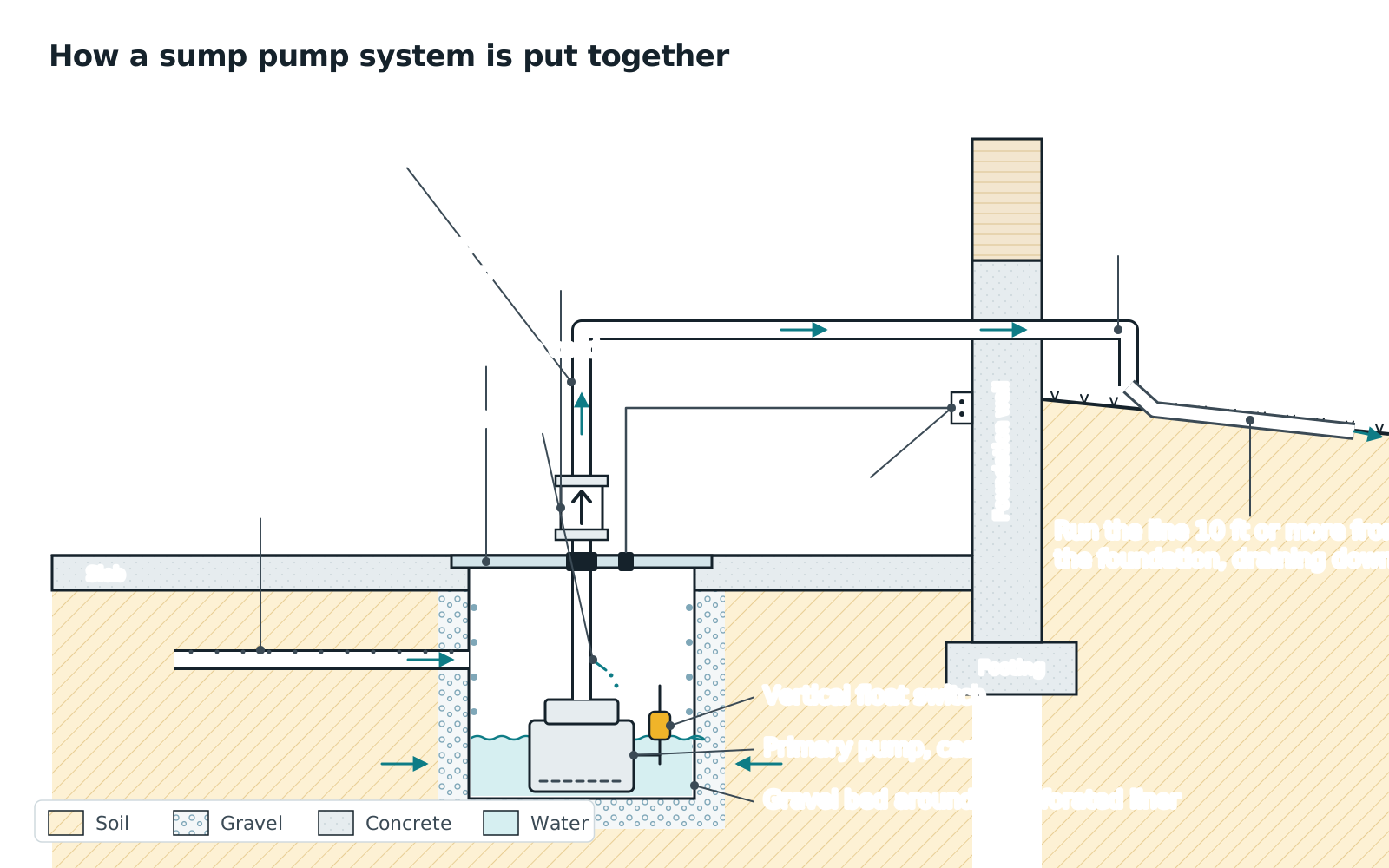
An existing lined pit with a riser and union is the cheap case. The plumber's time is an hour or two.
A pit that needs work adds to that: an unlined hole in the slab that should get a liner, a basin too small for the pump's float (Zoeller recommends 18 in. or larger for pumps with swinging floats; the IRC's storm-drainage section describes the standard pit as 18 in. across and 24 in. deep with a cover), a missing or broken lid, silted drain tile inlets that need flushing, or a riser with no union that has to be cut and rebuilt. Each is an hour and some parts, and the guides' basin-installation labor of $500 to $1,200 covers the case where the liner itself is replaced in an existing hole.
No pit at all is the expensive case, and there is no way around it: the slab has to be cut and a hole dug 24 in. or more below it, the liner set in gravel, the floor patched. The guides put that concrete and excavation work at $2,500 to $5,000 before the pump, and a dirt crawl space floor at a few hundred dollars instead. Access matters here too; one guide notes that a difficult basement or crawl space can push a full install toward $3,900.
Cost driver 3: where the water goes
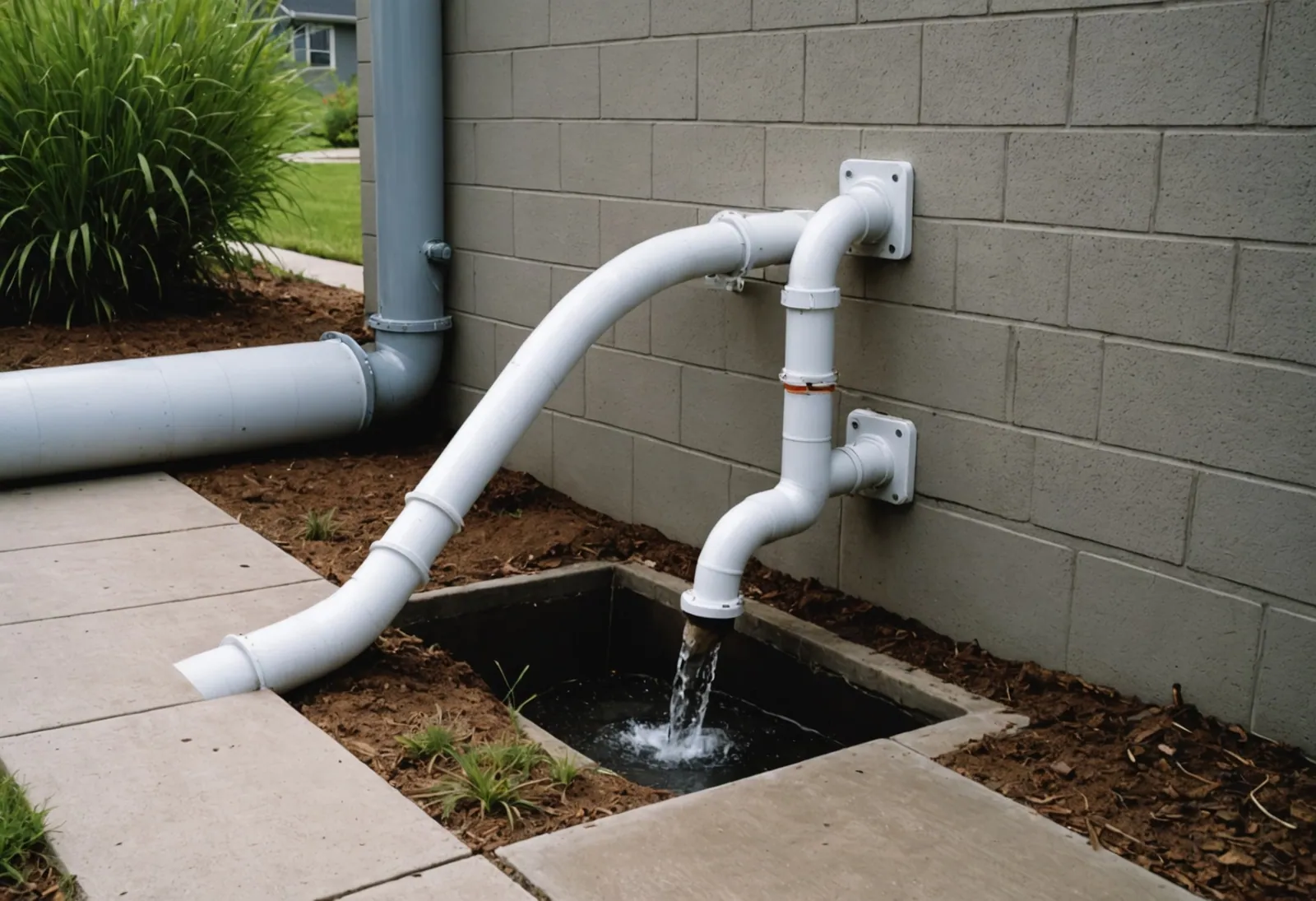
A pump that discharges 2 ft from the foundation pumps the same water forever. The discharge has to reach daylight well away from the house, downhill, and ideally where it will not freeze.
- Above-ground extension to a splash block or a hinged extension is the simple case; the guides price above-ground discharge piping at $150 to $400.
- A buried line to daylight, a dry well or a storm drain (where the municipality allows it; most prohibit sump discharge into the sanitary sewer) runs $250 to $2,000 in the same guides, depending on length, frost depth and what is in the way. Buried lines need slope along their whole length, a freeze-relief fitting near the house, and an outlet with an animal guard.
- A second discharge for a backup pump through the rim joist adds a core-drilled hole and a run of pipe; some local codes require it rather than a tee into the primary line.
Cost driver 4: the backup
The pump stops when the power does, and the storms that fill pits take lines down. Backups come in two kinds, and the guides price the hardware in overlapping ranges: a battery backup system from about $150 for a bolt-on add to $2,000 for a full combination unit, and a water-powered backup from about $200 to $1,000. Battery systems need a deep-cycle battery (sold separately on most of the ones we recommend), replaced every three to five years, and an afternoon of plumbing a second riser with its own check valve; our install guide shows the work. Water-powered units need municipal pressure, a tee into the supply with a backflow preventer, and in many jurisdictions a licensed plumber by rule; they cost nothing to keep ready but use roughly a gallon of city water for every two they pump.
Doing the backup in the same visit as the pump is cheaper than two visits. If the basement is finished, a backup is not optional; it is the difference between a pump failure that costs a service call and one that costs a floor.
Cost driver 5: electrical, permits and timing
Electrical. Both Zoeller's and Wayne's instructions call for the pump on its own properly grounded circuit with no extension cord, and current electrical codes require GFCI protection on basement receptacles. If the nearest outlet is across the room, shared with a freezer, or sitting where a pit overflow would reach it, an electrician adds a dedicated circuit, usually an hour or two of work plus materials; the cost guides do not price it separately, so get it as its own line on the quote.
Permits. Replacing a pump in an existing pit rarely needs one. A new pit, new electrical, or a discharge tied into municipal storm drainage often does, and some cities inspect the discharge to be sure it is not going into the sanitary sewer. Permit fees vary by jurisdiction; ask the building department before the quote, because a contractor who skips a required permit leaves you holding the fine and the insurance question.
Timing. After-hours and storm-week calls cost more, and the pump you get is whatever is on the truck. The cheapest sump pump job is the one scheduled on a dry weekday in September because the monthly test showed the old pump slowing down.
What the published guides put on each line
| Item | Range in published cost guides | Notes |
|---|---|---|
| Replacement in an existing pit, installed | $350 to $1,000 | One guide's homeowner survey: $400 to $700 with no digging |
| Full install, national average | About $1,350 to $1,400 | Typical ranges $645 to $2,100; high end about $4,000 and up |
| Submersible pump, unit only | $90 to $1,000 | 1/3 HP $90 to $250; 1/2 HP $160 to $400; 3/4 HP $200 to $500 |
| Pedestal pump, unit only | $80 to $800 | Cheaper and louder; motor above the water |
| Check valve / float switch, parts | $15 to $30 / $35 to $70 | Replace the valve with the pump every time |
| Basin installation labor | $500 to $1,200 | Liner, gravel and cover in an existing or dirt-floor hole; concrete not included |
| Breaking and digging a concrete floor | $2,500 to $5,000 | The reason a new pit costs what it does |
| Discharge piping, above ground | $150 to $400 | Extension to a splash block or hinged outlet |
| Discharge piping, buried to daylight | $250 to $2,000 | Depends on length, frost depth and obstacles |
| Battery backup system, hardware | $150 to $2,000 | Battery usually extra; replace it every 3 to 5 years |
| Water-powered backup, hardware | $200 to $1,000 | Needs municipal pressure and a backflow preventer; often a licensed-plumber item |
| Interior drain tile (French drain) to feed the pit | $2,800 to $6,500 | A separate project; only if water enters along the floor edge |
| Plumber labor rate | $45 to $150 per hour | Guides disagree; the low end is rural, the high end metro |
| Inspection / annual maintenance visit | $50 to $350 / $100 to $300 | Or do the five-minute test yourself |
Ranges compiled from the three cost guides listed under Sources, 2024 to 2026 editions. Regional pricing varies widely.
DIY versus pro: the honest math
A swap in an existing pit is a homeowner job if the riser has a union, the pit is lined, and the outlet is within cord reach. The parts are the pump, a check valve, a union, a male adapter, a few feet of 1-1/2 in. PVC and cement, so the DIY cost is the pump plus a small fraction of it, against $350 to $1,000 for the installed job. The savings are real, and so is the risk: the installs we pulled out after floods failed on float clearance, a reused check valve, a skipped weep hole or an extension cord, not on the pump. Our replacement guide walks the sequence; follow it and the result is as good as a plumber's.
A new pit through concrete is not a DIY job for most people, and not because of skill. A rented breaker, a day of hauling rubble in buckets, disposal, and a floor patch that does not crack is a long weekend that ends with a pit that may not sit at the low point of the slab. A waterproofer does it in a day with the right tools and warranties the result.
A battery backup is an afternoon if the pit is 18 in. and you are comfortable cutting PVC. A water-powered backup is a plumber's job in most places because of the backflow-preventer rules.
Electrical is an electrician's job, by code in most jurisdictions and by sense everywhere; a sump outlet is the one most likely to be standing in water.
What to ask before you sign the quote
- Which pump, exactly? Brand, model and horsepower in writing, with the flow at 10 ft of head, not the zero-head number. Cast iron or thermoplastic. Vertical or tethered float. If the answer is "a 1/2 horse," ask for the model.
- How did you size it? A good answer mentions lift, run and inflow. A bad one is "bigger is safer."
- New check valve and a union? Both, every time. Ask for a quiet-close valve if a bedroom is above.
- Is the weep hole included and where will it be? Below the check valve, above the pump. If they do not know what you mean, keep calling.
- Will you clean the pit and check the drain tile inlets? It should be part of a swap.
- Where does the discharge go now, and is it sloped and frost-protected? A plumber who walks outside to look is the one you want.
- What does the electrical look like? Dedicated circuit, GFCI as code requires, no extension cord. If the outlet is wrong, is the electrician on the quote or a separate call?
- Permit? Who pulls it and what it costs, or why the job does not need one.
- Warranty on labor, and who handles the pump's manufacturer warranty if it fails in year two.
- Backup options in the same visit, priced separately so you can decide.
- Disposal of the old pump and the time on site.
- What changes the price: an unlined pit, a riser without a union, a frozen or blocked discharge found on the day.
The form at the bottom of this page reaches vetted local plumbers and waterproofers through HelpMeNow.com. The more of these answers you already have, the closer the first quote will be to the final bill.
When to call a pro
Call a plumber or waterproofer for a new pit, any job that needs concrete cut, a water-powered backup, a discharge that has to be buried or tied into a municipal line, a riser with no union that disappears into a wall, any electrical work, or a pit that holds standing water above the pump's turn-on level with the pump running. Swapping a pump in a lined pit with a union is a homeowner job. If the basement has already flooded, the first 24 to 48 hours decide whether it is a cleanup or a mold job; our 72-hour guide covers that part.
Sources
- HomeAdvisor, "How Much Does Sump Pump Replacement Cost?" (updated December 2024, based on homeowner-reported projects): https://www.homeadvisor.com/cost/plumbing/install-a-sump-pump/
- Fixr, "Sump Pump Installation Cost" (updated January 31, 2025): https://www.fixr.com/costs/sump-pump-installation
- This Old House, "How Much Does a Sump Pump Cost?" (updated March 11, 2026): https://www.thisoldhouse.com/plumbing/sump-pump-cost
- Zoeller sump pump installation instructions FM2676 (check valve and union, vent hole, 18-in. basin, separately protected circuit, no extension cord): https://zoellerpumps.com/wp-content/uploads/sites/3/2026/07/fm2676-3-Year-Warranty-Installation-Instructions.pdf
- Wayne submersible sump pump manual 600002W-001-J (check valve required, GFCI receptacle, no extension cord): https://www.waynepumps.com/wp-content/uploads/2025/06/Sump_600002W-001-J_Web.pdf
Frequently asked questions
How much does it cost to replace a sump pump?
For a pump in an existing lined pit, published cost guides put the installed job at about $350 to $1,000, and one guide's homeowner survey at $400 to $700 when no digging is involved. The pump itself is roughly $90 to $500 for the 1/3 to 3/4 HP submersibles most homes use, so labor and the check valve, union and pipe make up the rest. A pit that needs a liner, a riser without a union, or electrical work adds to that.
How much does a new sump pump installation cost with no existing pit?
The published guides put the national average for a full install at about $1,350 to $1,400, but a new pit through a concrete floor sits at the top of their ranges: breaking and digging the slab alone is $2,500 to $5,000, plus $500 to $1,200 for the basin, plus the pump, riser and discharge. With two pumps, a buried discharge and a backup, the guides' high end is around $4,000 and up. A dirt crawl space floor is far cheaper to dig.
Is it cheaper to replace a sump pump yourself?
Yes, if the pit is lined, the riser has a union and the outlet is within cord reach: the parts are the pump plus a check valve, union, adapter and a few feet of PVC, against $350 to $1,000 for the installed job. The savings disappear if the install is wrong, and the failures we saw on homeowner installs were float interference, a reused check valve, a missing weep hole and extension cords, not bad pumps. New pits, electrical work and water-powered backups are pro jobs.
How much does a battery backup sump pump add to the cost?
Published guides price battery backup hardware from about $150 for a basic add-on to $2,000 for a full combination system, with the deep-cycle battery often sold separately and replaced every three to five years. Installation is an afternoon for a homeowner with an 18-in. pit or an hour or two for a plumber in the same visit as the primary pump. A water-powered backup runs about $200 to $1,000 for hardware plus a plumber for the supply tee and backflow preventer.
Do I need a permit to replace a sump pump?
Usually not for a like-for-like swap in an existing pit. A new pit, a new electrical circuit, or a discharge connected to municipal storm drainage often does require one, and many cities prohibit sump discharge into the sanitary sewer and inspect for it. Fees vary by jurisdiction. Ask the building department before you get quotes, and ask the contractor who pulls it; an unpermitted new circuit is a problem at sale time and after a loss.
How long does a sump pump last?
About seven to ten years for a typical submersible, longer for cast iron pumps in clean pits and shorter for pumps that short-cycle because they are oversized or the check valve has failed. Published cost guides quote a service life of roughly a decade. The switch usually goes first; a dead piggyback switch on a sound pump is a cheap repair, while a tired motor is a replacement. Plan the swap in a dry month rather than waiting for the pit to decide.
The seasonal checklist, by email
One email when the season changes — freeze week, spring thaw, hurricane season — with the checklist for that month. No weekly newsletter, no selling your address.
We send one confirmation link first. Every email has a one-click unsubscribe. Privacy.
Check your inbox for the confirmation link; the checklist follows as soon as you click it.
You are on the list. The next email arrives when the season changes.
That did not go through. Check the address and try again.
DryHomeLab is written and reviewed by the team behind HelpMeNow.com, a marketplace that connects homeowners with vetted local contractors for water-damage restoration, plumbing and waterproofing. Before HelpMeNow the same team ran a 24/7 water-damage restoration company in the Seattle area; the equipment on this site is what we specified, bought and ran on real water losses. We publish the rubric behind every score.
- Ran a 24/7 water-damage restoration company, Seattle area
- Operate HelpMeNow.com, a contractor marketplace
- Publishes its scoring rubric