

How to read this chart
A moisture meter reading means one of three things depending on the scale behind it, and the first job is to know which you are looking at.
- Percent moisture content (MC) on a pin meter's wood scale is a real percentage: the weight of water in the wood divided by the weight of the oven-dry wood, calibrated for one species (Douglas fir on a Delmhorst, Scots pine on a Tramex) with correction tables for the rest. Only wood scales and true gypsum scales report MC.
- Wood moisture equivalent (WME) is what Protimeter meters report on anything: the MC a piece of wood would reach in equilibrium with the material you are touching. It lets one set of green, yellow and red bands work across framing, drywall and plaster.
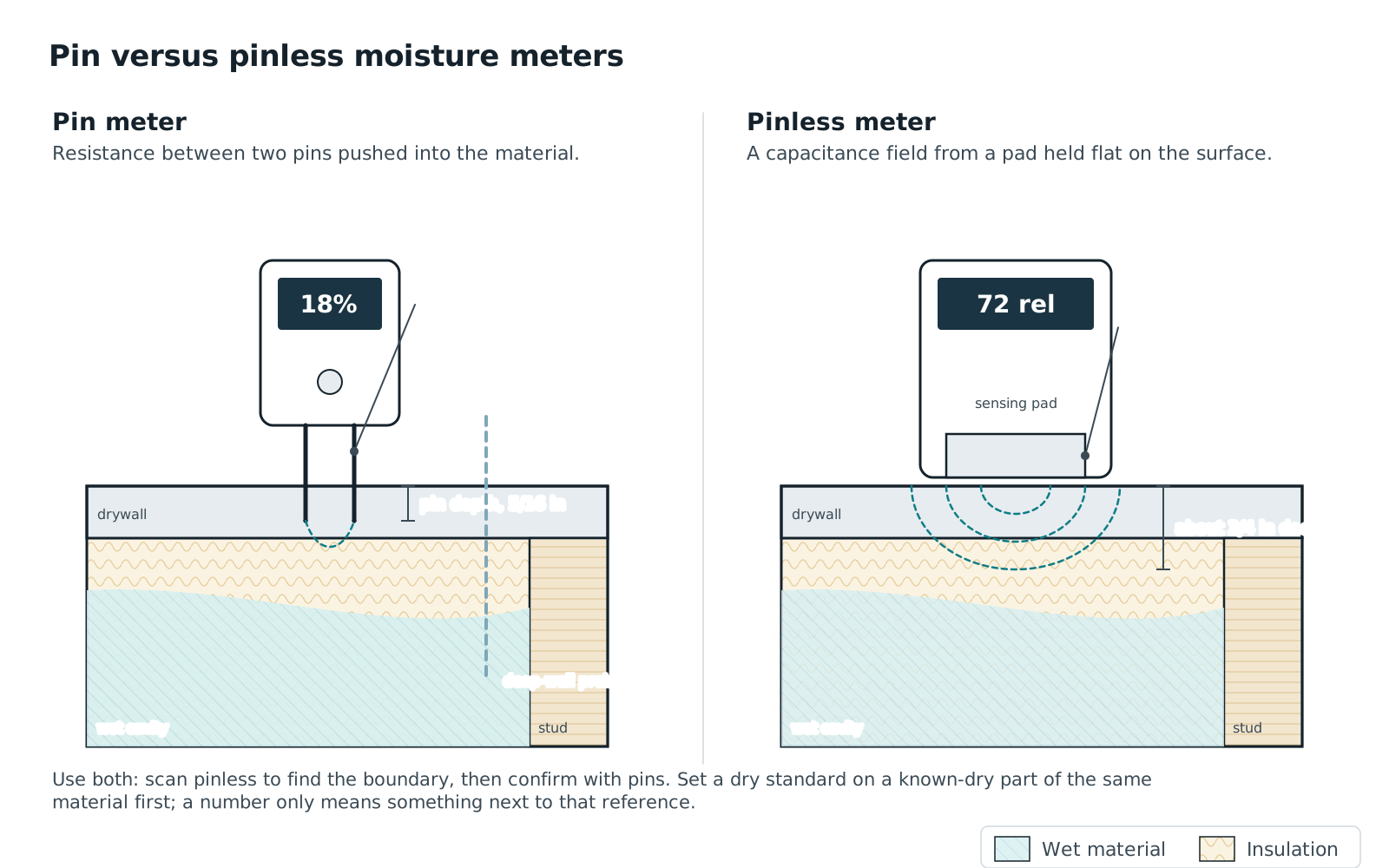
- Relative or reference numbers (0 to 100 on most pinless meters, 70 to 999 in Protimeter's search mode, a 'building materials' scale on a consumer pin meter) are not percentages of anything. They are useful only next to the same reading taken on the same material where you know it is dry.
Three tables follow, for wood, drywall and concrete, each row with its source. A fourth lists the places where the sources disagree. Then the procedure that matters more than any table: establishing a dry standard in the house you are standing in. For how to take the readings on a wall, see how to use a moisture meter on drywall; for which meter to buy, the best moisture meter roundup.
Wood: framing, sheathing, subfloor and flooring
| Material or condition | Reading | What it means | Source |
|---|---|---|---|
| Wood in equilibrium with indoor air at 70°F | 30% RH: 6.2% MC; 40%: 7.7%; 50%: 9.2%; 60%: 11.0%; 70%: 13.1%; 80%: 16.0%; 90%: 20.5% | Where dry wood settles in a conditioned house: about 8 to 13% MC between 40 and 70% RH. Your dry standard will fall in this band in most of the country, higher in a humid basement or crawl space. | USDA Wood Handbook, FPL-GTR-190, ch. 4, Table 4-2 |
| Wood flooring, normal in-service range | 6 to 9% MC | Target for installed hardwood; the expected equilibrium moisture content for the house is the real target. | Hardwood Floors Magazine (NWFA), Aug. 2024 |
| Framing after a year of HVAC (builder's field figure) | About 10 to 12% MC | Typical studs in a finished, conditioned house. | Fine Homebuilding (Risinger), 2013 |
| Pin meter wood scale, Delmhorst BD-2100 LED bands | Green 6 to 15%; yellow 15 to 17%; red above 17% | The meter maker's dry, borderline and wet bands for wood; calibrated on Douglas fir, species correction available. | Delmhorst BD-2100 owner's manual |
| Pin meter wood mode, General Tools MMD4E LED bands | Low 5 to 11.9%; mid 12 to 15.9%; high 16 to 50% with audible alarm | A consumer meter's bands; the alarm at 16% matches the restoration wet line. | General Tools MMD4E manual |
| Wood moisture equivalent (WME), Protimeter Surveymaster | Dry 7 to 16.9 (green); at risk 17 to 19.9 (yellow); wet 20 to 99.9 (red) | The same bands apply to drywall, plaster and masonry read in WME, in pin and search modes. | Protimeter Surveymaster manual INS5365 |
| Pinless wood scale, Tramex ME5 | 5 to 30% MC, audio alert above 18% | Calibrated on Scots pine (SG 0.40); adjust for species by the SG tables. | Tramex ME5 user guide |
| Restoration wet line for framing, sheathing and subfloor | Above 16% MC (solid wood); about 14% plywood, 13% OSB | The solid-wood MC that corresponds to 80% surface RH, the mold-design limit in ASHRAE 160; restoration crews treat framing above 16% as still wet. | Home Innovation Research Labs, citing ANSI/ASHRAE 160 |
| Mold growth on wood | Minimum about 16% MC | The lower limit at which secondary molds can establish on wood; growth needs sustained moisture, not a single reading. | Morris and Winandy, IRG/WP 02-10421 (Forintek / USDA FPL) |
| Framing before closing walls (builder's rule) | No lumber above 19% MC | Kiln-dried framing should arrive at about 12 to 14%; above 19% sustained is where mold activates and rot starts, per the author. | Fine Homebuilding (Risinger), 2013 |
| Decay in wood | Will not decay below 20% MC; decays above 30%; 20 to 30% is a grey area | Decay fungi need moisture above the fiber saturation point; 20% is the safe margin. | Morris and Winandy, IRG/WP 02-10421 |
| Fiber saturation point | About 30% MC on average; lower in extractive-rich species | Above this the wood holds free water; a pin meter reading near 30% is telling you the wood is saturated. | USDA Wood Handbook, FPL-GTR-190, ch. 4; Purdue FNR-163 |
| Wood subfloor before hardwood (strip flooring under 3 in. wide) | Within 4% MC of the flooring | NWFA installation tolerance; test 20 points per 1,000 sq ft, at least three per room. | NWFA Subfloor Guidelines (rev. 2016); Hardwood Floors Magazine 2024 |
| Wood subfloor before hardwood (plank 3 in. and wider) | Within 2% MC of the flooring | Wider boards tolerate less difference. | NWFA Subfloor Guidelines (rev. 2016) |
| Solid-board subflooring | Less than 15% MC | NWFA's maximum for kiln-dried board subfloors. | NWFA Subfloor Guidelines (rev. 2016) |
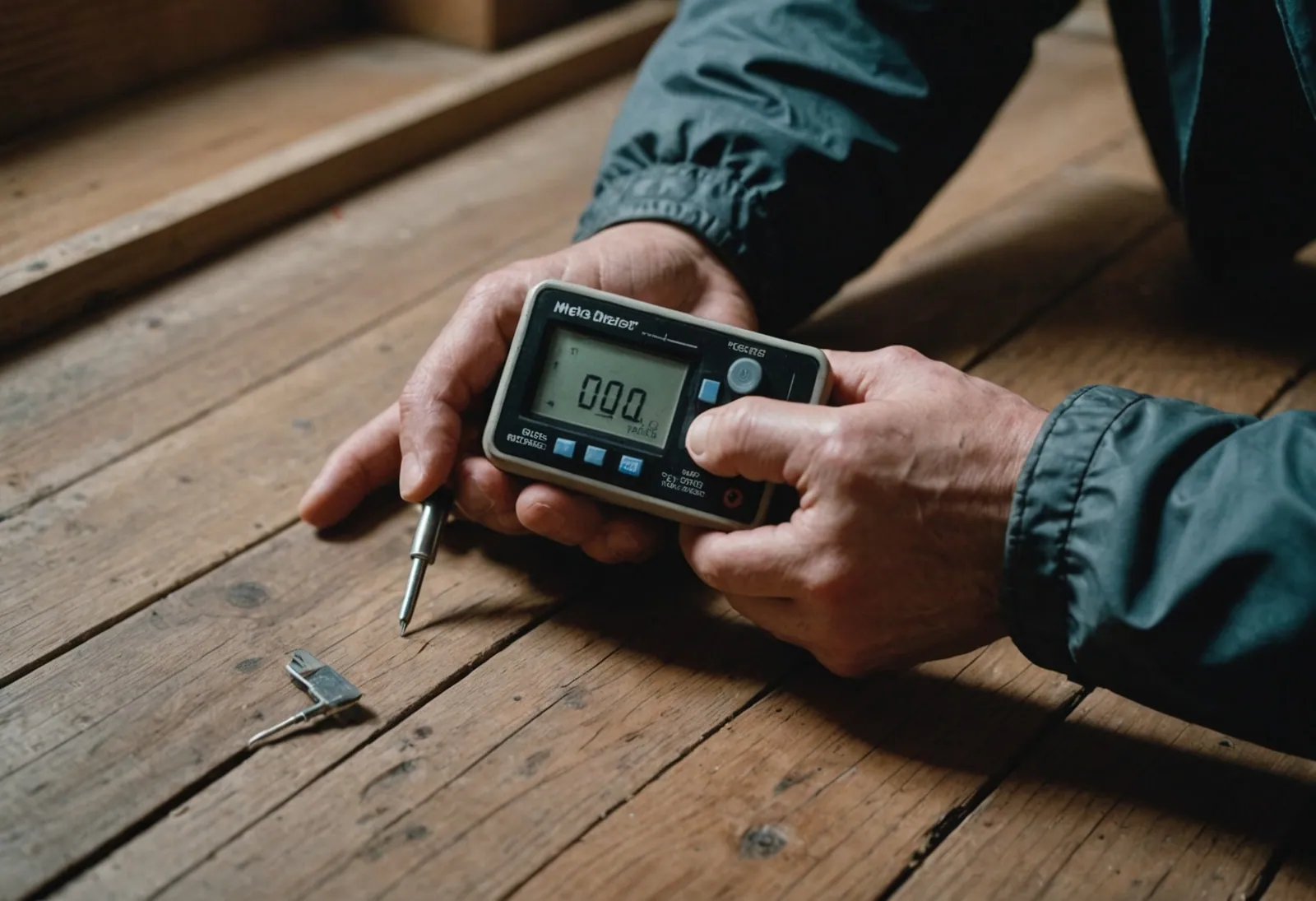
Pin meter wood scales and WME read percent moisture content. Pinless readings on wood are MC only on the wood scale with the right species setting; on other materials they are relative.
Drywall (gypsum board) and gypsum underlayment
| Material or condition | Reading | What it means | Source |
|---|---|---|---|
| Gypsum scale, Delmhorst BD-2100 LED bands | Green 0 to 0.5%; yellow 0.5 to 1%; red above 1% | Red is 'too wet for painting or wallpaper'; the only common consumer-accessible scale calibrated for gypsum. | Delmhorst BD-2100 owner's manual |
| Gypsum scale, Delmhorst guidance on drywall after a leak | Normal at 1% or lower; over 1% moisture-compromised; over 2% at any time, replace | Between 1 and 2% a board may be dried if it is dried quickly; the call belongs to someone experienced. | Delmhorst blog (Laurenzi), Oct. 2023 |
| WME scale on drywall, Protimeter | Dry 7 to 16.9; at risk 17 to 19.9; wet 20 and above | Protimeter applies its wood bands to non-wood materials read as WME. | Protimeter Surveymaster manual INS5365 |
| Consumer 'building materials' pin scale, General Tools MMD4E | Low 1.5 to 16.9%; mid 17 to 19.9%; high 20 to 33% with alarm | Not a gypsum percentage; a generic scale. Use it against a dry standard from an unaffected wall, not against the bands. | General Tools MMD4E manual |
| Pinless relative scales (Tramex ME5 0 to 100; Klein ET140 0 to 100; Protimeter search 70 to 999) | No absolute dry number | Relative readings; Tramex: find a known acceptably dry area to compare to. Field reaches through the board, so screws, corner bead and foil read as moisture. | Tramex ME5 user guide; Protimeter manual |
| Gypsum board that has been wetted (industry position) | No reliable gravimetric reading from a meter | Meters show relatively moist and relatively dry areas only. Replace water-exposed panels unless they can be dried before mold growth begins, typically 24 to 48 hours; floodwater or sewage exposure means replacement. | Gypsum Association GA-231 (rev. 2019) |
| Time to dry any wet material | Within 24 to 48 hours | EPA's homeowner guidance to prevent mold growth; keep indoor RH below 60%, ideally 30 to 50%. | EPA 402-K-02-003 |
| Gypsum concrete underlayment (gypcrete) | 1% or less conservative; some manufacturers allow up to 5% before flooring | Read it on a gypsum scale; confirm the limit with the flooring manufacturer. | Delmhorst blog (Laurenzi), Oct. 2023 |
Only a gypsum scale reports a percentage of the board itself. Every other reading on drywall is comparative, which is why the dry standard comes first.
Concrete slabs
| Material or condition | Reading | What it means | Source |
|---|---|---|---|
| In-situ relative humidity, ASTM F2170 | Probe at 40% of slab depth (20% if drying from both sides); read after at least 24 hours (was 72); slab at service conditions 48 hours first | The quantitative test flooring manufacturers specify; three tests for the first 1,000 sq ft and one more per additional 1,000. | Wagner Meters F2170 guidelines; Delmhorst, 2017; ForConstructionPros |
| In-situ RH limit for wood flooring | Greater than 75% RH requires a vapor retarder | NWFA's trigger; many wood flooring and adhesive makers set 75% as the ceiling. | NWFA Subfloor Guidelines (rev. 2016) |
| In-situ RH limits by flooring type (typical) | Wood glue-down 75% or less; rubber and vinyl about 80 to 85%; VCT about 85 to 95% | Always the manufacturer's installation document, not a generic number; the range across products runs from 75% to 99%. | Wagner Meters F2170 guidelines |
| Calcium chloride MVER, ASTM F1869 | Reported in lb per 1,000 sq ft per 24 h; 60 to 72 h exposure; 75 ±10°F and 50 ±10% RH for 48 h before and during; three tests per 1,000 sq ft plus one per additional 1,000 | Measures vapor emission from the surface only; not for gypsum concrete or lightweight-aggregate slabs. | ASTM F1869-23 |
| Calcium chloride limit for wood flooring | More than 3 lb requires a vapor retarder | NWFA trigger; adhesive makers publish their own limits, some higher. | NWFA Subfloor Guidelines (rev. 2016) |
| Calcium carbide (CM) test | Greater than 2.5% requires a vapor retarder | NWFA's third accepted method (ASTM D4944). | NWFA Subfloor Guidelines (rev. 2016) |
| Electrical impedance (pinless) concrete meters, ASTM F2659 | Comparative reading of the upper 1.0 in. only | A preliminary, comparative survey tool; the guide states it is not intended to provide quantitative results as a basis for acceptance of a floor. | ASTM F2659-23 |
| Tramex CME5 concrete scale | 0 to 6% moisture by mass, about 3/4 in. deep | Remove curing compounds and sealers first; readings through coatings are comparative; acceptable levels come from the adhesive or flooring maker. | Tramex CME5 user guide |
| Pin meter reference scale on concrete, Delmhorst BD-2100 | Green 0 to 85; yellow 85 to 95; red above 95; 85 to 95 is roughly 2 to 4% MC | Qualitative only; the manual states meters do not provide quantitative results for accepting a slab for moisture-sensitive flooring. | Delmhorst BD-2100 owner's manual |
Flooring is accepted on F2170 or F1869 results against the flooring manufacturer's limit. Meters, pin or pinless, locate wet areas and track drying; they do not accept a slab.
How to establish a dry standard in the house
The IICRC S500 standard, which restoration contractors and insurers work from, does not define dry as a fixed number. It defines a dry standard as a reasonable approximation of the moisture content or level of a material before the water intrusion, and a drying goal as the target moisture content or level to be reached at the end of drying. S500's accepted method for finding the dry standard is to measure similar materials in unaffected areas of the same building. Framing in a Phoenix house in June and framing in a Seattle house in November sit at different moisture contents, and both are dry; the EMC table in the first chart is why.
The procedure we used on every loss, and the one an adjuster will accept:
- Same material, same construction. Drywall against drywall of the same thickness on the same kind of framing; subfloor against the same subfloor; a joist against a joist. A dry standard taken on the wrong material is a random number.
- Same meter, same mode, same setting. Pin or pinless, wood scale or gypsum scale or relative, species setting unchanged. Write the mode on the log sheet. A reading taken in a different mode is not comparable, even on the same meter.
- Unaffected area on the same floor, same orientation. An exterior wall on the north side of the house is a better reference for another north exterior wall than a closet in the middle. Stay away from bathrooms, kitchens and the slab's cold corners unless that is what you are comparing to.
- Three or more points, averaged. Take readings at 6, 18 and 30 in. above the floor on a wall, or at three spots a few feet apart on a floor or joist, and average them. One reading is an anecdote.
- Record it before drying starts, with the date, the room, the meter, the mode and the ambient temperature and humidity. The adjuster and the contractor will both want this page.
- Set the drying goal from it. The goal is the dry standard or within a point or two of it; industry practice reads S500 as within about 10 percent of the unaffected material's reading. Published numbers in the tables above are the sanity check: if your dry standard on framing comes back at 22%, the house has a moisture problem that predates the leak.
- Dry until every marked point reaches the goal and holds there on the next day's reading. Moisture deep in a material migrates back to the surface overnight; a point that reads dry at 5 p.m. and wet at 8 a.m. was not dry. Our guide to how long to run fans and a dehumidifier after a leak covers the equipment side.
If there is no unaffected area, which happens in a whole-house flood, use the regional equilibrium figures from the Wood Handbook table (about 9% MC at 70°F and 50% RH) for wood and the gypsum-scale guidance for drywall, and say so in the log.
Where the sources disagree
| Question | The numbers in circulation | How we read it |
|---|---|---|
| Where wood becomes 'wet' | 16% (MMD4E alarm, ASHRAE 160 equivalent, mold minimum) / 17% (Delmhorst red) / 18% (Tramex audio) / 19% (builder's rule) / 20% (Protimeter red, decay threshold) | Each number answers a different question: mold risk begins near 16%, decay cannot start below 20%. Restoration practice uses 16% as the drying line for framing; your dry standard overrides all of them. |
| Dry drywall | Delmhorst: 1% or lower on a gypsum scale / Gypsum Association: meters cannot give a reliable gravimetric moisture content | Both are right: a gypsum scale is a useful comparative tool, not a laboratory measurement. Use it with a dry standard and GA-231's replacement rules. |
| F2170 equilibration time | 72 hours (editions before the 2014 precision study) / 24 hours (current) | Read the edition your flooring manufacturer names; older specifications still say 72. |
| Concrete RH limit | 75% (NWFA, most wood flooring) / 80 to 85% (many resilient products) / up to 95% (some VCT) | There is no universal concrete number; the product going on the slab sets it. |
| 'Dry' lumber vs dry framing | 19% or less (kiln-dried framing as delivered and the builder's close-in rule) / about 8 to 13% (framing in equilibrium with conditioned indoor air) | A stud reading 17% is dry by the lumber rule and wet by the restoration rule. After a loss, the in-service figure and your dry standard are the ones that count. |
None of these is an error. Different sources answer different questions, and meter makers set their bands conservatively.
What the numbers do not tell you
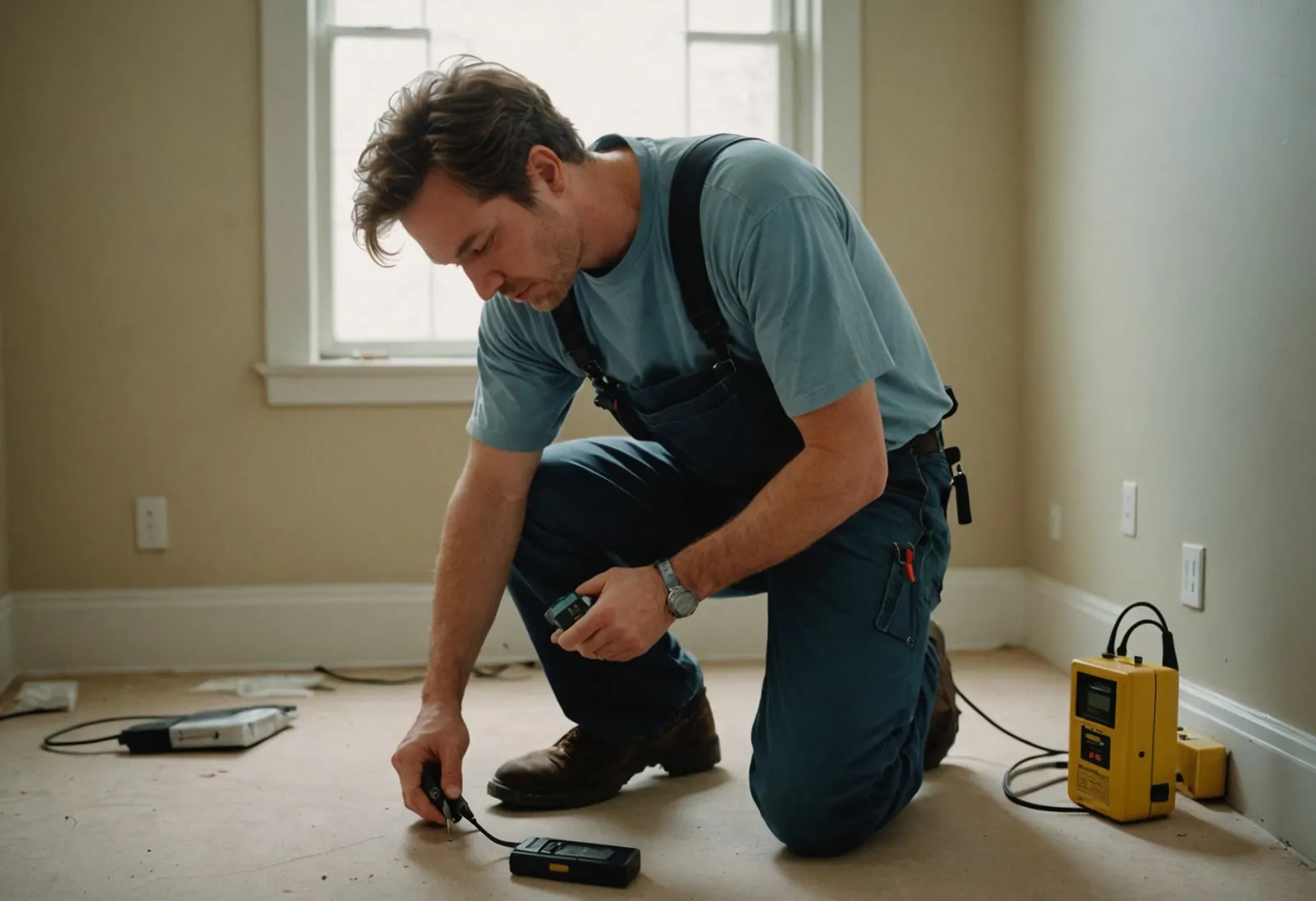
A dry reading at the surface is not a dry wall. Pins read 5/16 in. deep unless you fit deep-wall probes; a pinless pad averages about 3/4 in. Insulation, a sole plate behind the baseboard and the back of the drywall can stay wet after the face reads dry. Read low on the wall, and read the plate.
Metal lies. Screws, corner bead, foil-faced insulation, metal lath and conductive salts all read as moisture on both pin and pinless meters. Protimeter, Tramex and Delmhorst each say so in their manuals. A reading that spikes on a 16-in. grid is a stud line of screws, not a leak.
Temperature shifts the numbers. Delmhorst applies no correction between 50°F and 90°F; outside that range the manual's correction table applies. Cold framing in a crawl space reads low.
A gypsum reading does not restore a board. Drywall that has been saturated and dried will not read like new drywall on a gypsum scale, and the Gypsum Association's position is replacement unless the panel was dried before mold could start, typically within 24 to 48 hours. Our wet drywall: cut or dry guide walks through that decision.
Health claims stay procedural. EPA's guidance is to dry water-damaged materials within 24 to 48 hours and keep indoor humidity below 60%, ideally 30 to 50%. What a given reading means for anyone's health is not something a meter can tell you; if growth is visible or the smell is bigger than what you can see, follow the EPA do-it-yourself limits in our mold after water damage guide.
Sources
Every figure in the tables above comes from one of these documents, retrieved October 30, 2026.
- USDA Forest Service, Forest Products Laboratory. Wood Handbook: Wood as an Engineering Material, FPL-GTR-190 (2010), Chapter 4, Moisture Relations and Physical Properties of Wood (fiber saturation point; Table 4-2 equilibrium moisture content). research.fs.usda.gov/treesearch/37428
- Purdue Extension, FNR-163, The Shrinking and Swelling of Wood and Its Effect on Furniture (fiber saturation values by species). extension.purdue.edu/extmedia/FNR/FNR-163.pdf
- Morris, P. I. and Winandy, J. E. Limiting Conditions for Decay in Wood Systems, IRG/WP 02-10421, Forintek Canada and USDA Forest Products Laboratory (2002) (decay above 30%, none below 20%, mold minimum about 16%). fpl.fs.usda.gov/documnts/pdf2002/morri02a.pdf
- Home Innovation Research Labs. How Wet Is Too Wet? (ASHRAE 160's 80% surface RH and its 16% solid-wood, 14% plywood and 13% OSB equivalents; the 20% decay margin). homeinnovation.com/insights/blog/how-wet-is-too-wet/41305
- Risinger, M. What Happens if Your Framing Gets Rained On?, Fine Homebuilding (2013) (19% rule, 12 to 14% kiln-dried delivery, 10 to 12% in service). finehomebuilding.com/item/26842
- Delmhorst Instrument Co. BD-2100 Owner's Manual, form 510INS-0006 (wood, gypsum and reference scale bands; concrete reference readings; calibration and temperature correction). res.cloudinary.com/iwh/.../Delmhorst_BD-2100_Owners_Manual.pdf
- Laurenzi, T. What's the Ideal Moisture Content of Drywall/Gypcrete?, Delmhorst (October 2023). res.cloudinary.com/iwh/.../Whats_the_Ideal_Moisture_Content_of_Drywall-Gypcrete.pdf
- Protimeter. Surveymaster BLD5365 Instruction Manual, INS5365 Rev. A (June 2013) (WME definition and bands, search mode, false positives, calibration check). core.instrumart.com/assets/BLD5365-manual.pdf
- Tramex. Moisture Encounter 5 User Guide (scales, depth, comparative readings, metal, species basis). tramexmeters.com/.../tramex-moisture-encounter-5-user-guide.pdf
- Tramex. CME5 Concrete Moisture Encounter User Guide (0 to 6% by mass, 3/4-in. depth, surface preparation). tramexmeters.com/perch/resources/cme5-a-online-user-guide.pdf
- General Tools. MMD4E Moisture Meter User Manual (ranges, LED bands, alarm points, calibration check). images.toolsid.com/general-tools/items/pdf/mmd4e-manual.pdf
- Gypsum Association. GA-231, Assessing Water Damage to Gypsum Board (rev. 2019), summarized at gypsum.org/2019/05/moisture-in-gypsum-panel-products
- U.S. EPA. A Brief Guide to Mold, Moisture, and Your Home, EPA 402-K-02-003. epa.gov/sites/production/files/2016-10/documents/moldguide12.pdf
- Woolen, J. What Is Acceptable Dry?, Restoration and Remediation (June 2021), quoting the IICRC S500 fifth-edition definitions of dry standard and drying goal. randrmagonline.com/articles/89445-what-is-acceptable-dry
- National Wood Flooring Association. Subfloor Guidelines and Specifications (rev. February 2016) (subfloor MC tolerances; calcium chloride, RH and CM vapor-retarder triggers). NWFA Guide 3 PDF
- Wright, J. A Wood Floor Installer's Guide to Moisture Testing, Hardwood Floors Magazine (August 2024) (6 to 9% flooring range; 2% and 4% tolerances; test density). hardwoodfloorsmag.com/2024/08/09/a-wood-floor-installers-guide-to-moisture-testing
- ASTM International. F1869-23, Standard Test Method for Measuring Moisture Vapor Emission Rate of Concrete Subfloor Using Anhydrous Calcium Chloride, scope and procedure excerpt. ASTM F1869-23 sample
- ASTM International. F2659-23, Standard Guide for Preliminary Evaluation of Comparative Moisture Condition of Concrete, Gypsum Cement and Other Floor Slabs and Screeds Using a Non-Destructive Electronic Moisture Meter, scope. store.astm.org/f2659-23.html
- Wagner Meters. 10 Guidelines for ASTM F2170 Concrete Testing and Preparation (probe depth, 24-hour equilibration, 48-hour service conditions, test counts, typical RH limits by flooring type). wagnermeters.com/.../10-guidelines-for-astm-f2170-compliance
- Delmhorst. Top 6 Things You Need to Know About ASTM F2170 (December 2017) (40% depth, 24-hour change from 72). delmhorst.com/blog/top-6-things-you-need-to-know-about-astm-f-2170
- ForConstructionPros. Updated ASTM F2170 Reflects the Newest Science about RH Testing (the 2014 precision and bias study behind the 24-hour reading). forconstructionpros.com/concrete/article/21007065
Methodology note. We compiled the tables from the documents above rather than from our own instrument tests; where a manufacturer publishes a band we quote the band, and where a standard sets a procedure we quote the procedure. Restoration framing from our years running a water-damage company is marked as practice, not as a published figure. We re-check these sources when a manual or standard is revised.
Frequently asked questions
What is an acceptable moisture reading for drywall?
On a pin meter with a true gypsum scale, Delmhorst's bands put dry drywall at 0 to 0.5%, borderline at 0.5 to 1% and wet above 1%, and its guidance treats board over 1% as moisture-compromised and board over 2% at any time as a replacement. On a WME scale, Protimeter calls 7 to 16.9 dry and 20 and above wet. On a pinless meter the number is relative and only means something against a reading from a dry wall of the same construction in the same house. The Gypsum Association adds that no meter gives a reliable gravimetric moisture content for gypsum board.
What is an acceptable moisture content for wood framing?
Dry framing in a conditioned house sits at the equilibrium moisture content for the indoor air: about 8 to 13% at 70°F between 40 and 70% relative humidity per the USDA Wood Handbook, and typically 10 to 12% after a year of HVAC. Restoration practice treats framing above 16% as still wet, Delmhorst's red band starts at 17%, Protimeter's at 20%, and the Forest Products Laboratory's decay research puts the safe line at 20% with decay above 30%. Your dry standard from unaffected framing in the same house overrides all of them.
What is an acceptable moisture reading for a concrete slab?
For flooring, the accepted answers come from ASTM F2170 in-situ relative humidity probes or ASTM F1869 calcium chloride tests, compared with the flooring manufacturer's limit. The NWFA requires a vapor retarder above 75% RH or above 3 lb per 1,000 sq ft per 24 hours; many resilient products allow 80 to 85% RH. A pinless concrete meter such as the Tramex CME5 (0 to 6% by mass, about 3/4 in. deep) or a pin meter's reference scale is a comparative survey tool; ASTM F2659 says such readings are not a basis for accepting a floor.
What does a reading of 70 or 300 on a pinless moisture meter mean?
By itself, nothing. Pinless meters on drywall, plaster and masonry report a relative number (0 to 100 on a Tramex or Klein, 70 to 999 in Protimeter's search mode) that is not a percentage of anything. It becomes meaningful when you take the same reading, with the same meter in the same mode, on the same material in a part of the house that did not get wet. A wall that reads 25 where the dry wall reads 20 is close to dry; one that reads 70 against a 20 dry standard is wet. Confirm the wettest spot with pins.
How do I know when a material is dry after a leak?
When every marked reading point on it is at or within a point or two of the dry standard you took from the same material in an unaffected area before drying started, using the same meter and mode, and the next day's reading is the same or lower. The IICRC S500 defines the dry standard as the approximate pre-loss moisture level of the material and the drying goal as the target at the end of drying; industry practice treats a drying goal met within about 10 percent of the unaffected reading. Surface readings on day three that climb back overnight mean the material is not done.
The seasonal checklist, by email
One email when the season changes — freeze week, spring thaw, hurricane season — with the checklist for that month. No weekly newsletter, no selling your address.
We send one confirmation link first. Every email has a one-click unsubscribe. Privacy.
Check your inbox for the confirmation link; the checklist follows as soon as you click it.
You are on the list. The next email arrives when the season changes.
That did not go through. Check the address and try again.
DryHomeLab is written and reviewed by the team behind HelpMeNow.com, a marketplace that connects homeowners with vetted local contractors for water-damage restoration, plumbing and waterproofing. Before HelpMeNow the same team ran a 24/7 water-damage restoration company in the Seattle area; the equipment on this site is what we specified, bought and ran on real water losses. We publish the rubric behind every score.
- Ran a 24/7 water-damage restoration company, Seattle area
- Operate HelpMeNow.com, a contractor marketplace
- Publishes its scoring rubric