

Fix the moisture first, or nothing else matters
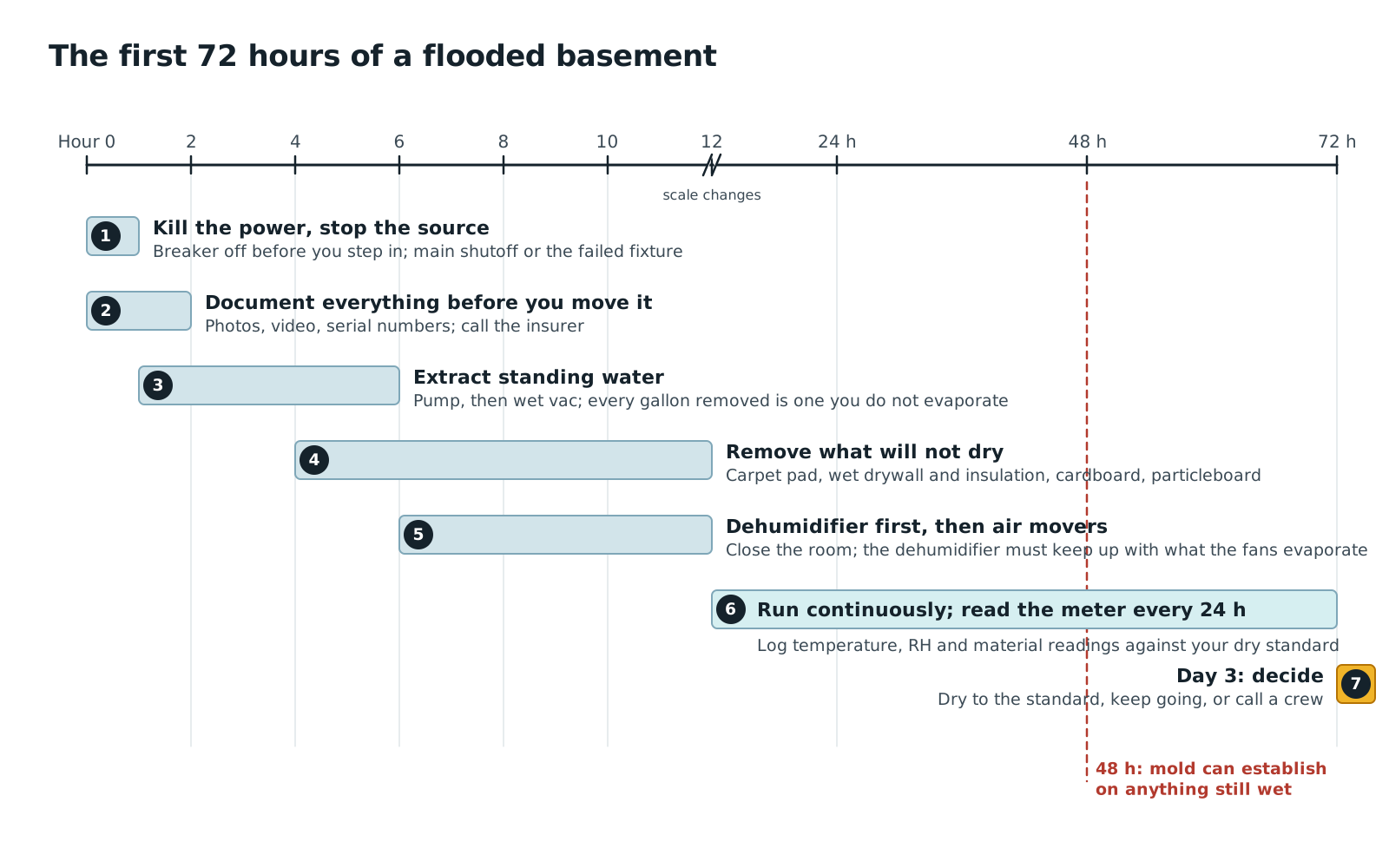
Every line of EPA's mold guidance starts from the same fact: mold needs water, and it will come back as long as the water does. Its homeowner guide says to fix leaks and other water problems as soon as possible and to dry water-damaged areas and items within 24 to 48 hours to prevent mold growth. Cleaning growth off a wall that is still wet, or that gets wet again next time it rains, is a chore you will repeat every few weeks until the drywall is gone.
So the order is fixed. Stop the source: the valve, the appliance, the roof, the grading. Dry the materials that can be dried, with air movers and a dehumidifier and a moisture meter to prove it, which is the subject of our 72-hour drying guide and the fans-and-dehumidifier schedule. Only then deal with whatever grew. If you found the leak late and growth is already there, drying and removal happen together, but the drying still has to finish; a remediated wall that stays damp is a remediated wall for about a month.
The timeline below is the one restoration crews work to. The 24-to-48-hour window is EPA's; the 72-hour mark is where restoration practice starts treating a wet material as a mold question as well as a drying question.
The 10 square foot rule, and what it does not say
EPA's homeowner guide, A Brief Guide to Mold, Moisture and Your Home, says that if the moldy area is less than about 10 square feet, roughly a 3 ft by 3 ft patch, in most cases you can handle the job yourself. Above that, or where there has been a lot of water damage, it points to its longer document, Mold Remediation in Schools and Commercial Buildings, which is the reference contractors use and which escalates containment and protective equipment through small (under 10 sq ft), medium (10 to 100 sq ft) and large (over 100 sq ft) jobs.
The same homeowner guide adds four conditions that move a job out of the DIY column no matter how small it looks. If the water was sewage or otherwise contaminated, call a professional who has experience with buildings damaged by contaminated water. If you know or suspect the HVAC system is contaminated, do not run it, and have it inspected before you do. If you have health concerns, consult a health professional before starting the cleanup. And if you suspect hidden mold, behind wallpaper or paneling, on the back of drywall, under carpet and pad, EPA's advice is to consider hiring an experienced professional, because opening those areas releases spores.
What the rule does not say is that 10 square feet of visible growth means 10 square feet of mold. Growth on the face of drywall is usually the last place it appeared; the back of the board, the paper against the studs and the insulation behind it have been growing longer. Ten square feet on the front of a wall is often a hundred behind it, which is why the question below the size question is always: what is behind this, and how long has it been wet?
The industry standard a remediation contractor works to is IICRC S520, the Standard for Professional Mold Remediation. Its vocabulary is useful even for a homeowner: Condition 1 is a normal indoor environment, Condition 2 is a surface with settled spores but no growth, and Condition 3 is actual growth. The point of remediation is to return Condition 3 and Condition 2 areas to Condition 1 by removing the growth, not by killing it in place.
Clean it or throw it out, by material
EPA's instruction for hard surfaces is to scrub the mold off with detergent and water and dry completely. For absorbent or porous materials, its wording is that they may have to be thrown away if they become moldy, and in restoration practice that "may" becomes "do" for anything that was wet long enough to grow. The table sorts the common materials.
What gets cleaned and what gets removed
| Material | Porosity | What to do | Why |
|---|---|---|---|
| Tile, glass, metal, sealed concrete, plastic, finished hardwood surface | Non-porous | HEPA vacuum, scrub with detergent and water, rinse, dry; HEPA vacuum again | Growth sits on the surface and comes off |
| Framing lumber, plywood and OSB subfloor, exposed concrete block, rough concrete | Semi-porous | HEPA vacuum, damp-wipe or scrub with detergent, dry to under 16% with a meter; pros sand, wire-brush or media-blast surface growth | Growth is shallow; the material is structural and dries |
| Drywall, plaster board, ceiling tiles | Porous | Remove 12 to 24 in beyond visible growth and wet readings; bag at the source | Paper facing and gypsum core cannot be cleaned; growth continues on the back |
| Fiberglass, cellulose and mineral wool insulation | Porous | Remove and bag; replace when framing meters dry | Holds water against framing; cannot be cleaned |
| Carpet and pad, upholstered furniture, mattresses, drapes | Porous | Remove and discard if moldy or wet more than about 48 hours (pad always) | Cannot be cleaned through; EPA lists carpet as a discard example |
| Paper, cardboard, books, particleboard and MDF furniture | Porous | Discard if moldy; photograph for the claim first | Absorb water through and swell; cleaning is cosmetic |
| Painted trim and solid-wood furniture | Semi-porous | Clean and dry; discard if growth is inside joints or the wood has swelled | Finish protects the surface; raw end grain does not |
Porous goes out; non-porous gets cleaned; semi-porous gets cleaned and dried with a meter to prove it. When in doubt about a porous material, the bag is cheaper than the second visit.
A small cleanup done properly (under 10 square feet, clean water)
- 1
Confirm the water is stopped and the area is drying
Put a pin meter on the wall and the framing around the growth and compare with a dry wall elsewhere in the house, the way our moisture meter guide describes. If readings are rising, the leak is not fixed and cleaning is pointless; if they are wet but falling, set up the dehumidifier and air movers so drying runs while you work. Photograph everything before you touch it if there is any chance of a claim.
- 2
Put the protective equipment on before you disturb anything
EPA's homeowner guide recommends an N-95 respirator to limit what you breathe, goggles without ventilation holes, and long gloves to the middle of the forearm; for cleaning solutions it names natural rubber, neoprene, nitrile, polyurethane or PVC. Add disposable coveralls so you are not carrying spores to the rest of the house on your clothes. A P100 half-mask filters better than an N95 and seals better with a beard-free face; either must fit tightly to work.
- 3
Contain the room
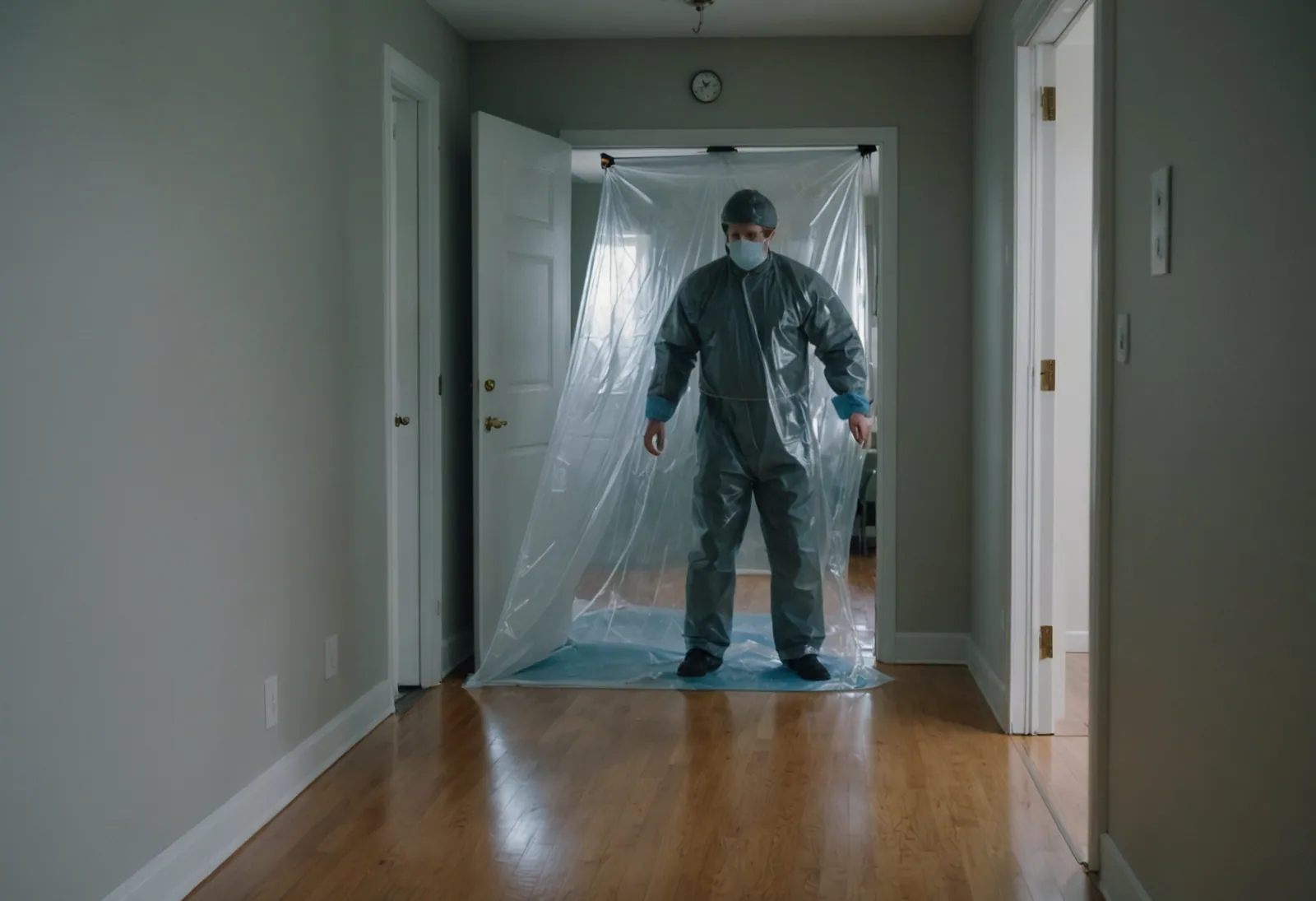
Close the door and tape 6-mil plastic over it with a slit to pass through, tape plastic over every HVAC supply and return in the room, and turn the system off while you work; EPA's guidance is not to run the HVAC if you suspect it is contaminated, and a running return will pull your dust through the whole house. Put a box fan in a window blowing out, with the gaps around it sealed, so the room runs at slight negative pressure and anything you stir up goes outside. Cover the floor path to the exit with plastic. This is the homeowner version of the containment and negative air a crew sets up for a bigger job.
- 4
Remove the porous materials, bagging as you go
Lightly mist the surface with water from the spray bottle so you are cutting damp material rather than raising dust. Remove baseboard, then cut the drywall 12 to 24 in past the visible growth and past the last wet meter reading, rounding to 16, 24 or 48 in from the floor so the patch lands on a sheet dimension; our wet drywall guide covers the cut. Pull wet or discolored insulation to above the wet line. Bag everything at the spot where you remove it, in heavy bags, and seal each bag before it leaves the containment; double-bag anything crumbly. Carry bags out through the window if there is one rather than through the house.
- 5
Clean what stays
HEPA vacuum the framing, the back of the remaining drywall and the plate channel. Scrub the studs, plate and any hard surface with detergent and water and a brush, wipe with clean water, and let the air movers dry it. HEPA vacuum again once it is dry. Visible staining in the wood is often permanent and is not the same as live growth; pros sand or wire-brush it off and so can you, with the respirator on and the vacuum running. Do not reach for bleach: EPA says the use of a biocide such as chlorine bleach is not recommended as a routine practice during mold cleanup, that it is not enough to simply kill the mold, it must be removed, and that dead mold can still cause reactions. Water-based bleach solutions also soak porous materials you are trying to dry.
- 6
Dry it and prove it
Leave the dehumidifier and at least one air mover running on the open cavity until the framing reads at the dry standard, typically three to five days for studs and longer for a sole plate on a slab; restoration practice wants framing under 16 percent before it is closed. Readings that stop falling mean something wet is still in the wall. Do not insulate, close or paint until the numbers say so; EPA's guide is explicit that you should not paint or caulk moldy surfaces, and paint over damp framing peels and hides the next round of growth.
- 7
Clear the containment
With the cavity dry and clean, wipe the plastic down, fold it inward on itself and bag it, HEPA vacuum the floor and the path out, and bag the coveralls and gloves last. Shower. Run the dehumidifier another day in the room with the door open. The wall is ready for new insulation, drywall, a stain-blocking primer and paint; keep the meter photos and the bagged-material photos in the claim file.
What not to do
- Bleach as the cleanup. It is not a routine mold cleanup method in EPA's guidance, it does not penetrate porous material, it adds water to drywall and wood, and it does not remove anything. Detergent, scrubbing and removal do the work. Never mix bleach with ammonia or other cleaners.
- Painting, caulking or sealing over it. EPA's guide says not to; the growth continues underneath and the moisture is trapped where the meter cannot see it. Encapsulant coatings have a place at the end of a professional remediation on cleaned, dry wood, not as a substitute for removal.
- Ozone generators and foggers. EPA's guidance on ozone generators sold as air cleaners is that at concentrations within public health standards ozone does not effectively remove mold, that it would take 5 to 10 times those limits to do more than inhibit growth while the ozone is present, and that even then it may have no effect on growth embedded in porous material. Fogging a room with any product does not remove the drywall that is growing it.
- Running the HVAC through it. A return in the work room sends the dust everywhere, and a contaminated air handler or duct re-seeds every room it serves; EPA says not to run a system you suspect is contaminated.
- Dry-sanding or demolishing without containment. The cleanup turns a wall problem into a house problem.
- A shop vac without a HEPA filter. The exhaust is a spore sprayer.
- Leaving the pad, the batts or the back half of the drywall because the front looks clean. The front is the last thing that grows.
Signs it is bigger than it looks
Stop and reassess if any of these are true, because the job has left the 10 square foot column whether or not you can see it:
- A musty smell with little or no visible growth. The growth is inside a cavity, under a floor, or behind a finish. Smell is a better detector than your eyes for hidden mold.
- Growth on the back of a baseboard or a piece of trim you pulled. The wall behind it is wet lower and farther than the stain.
- The leak ran for a while. A supply line that dripped for a month, a roof that leaked all winter, a slow dishwasher leak. Time wet matters more than volume.
- It is on a ceiling or an exterior wall with insulation. The cavity above or behind is wet and cannot be dried from the room.
- Staining or dust at supply registers, or a smell when the system runs. EPA treats HVAC contamination as a professional job.
- More than one room, or growth that returned within weeks of a cleanup. Something is still wet or still leaking.
- Anyone in the house with asthma, allergies or a weakened immune system. EPA's guidance is to consult a health professional before starting; the practical version is that those people should not be in the house during the work, and the margin for a sloppy job is gone.
Does testing matter?
Less often than the people selling it suggest. EPA's homeowner guide says that in most cases, if visible mold growth is present, sampling is unnecessary, and it notes there are no federal limits for mold or mold spores to compare a result against. Testing earns its cost in a few situations: when you smell growth and cannot find it, where an inspector with a moisture meter, a borescope and air or surface samples can locate it; after a professional remediation on a large or contaminated-water job, where an independent assessor's post-remediation verification is how you know the containment can come down; and in landlord-tenant, real estate or insurance disputes where a third party's report is the evidence. A handful of states, Texas, Florida and New York among them, license mold assessors and remediators and require the company that assesses to be separate from the company that remediates; check your state before you hire either.
A home test kit that grows colonies in a dish tells you there are spores in the air, which is true of every house on earth. It does not tell you how much, where the growth is, or whether the wall needs to come out. A moisture meter answers more of those questions than a petri dish does.
General Tools MMD4E Digital Pin Moisture Meter
The cheap pin meter that is accurate enough to tell you whether to open a wall.
Best for homeowners who want one accurate, verifiable meter for leaks and the occasional firewood check.
Score breakdown
| Calibration check | true | 10.0 |
| Published accuracy | 2 | 7.5 |
| Versatility | pin | 7.0 |
| Professional grade | false | 0.0 |
| Scan depth | n/a | — |
| Warranty | 1 | 2.0 |
| Reading hold | true | 10.0 |
| Backlight | true | 10.0 |
| Temperature / RH | false | 0.0 |
Stars are DryHomeLab's rating from the published rubric (score ÷ 2, to the half star). Not a customer rating.
- Manufacturer-rated ±2% accuracy, unusual at this price
- Calibration check holes in the pin cap (18.3% reference)
- Backlight, hold, audible alarm and auto power-off
- Two scales: wood 5–50% and building materials 1.5–33%
- Pin holes in every surface you test
- No species or temperature correction
- One-year warranty
- Reads only the surface unless the pins penetrate
The MMD4E is the pin meter most homeowners end up with, and for once the popular choice is a sound one. General Tools rates it at ±2% across a 5 to 50% range for wood and 1.5 to 33% for building materials, with a backlit LCD, a hold button, an audible alarm that trips at 16% in wood and 20% in building materials, and auto power-off after three minutes. It runs on a 9 V battery and the pins are replaceable.
The feature that earns it a place on a professional's list is the calibration check built into the pin cap: press the pins into the two holes and the meter should read 18.3% ±1% in wood mode. That is a real check against a fixed resistor, not a self-test light, and it is why we trust this meter more than pinless meters at the same price that cannot be verified at all.
What it will not do: it reads only where the pins touch, so you leave two small holes per reading and you only learn about the surface layer unless you drive the pins through paint into the paper and gypsum. It has no species or temperature correction, so treat wood readings as approximate and always compare with a dry reference area in the same house. The one-year warranty is short.
Buy it if you want to know, today, whether the drywall behind the washing machine is wet. Pair it with a pinless meter if you need to scan a whole room without leaving marks.
Customer reviews: read them on Amazon (paid link). We link to them and never copy or score them.
When to stop, and what a proper remediation includes
Stop and call a remediation contractor when the growth is more than about 10 square feet or you suspect it extends into cavities you cannot see; when the water was sewage, floodwater or anything else contaminated; when the HVAC system or ductwork is involved; when someone in the home has a health condition that makes exposure a concern; when the growth came back after a cleanup; or when the loss is an insurance claim and the insurer wants a protocol and a clearance report. Many policies cap what they pay for mold, so the documentation of when the water happened and how fast it was dried matters more than usual; our claim checklist covers it.
A contractor working to IICRC S520 will: assess the moisture source and the extent of growth, with a meter and often a thermal camera; build containment with plastic and negative air machines exhausting through HEPA filters, so the work area is at lower pressure than the house; wear and dispose of the protective equipment above; remove and bag porous materials rather than treat them in place; HEPA vacuum, clean and where needed sand or abrade semi-porous surfaces; dry the structure to a documented dry standard; and have the work verified, on larger jobs by an independent assessor, before the containment comes down. Ask for each of those in the scope. If a quote is mostly fogging, spraying or a coating, with little demolition and no drying log, it is not a remediation.
When to call a pro
Call a restoration or remediation contractor for any of the stop conditions above, and call one first if the water is still coming in and you have not found the source; the drying has to start inside the first 48 hours and the mold question usually answers itself once the walls are open and metered. Call a plumber or a roofer for the source. Ask your physician, not a contractor, about health questions. The form below reaches vetted local restoration contractors through HelpMeNow.com; describe what you see, how long it has been wet, and where the water came from.
Frequently asked questions
Can I remove mold myself after a water leak?
EPA's homeowner guidance says that if the moldy area is less than about 10 square feet, roughly a 3 by 3 ft patch, in most cases you can handle it yourself, with an N-95 respirator, goggles and long gloves, provided the water was clean, the HVAC system is not involved and nobody in the house has health concerns that make exposure a problem. Fix the leak and dry the area first, contain the room, remove and bag porous materials like drywall and insulation, scrub hard surfaces with detergent and water, and dry the framing with a meter to prove it. Larger, hidden or contaminated-water growth is a job for a remediation contractor.
Should I use bleach to clean mold on drywall?
No. EPA says that using a biocide such as chlorine bleach is not recommended as a routine practice during mold cleanup, and that it is not enough to kill mold, it must be removed. Bleach solution is mostly water, so it soaks the drywall and framing you are trying to dry, it does not reach the growth on the back of the board or in the insulation, and the stain it lightens is not the problem. Moldy drywall is cut out and bagged; the framing behind it is HEPA vacuumed, scrubbed with detergent and water, and dried to a metered standard.
How long after water damage does mold start to grow?
EPA's guidance is to dry water-damaged materials within 24 to 48 hours to prevent mold growth, and restoration practice treats 72 hours as the point where a wet porous material becomes a removal question rather than a drying question. The clock runs from when the material got wet, not when you noticed it, which is why a slow leak found after weeks is a mold job even if the wall looks clean. Growth starts on the back of drywall, in the pad under carpet and in insulation before it shows on a visible surface.
Do I need a mold test after water damage?
Usually not. EPA's homeowner guide says that if visible mold growth is present, sampling is unnecessary in most cases, and there are no federal limits to compare a result against. Testing is worth paying for when you smell growth but cannot find it, when an independent assessor verifies a professional remediation before containment comes down, and in disputes with a landlord, seller or insurer. A moisture meter, which tells you whether the wall is still wet and where, answers more useful questions than a home test kit that grows colonies in a dish.
What does professional mold remediation involve?
A contractor working to IICRC S520 finds and documents the moisture source and the extent of growth, builds plastic containment with negative air machines exhausting through HEPA filters, removes and bags porous materials such as drywall, insulation, carpet and pad, HEPA vacuums and cleans or abrades the framing and other semi-porous surfaces, dries the structure to a documented dry standard with equipment and daily moisture logs, and on larger jobs has the work verified by an independent assessor before containment comes down. A scope that is mostly spraying, fogging or coating with little removal and no drying log is not a remediation.
Does homeowners insurance cover mold after a leak?
Often only partly. Many policies cover mold that results from a covered sudden water loss, such as a burst pipe, but cap the amount, and most exclude mold from long-term leaks, humidity, groundwater or neglected maintenance. The documentation that matters is proof of when the water happened and how fast it was dried: photos with dates, the plumber's invoice, equipment rental receipts and a daily moisture log. Report the water loss immediately rather than waiting until growth appears, and ask the adjuster specifically about the mold limit on your policy.
The seasonal checklist, by email
One email when the season changes — freeze week, spring thaw, hurricane season — with the checklist for that month. No weekly newsletter, no selling your address.
We send one confirmation link first. Every email has a one-click unsubscribe. Privacy.
Check your inbox for the confirmation link; the checklist follows as soon as you click it.
You are on the list. The next email arrives when the season changes.
That did not go through. Check the address and try again.
DryHomeLab is written and reviewed by the team behind HelpMeNow.com, a marketplace that connects homeowners with vetted local contractors for water-damage restoration, plumbing and waterproofing. Before HelpMeNow the same team ran a 24/7 water-damage restoration company in the Seattle area; the equipment on this site is what we specified, bought and ran on real water losses. We publish the rubric behind every score.
- Ran a 24/7 water-damage restoration company, Seattle area
- Operate HelpMeNow.com, a contractor marketplace
- Publishes its scoring rubric