

The short answer, by climate
Humid climates (the Southeast, Gulf Coast, Mid-Atlantic, and most of the Midwest and Northeast in summer): close the vents year-round, cover the ground with a sealed vapor retarder, and give the space a way to dry: a dehumidifier or conditioned air from the house. Open vents in July add water to the crawl space; they do not remove it.
Dry climates (the interior West and Southwest): open vents work most of the time, because the outside air is drier than the crawl space for most of the year. Cover the ground anyway, and close the vents for hard freezes if there is plumbing down there.
Marine Northwest: vented crawl spaces can stay dry here. Washington State University's monitoring found vented crawl spaces in Vancouver and Moses Lake rarely, if ever, reached dew point, with no moisture buildup in the framing. If yours is dry with the vents open and the ground covered, leave it; if it is not, close it and dry it like a humid-climate space.
Cold climates with pipes or ducts in the crawl space: close them for the winter at minimum, and consider a sealed, wall-insulated crawl space so the plumbing lives inside the heated envelope.
The vents were never the moisture control; the ground cover and the drying mechanism are. The rest of this guide is the reasoning and the work.
What vents were supposed to do, and why dew point defeats them
Foundation vents date from the idea that outside air blowing through the crawl space carries moisture out. That works only when the outside air is drier than the crawl space, and a crawl space in summer is a cool place: the soil keeps it in the 60s, and air-conditioning ducts run colder than that. Air does not care about relative humidity; it condenses on any surface colder than its dew point. The table shows what happens to ordinary summer air when it meets a 60 to 65°F joist or duct.
Summer air through an open vent
| Outside air | Dew point | On a 65°F joist | On a 60°F duct |
|---|---|---|---|
| 90°F, 60% RH (a humid afternoon) | 74°F | Condenses | Condenses |
| 80°F, 70% RH (a muggy morning) | 69°F | Condenses | Condenses |
| 75°F, 85% RH (after a storm) | 70°F | Condenses | Condenses |
| 90°F, 30% RH (a dry-climate afternoon) | 54°F | About 69% RH, no condensation | About 82% RH, damp but no dew |
| 70°F, 50% RH (a dry fall day) | 51°F | About 59% RH, drying | About 71% RH, no dew |
Any outside air with a dew point above the temperature of the ducts and framing wets them when it enters. In humid climates that is most summer days; in dry climates it is almost none.
The field data match the table. Advanced Energy's study of twelve identical houses in the humid Southeast, part of the Building America research program, left four crawl spaces wall-vented with a ground cover and closed the rest. Over the summer of 2003 the wall-vented crawl spaces were above 70 percent relative humidity 98 percent of the time and above 80 percent for 86 percent of the time, and repeatedly reached condensing conditions; the closed crawl spaces were above 70 percent only 5 percent of the time and never reached condensation. Over the following eleven months the closed-crawl-space houses used 15 to 16 percent less electricity for heating and cooling, and the Department of Energy's Building America summary credits the approach with 15 to 18 percent savings and a humidity reduction of more than 20 percent. That research put the unvented crawl space into the 2009 and 2012 editions of the International Residential Code as Section R408.3.
It matters for the wood because framing in a dry crawl space reads about 8 to 14 percent moisture content on a pin meter, and the USDA Forest Products Laboratory's rule of thumb is that wood above about 19 percent can support mold growth. A crawl space that spends the summer above 80 percent relative humidity pushes the joists past that line by August.
What the data does not say is that closing vents alone fixes anything. The closed spaces in the study had a sealed liner and a measured supply of conditioned air; a closed crawl space over bare dirt with no drying mechanism is a terrarium. The same WSU monitoring that found vented crawl spaces dry in the marine Northwest measured radon in closed crawl spaces without an exhaust fan at roughly ten times the vented level, and found that about 40 percent of the air in those houses had come up from the crawl space. Closing the vents makes the crawl space part of the house, and it has to be treated like one.
Measure before you decide
Three readings settle the question for your house better than any map.
Crawl space humidity. A hygrometer that logs or holds a maximum, in the middle of the space, off the ground and away from a vent, for a week in summer. The EPA's guidance for indoor spaces is to keep relative humidity below 60 percent, ideally 30 to 50; a crawl space running in the 70s and 80s with the vents open is being wetted by them.
Duct and joist temperature against the outdoor dew point. An infrared thermometer on the supply ducts and the underside of the subfloor at the perimeter, compared with the dew point in the forecast. If the duct reads 58°F and the dew point is 70°F, every cubic foot of outside air that touches it leaves water behind.
Framing moisture content. A pin meter in a floor joist and the subfloor at three or four points, especially under bathrooms and at the perimeter. Dry framing reads 8 to 14 percent; above 16 percent the space has a moisture problem whatever the vents are doing; at 20 percent or more, or with visible growth, you are in remediation territory, and the crawl space humidity guide covers that boundary.
Look while you are down there: droplets or rust streaks on the ducts, batts sagging out of the joist bays from the weight of absorbed water, growth on the joists, a water line on the piers, and the smell.
Winter: close them everywhere
Open vents in winter are a wind tunnel across the water lines. The Insurance Institute for Business & Home Safety puts the point where unprotected pipes in unheated spaces begin to freeze at about 20°F outdoors, and a crawl space with open vents on a windy night gets there. Close and cover the vents before the first hard freeze, sleeve the pipes and air-seal the rim; the routine is in our pipe winterizing checklist. Winter air is dry, so closed vents cost nothing in moisture, and the floors above feel warmer.
Summer: humid climates close, dry climates can vent
In a humid climate the summer decision is the one the table makes: close the vents and dry the space with a dehumidifier or conditioned air. In a dry climate, where summer dew points sit in the 40s and 50s, open vents move drier air through and the ground cover does the rest; close them during monsoon weeks if your region has them. In the marine Northwest, test rather than assume: a week of readings under 60 percent with the vents open means the vents are not hurting you.
Automatic vents: what they fix and what they do not
Temperature-actuated foundation vents use a bimetal coil, no electricity, to open as the air warms and close as it cools; the common Temp-Vent design is fully open at about 70°F and fully closed at about 40°F. That solves the freezing half of the problem without anyone crawling around the house in November. It does nothing for the moisture half, because the vent is open exactly when the outside air is warmest and wettest and the ducts are coldest. In a humid climate an automatic vent is a convenience for a crawl space you have decided to keep vented, not a moisture strategy.
Tools and materials for closing the vents
- Rigid foam board (2 in. XPS or polyiso) cut to each vent opening, or purpose-made vent covers; low-expansion spray foam and exterior sealant
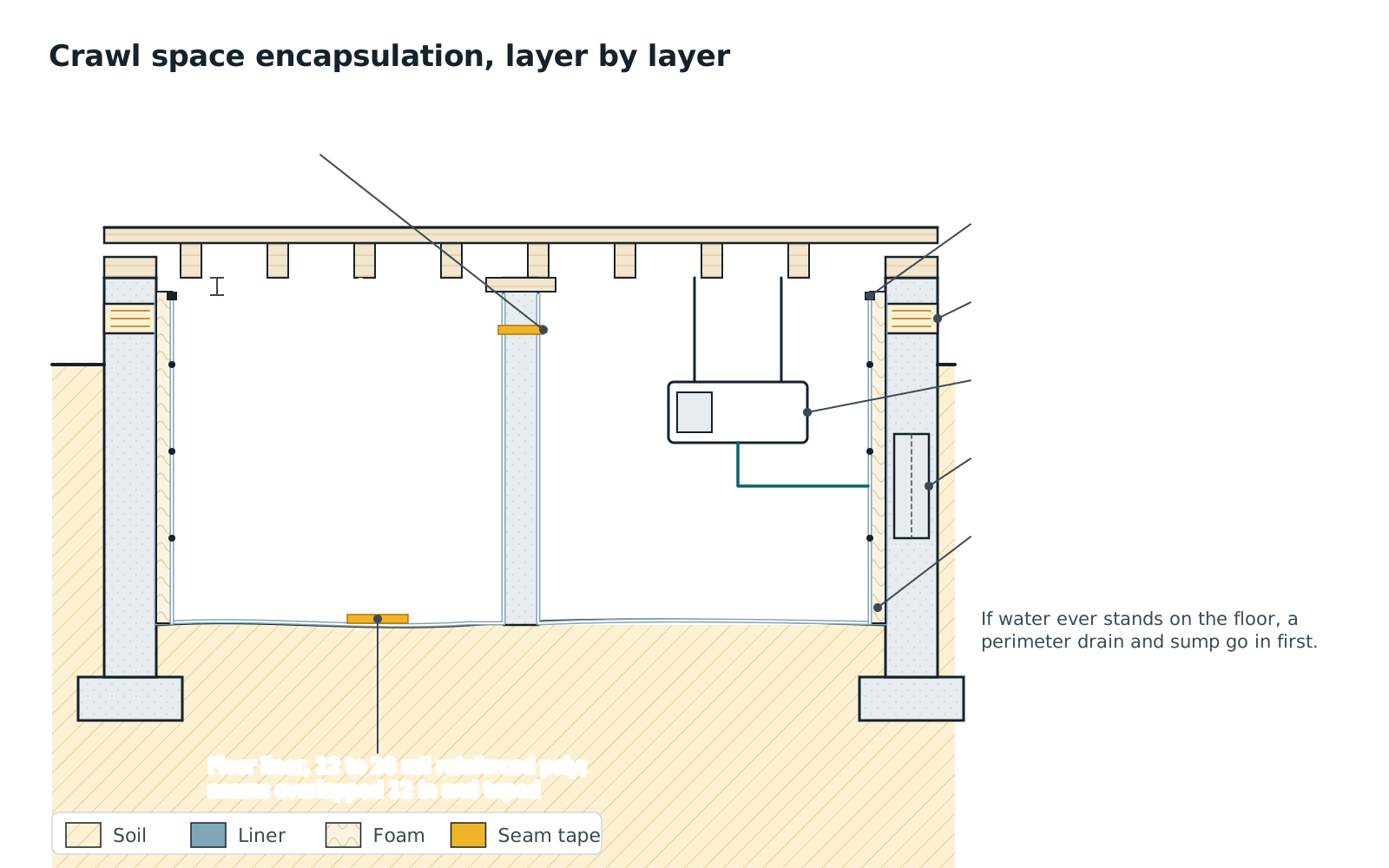
- A Class I vapor retarder for the ground: 6-mil polyethylene is the code minimum, a reinforced 10 to 20 mil liner survives being crawled on; seam tape rated for it, fasteners or termination bar for the wall
- Foam or caulk for the rim joist and penetrations; weatherstripping for the access door
- A dehumidifier sized to the space with a condensate drain line or pump, or a supply register tapped off the house ductwork
- A hygrometer, a pin moisture meter and a radon test kit
- Knee pads, headlamp, coveralls, an N95 respirator and gloves
Closing the vents the right way
- 1
Stop the bulk water first
Vents closed over wet ground make a wetter crawl space. Before anything else, fix what is putting water in: downspouts that discharge at the foundation, grade that slopes toward the house, a dripping drain line or hose bib, a condensate line that ends on the dirt. Our grading and downspouts guide is the outside work. Standing water or a seasonal stream through the crawl space means a perimeter drain and a sump before the liner goes down.
- 2
Cover the ground with a sealed vapor retarder
This is the step that does the work the vents were supposed to do. The code's unvented crawl space section (IRC R408.3) requires a continuous Class I vapor retarder over the exposed earth, joints overlapped 6 in. and sealed or taped, run at least 6 in. up the stem wall and attached and sealed there. Six-mil polyethylene meets the letter; a reinforced 10 to 20 mil liner is what crews install because it survives the plumber. Cut it around piers and seal the collars. Where termite pressure exists, stop the liner and any wall insulation short of the sill: the Department of Energy's weatherization specifications call for a 3-in. inspection gap between the top of the insulation and any wood, and pest control contracts often require the same.
- 3
Block and seal the vents from inside
Cut rigid foam to fit each vent opening snugly, push it in from the crawl space side, and foam the perimeter. Leave the louvered vent in place outside as a screen, or fit a flush cover plate and seal its edges with exterior sealant so wind-driven rain cannot enter. Do the same with any gap around the dryer vent, the plumbing and wire penetrations through the rim, and the access door, which gets weatherstripping and a latch. The crawl space should now be as airtight as the rooms above it; a draft you can feel anywhere is a leak to fix.
- 4
Give the space a way to dry
Closed without a drying mechanism, a crawl space holds whatever moisture is left in the soil and framing. The code offers four options for an unvented crawl space; the two that fit retrofits are a dehumidifier rated for at least 70 pints a day per 1,000 sq ft of crawl space floor, or a conditioned air supply of 1 cfm per 50 sq ft from the house ductwork. The dehumidifier is the usual choice because it works whether or not the air handler is running, and a supply register also needs a return path to the house. Set it on a stand with a drain line sloping continuously to a drain, a condensate pump or daylight, and set it to 50 to 55 percent.
- 5
Check the appliances and the radon
Sealing the crawl space changes the air supply to anything that burns fuel down there. A gas furnace or water heater in the crawl space needs a heating contractor to confirm it is direct-vented or has a dedicated combustion air supply before the vents are closed. Then test for radon, before and a few weeks after; the WSU data on closed crawl spaces without exhaust is the reason, and the EPA's action level is 4 pCi/L. A closed crawl space that tests high gets a sub-liner depressurization system, which is the same fan-and-pipe setup used for slab radon and happens to dry the soil as well.
- 6
Run it, then read the numbers
Run the dehumidifier continuously for the first two to four weeks; it is pulling months of stored water out of the framing and the top of the soil, and the bucket or drain line will show it. Then re-read the hygrometer and the pin meter. The target is 50 to 55 percent relative humidity and framing moisture content falling toward the low teens. If humidity will not come down, look for a liner seam that opened, a vent cover that leaks, a drain line with a belly that has air-locked the dehumidifier, or bulk water you missed. If the numbers are right, the next decision is whether to go further.
Closed vents with a dehumidifier, or full encapsulation?
The steps above produce a closed, dried crawl space. Full encapsulation adds the liner run all the way up the walls, insulation on the foundation walls instead of (or as well as) the floor, a sealed sump if ground water is present, and often a drainage mat under the liner. It is the right next step in a cold climate where the pipes and ducts need to be inside the insulated envelope, in a house whose crawl space floods seasonally, and where the owners want the space clean enough to store things. Most humid-climate crawl spaces do not need it to stop the summer condensation; the sealed ground cover, sealed vents and a correctly sized dehumidifier do that, and the crawl space humidity guide walks the whole sequence including the drainage work.
Sizing is the decision that matters either way. The code floor is 70 pints per day per 1,000 sq ft, cold air cuts a refrigerant dehumidifier's output, and most crawl spaces sit in the 40s and 50s for months: Santa Fe and AprilAire publish minimum operating temperatures of 49 and 50°F, AlorAir's Sentinel line 33.8°F with automatic defrost. Height matters too, since many crawl spaces have 18 in. of clearance or less. The two below cover the common cases; our crawl space dehumidifier roundup ranks the field, the Santa Fe vs AprilAire comparison covers the two ductable brands, and the calculator sizes the unit from the floor area and how well the space is sealed.
What size dehumidifier do you need?
Enter the space. We size by the current DOE pint rating (the number on the box since 2019), with the headroom restoration crews build in.
- Minimum removal needed: about 18 pints/day; with 25% headroom, 22 pints/day.
- Estimated running cost: roughly $28/month in season at ~550 W. ENERGY STAR units cut this 10–15%.
- Route the drain hose to a floor drain or condensate pump so it never stops to empty a bucket.
- Santa Fe Compact70Score 7.8 · 70 pt/day · 2600 sq ftCheck price
- AlorAir Sentinel HD55Score 6.4 · 53 pt/day · 1200 sq ftCheck price
- Paid links.
Santa Fe Compact70
The 12-inch-tall unit that fits where nothing else in this class does.
Best for sealed crawl spaces up to about 2,200 sq ft with under 18 in. of clearance and a gravity drain.
Score breakdown
| Right-sized moisture removal | 70 | 10.0 |
| Efficiency | 2.6 | 6.7 |
| Cold crawl space performance | 49 | 7.3 |
| Warranty | 6 | 10.0 |
| Fits a low crawl space | 12 | 10.0 |
| Quietness | 55 | 6.7 |
| Coverage | 2600 | 8.0 |
| Condensate pump included | false | 0.0 |
| Ductable | true | 10.0 |
| Airflow | 150 | 2.5 |
Stars are DryHomeLab's rating from the published rubric (score ÷ 2, to the half star). Not a customer rating.
- 12 in. tall and 55 lb: fits through a standard hatch and under low joists
- MERV-13 filter standard; most competitors ship MERV-1 or MERV-8
- 6-year warranty on the current (4044110) version
- Rotatable exhaust and optional duct kit for divided crawl spaces
- 49°F minimum operating temperature; cycles off in cold vented crawl spaces
- Condensate pump and duct kit are extra-cost accessories
- Onboard controls only; no remote or wall control listed
- 150 CFM is the lowest airflow of the full-size units here
The Compact70 is the unit we find already installed in more crawl spaces than any other, and the reason is the cabinet: 12 in. wide, 12 in. tall, 21 in. deep, 55 lb. It slides through a 16-by-24 access hatch and sits on a vapor barrier where an 18- or 19-inch-tall box will not. Santa Fe rates it at 70 pints per day at 80°F/60% RH and 2.6 L/kWh, with 150 CFM of airflow and a MERV-13 filter in front of the coil. The current version (part 4044110) carries a 6-year warranty.
Where it falls short: the published minimum operating temperature is 49°F, so in a cold, vented crawl space it will spend late fall through early spring cycling off. (Seal the space first; the roundup explains why.) Santa Fe also publishes the efficiency drop in cool air, 2.6 L/kWh at 80°F falling to 1.96 L/kWh at 65°F, which is the honest number to budget on in a crawl space. There is no condensate pump in the box; Santa Fe's pump kit (up to 12 ft of lift) is a separate purchase, as is the duct kit. Controls are on the unit, which matters when the unit is 40 ft from the hatch, so budget for a remote hygrometer so you are not crawling in to read the display.
Buy it for a sealed or encapsulated crawl space up to roughly 2,200 sq ft (Santa Fe says 2,600 sq ft if tightly sealed, 1,800 sq ft if loose), where height is the constraint and you can gravity-drain. If the space is larger, divided by footings, or you need a pump and remote control included, look at the AlorAir Sentinel HDi90 or the AprilAire E080.
Customer reviews: read them on Amazon (paid link). We link to them and never copy or score them.
AlorAir Sentinel HD55
The light, low, basic unit for a small sealed crawl space on a budget.
Best for sealed crawl spaces and utility basements under about 1,200 sq ft with a downhill drain path.
Score breakdown
| Right-sized moisture removal | 53 | 5.8 |
| Efficiency | 2.27 | 3.9 |
| Cold crawl space performance | 33.8 | 10.0 |
| Warranty | 6 | 10.0 |
| Fits a low crawl space | 13.3 | 8.7 |
| Quietness | 50 | 10.0 |
| Coverage | 1200 | 1.0 |
| Condensate pump included | false | 0.0 |
| Ductable | false | 0.0 |
| Airflow | 120 | 1.0 |
Stars are DryHomeLab's rating from the published rubric (score ÷ 2, to the half star). Not a customer rating.
- 13.3 in. tall and 41.7 lb; easy to get through a hatch and across a vapor barrier
- 33.8°F minimum operating temperature with automatic defrost
- 6-year limited warranty
- Under 50 dBA
- 53 pints/day at AHAM covers only about 1,200 sq ft
- 2.27 L/kWh is the lowest efficiency of the six
- Gravity drain only; no pump, no duct option, remote sold separately
- MERV-1 filter; amperage not published
The Sentinel HD55 is the small-crawl-space unit: AlorAir rates it at 53 pints per day at AHAM conditions (113 at saturation), 2.27 L/kWh, 120 CFM, and up to 1,200 sq ft, in a 19.2 by 12.2 by 13.3 in. cabinet that weighs 41.7 lb. That is the second-lowest profile in this group after the Compact70, and the lightest by 13 lb, which matters when you are dragging it 30 ft across a vapor barrier on your stomach. Like the HDi90 it runs down to 33.8°F with automatic defrost, and it carries AlorAir's 6-year limited warranty.
It is a basic machine. Gravity drain only (no pump), a MERV-1 filter, onboard controls with the remote sold separately, no duct option, and the lowest efficiency of the six at 2.27 L/kWh against 2.6 to 2.9 for the Santa Fe and AprilAire units, which adds up over a season of continuous running. AlorAir does not publish amperage on the product page. Mind the model spread: the HD55S is the ENERGY STAR-listed variant and the HD55P adds a pump; the plain HD55 is what we spec here. Sound is listed under 50 dBA.
Buy it for a sealed crawl space or utility basement under about 1,200 sq ft where you can run a drain line downhill and the budget does not stretch to a Compact70. For anything larger or wetter, the extra capacity and the pump of the HDi90 are worth the difference.
Customer reviews: read them on Amazon (paid link). We link to them and never copy or score them.
When to call a pro
Call a crawl space or encapsulation contractor when there is standing water or a seasonal stream through the space (a perimeter drain and sump come before the liner), when the clearance is too low to work in, when the joists show growth or read 20 percent or more on a pin meter (remediation first, following EPA and IICRC guidance for the extent of the growth), or when you want the wall insulation, drainage mat and warranty that come with full encapsulation. Call a heating contractor before closing vents on a crawl space with a gas furnace or water heater in it, and a radon mitigator if the post-closure test is above 4 pCi/L. A frozen or burst line in front of an open vent is a plumber's job and is covered in our winterizing guide. The form below reaches vetted local crawl space, waterproofing and remediation contractors through HelpMeNow.com.
Frequently asked questions
Should crawl space vents be open or closed in summer?
In a humid climate, closed. Summer air with a dew point of 70°F condenses on 60°F ducts and 65°F joists the moment it enters, so open vents add water to the crawl space; Advanced Energy's Southeast field study found wall-vented crawl spaces above 80 percent relative humidity 86 percent of the summer while closed ones stayed below 70 percent nearly all the time. In a dry climate, where summer dew points sit in the 40s and 50s, open vents work. Closing vents only helps if the ground is covered with a sealed vapor retarder and a dehumidifier or supply air does the drying.
Should crawl space vents be closed in winter?
Yes, everywhere there is plumbing or ductwork in the crawl space. Winter air is dry, so closed vents cost nothing in moisture, and open vents on a windy night put water lines in air that can freeze them; the Insurance Institute for Business & Home Safety puts the risk point for unprotected pipes in unheated spaces at about 20°F outdoors. Block the vents from inside with foam or fitted covers before the first hard freeze, sleeve the pipes, and seal the rim joist.
Is it against code to close crawl space vents?
No. The International Residential Code has allowed unvented crawl spaces since the 2009 edition (Section R408.3), on conditions: a continuous Class I vapor retarder over the ground with seams lapped 6 in. and sealed and the edges run 6 in. up the wall and sealed, plus one of four drying methods, the practical two being a dehumidifier rated for at least 70 pints a day per 1,000 sq ft or a conditioned air supply of 1 cfm per 50 sq ft. Local amendments vary, so check with the building department, especially in termite regions where an inspection gap is required.
Do automatic crawl space vents work?
For freezing, yes; for moisture, no. A temperature-actuated vent uses a bimetal coil to close at about 40°F and open fully at about 70°F, so it protects pipes in winter without anyone crawling around the house. In summer it is open exactly when outside air is warmest and wettest and the ducts are coldest, which is when the condensation happens. In a humid climate an automatic vent is a convenience for a crawl space that stays vented, not a fix for a damp one.
What happens if I close the vents without a dehumidifier?
The crawl space keeps whatever moisture the soil and framing already hold and adds what comes up through bare ground, with nowhere for it to go. Humidity climbs, the joists absorb it and mold follows. Closing the vents only works as part of a system: a sealed ground cover first, then the vents and rim sealed, then a dehumidifier sized to the space or a supply of conditioned air, then a radon test. Done in that order the space settles at 50 to 55 percent within a few weeks.
How do I tell if my crawl space vents are causing moisture problems?
Leave a hygrometer in the middle of the space for a week in summer; readings in the 70s and 80s with the vents open mean the vents are wetting it. Compare the surface temperature of the ducts and joists, read with an infrared thermometer, to the outdoor dew point in the forecast; if the dew point is higher, outside air is condensing on them. Push a pin moisture meter into a few joists: 8 to 14 percent is dry, above 16 percent is a problem, 20 percent or more or visible growth means remediation before anything else.
The seasonal checklist, by email
One email when the season changes — freeze week, spring thaw, hurricane season — with the checklist for that month. No weekly newsletter, no selling your address.
We send one confirmation link first. Every email has a one-click unsubscribe. Privacy.
Check your inbox for the confirmation link; the checklist follows as soon as you click it.
You are on the list. The next email arrives when the season changes.
That did not go through. Check the address and try again.
DryHomeLab is written and reviewed by the team behind HelpMeNow.com, a marketplace that connects homeowners with vetted local contractors for water-damage restoration, plumbing and waterproofing. Before HelpMeNow the same team ran a 24/7 water-damage restoration company in the Seattle area; the equipment on this site is what we specified, bought and ran on real water losses. We publish the rubric behind every score.
- Ran a 24/7 water-damage restoration company, Seattle area
- Operate HelpMeNow.com, a contractor marketplace
- Publishes its scoring rubric