

First: what kind of water, and is it safe to go under there
The water decides the job. The IICRC S500 standard sorts water into three categories, and almost everything that floods a crawl space is in the worst one. Rising groundwater, surface runoff that came in through the vents or the access door, and anything from a sewer line or a septic field are Category 3, grossly contaminated: porous materials they touched are removed, not dried, and the cleanup is done in protective gear. A burst supply line or a water heater in the crawl space is Category 1, clean, and becomes Category 2 or 3 the longer it sits on dirt. Decide which you have before you plan anything, because a sewage flood under the house is a crew job from the first hour.
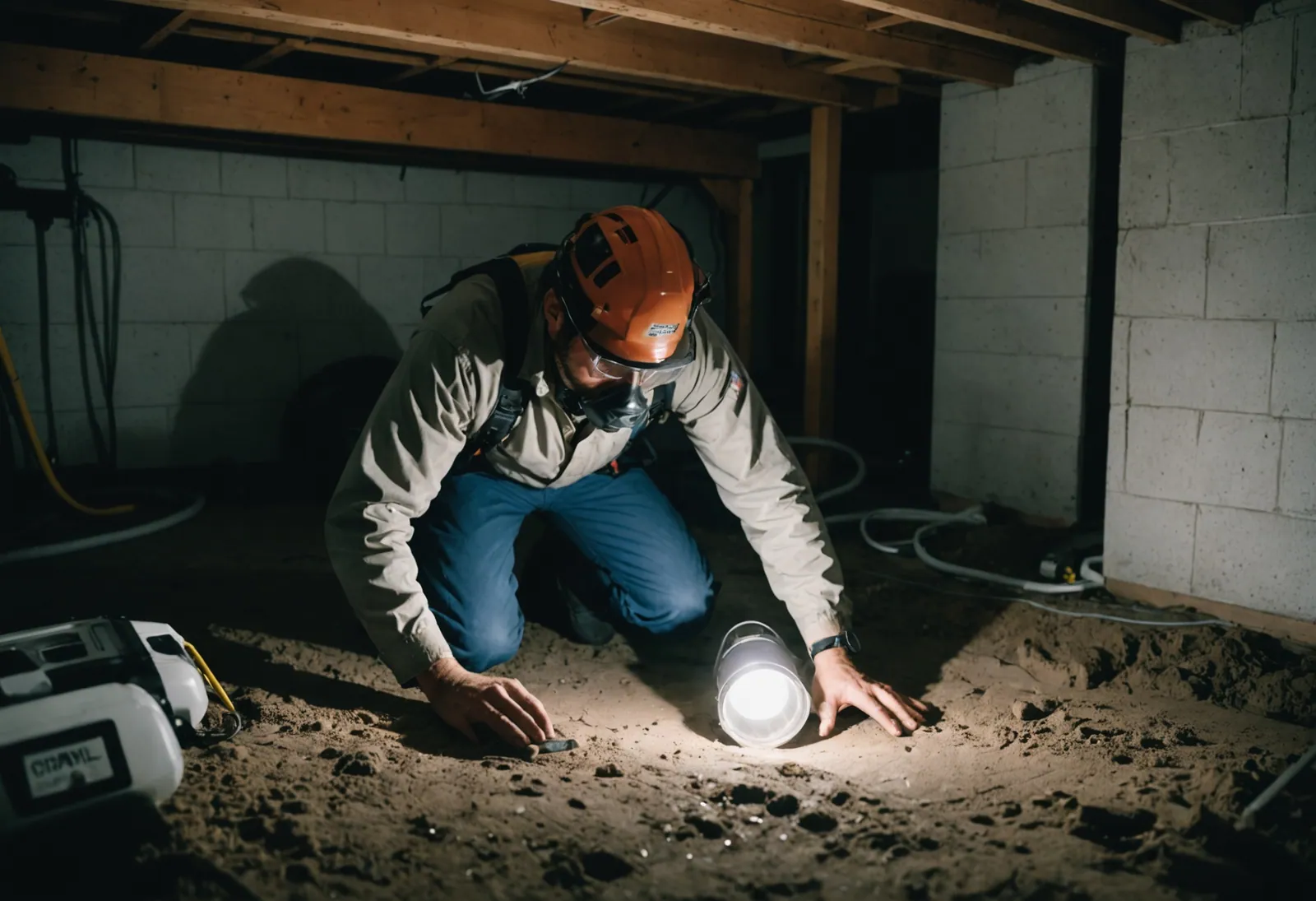
Then the hazards, in order. Water and wiring: crawl spaces carry the house's electrical runs, junction boxes, the sump pump cord, the furnace or air handler and its condensate pump, and sometimes a well pump. If water is standing and you cannot see every box and cord above it, turn off power to the crawl space circuits at the panel, or the main if you are not sure which they are, before anyone goes down. Gas: a furnace or water heater in a flooded crawl space gets its gas valve shut and a service call before it is relit, and a gas-powered pump or generator never runs under or inside the house because of carbon monoxide. Structure: a pier that has been undermined or a joist that gives under your hand is a reason to come back out. Air: a flooded crawl space is a closed space full of damp soil, mold spores if it has been wet long, and whatever the water carried, so a respirator (N95 at minimum, a P100 half-mask for sewage), goggles, waterproof gloves, coveralls and a headlamp are the uniform, and someone should know you are down there. Pests move in with the water and out of it; look before you reach.
If any of that is beyond what you want to handle, skip to the bottom of this page; the form reaches crews that do this every week.
Where the water came from decides how fast you can win
There are four sources, and the response is different for each.
Rising groundwater. The water table came up to the crawl space floor after days of rain or snowmelt. Pumping is a holding action until the water table drops; a pump in a low spot will run for days and the soil will stay saturated. Start the pump anyway to keep it off the framing, but plan the real drying for when the inflow stops, and plan a sump pump in the crawl space as part of the fix.
Surface runoff. Water ran in through foundation vents, the access well, or a low spot in the grade during a storm. This stops when the rain stops, pumps out in hours, and is the most fixable: gutters, downspout extensions, grading and vent-well covers, all on the basement waterproofing checklist.
A plumbing or appliance leak. A split supply line, a failed water heater, or a condensate line dumping under the house. Clean water, often unnoticed for weeks, which is its own problem. Shut the valve or the main; our shutoff guide covers finding it.
Sewer or septic. A backed-up drain line or a failed septic component. Category 3 regardless of volume: stop using the plumbing, call a plumber and a restoration crew, and do not try to dry it yourself.
Tools and materials
- A submersible utility pump or a sump pump with enough hose to reach daylight at least 10 ft from the foundation and downhill of it, on a GFCI-protected circuit or a GFCI adapter. A 1/3 HP pump moves a flooded crawl in hours; the sump pump roundup covers what to buy if it will stay.
- A wet-dry vacuum for the last inch and the low spots a pump cannot reach.
- A shovel, a flat scraper and a rake for silt and debris.
- Contractor bags (lots) for insulation, liner and debris, and a tarp to drag them to the hatch.
- A dehumidifier that can live in a crawl space: a rented low-grain refrigerant (LGR) unit with an internal pump is the right tool; the Dri-Eaz Revolution at 60 lb and 12.5 in wide is the one that fits through a standard 18 x 24 in access opening. A consumer dehumidifier is not enough and cannot drain uphill without a pump.
- Air movers, low-profile or centrifugal, one per 12 to 16 ft of foundation wall in our experience, plus a row down the center of a wide crawl. Count the circuits: a Velo Pro draws 1.9 A on high and Legend Brands rates up to ten on one 15 A circuit; the dehumidifier gets its own.
- Heavy extension cords (12 gauge), a GFCI adapter, and a power strip rated for the load.
- A pin moisture meter for the joists, sill plates and subfloor, and a hygrometer with a remote sensor so you can read the crawl space from upstairs.
- 6-mil poly and tape to close the vents while the equipment runs, and the new liner afterward: 6-mil minimum, 10 to 12 mil if you are encapsulating.
- PPE: N95 or P100 respirator, goggles, waterproof gloves, coveralls, knee pads, headlamp.
- An EPA-registered antimicrobial labeled for the surfaces, if the water was Category 2 or 3, applied per its label.
Drying a flooded crawl space, step by step
- 1
Make it safe and photograph it
Power off to the crawl space circuits, gas appliances in the crawl space off, PPE on. Before you move anything, photograph the water line on the piers and the foundation wall, the standing water, the wet insulation, and whatever you can see of the source, with a tape measure in frame. If this is a claim, the insurance documentation checklist lists what the adjuster will want. Note the time; the drying clock on the framing started when it got wet, not now.
- 2
Pump out the standing water
Set the pump in the lowest spot; dig a shallow hole in the dirt so the intake sits below the floor and keeps pulling after the surface is gone. Run the discharge hose out the vent or hatch to daylight, at least 10 ft from the foundation and downhill, never into a floor drain that goes to a septic system. A 1/3 HP pump moves a flooded crawl in a few hours. If the water keeps coming back as fast as you pump, the water table is up and you are in a holding action: keep the pump running to protect the framing and wait for the inflow to stop before you start the drying equipment. Wet-vacuum the last inch and the low corners.
- 3
Strip out everything that will not dry
Fiberglass batts between the joists that touched water, or that are sagging and dripping, come down: cut them free, bag them under the house, and drag the bags to the hatch on a tarp. Wet batts hold water against the subfloor for weeks and will not dry in place. The old vapor barrier comes out if it is torn, silted or floating; a liner with a layer of mud on it is a mold farm. Cardboard, lumber scraps, old ductwork insulation that got wet, anything stored down there: out. Shovel and rake the silt and debris into bags. For Category 3 water, this step includes the top layer of soil the sewage soaked into and anything porous it touched, and the framing gets cleaned and treated with an EPA-registered antimicrobial according to its label before any fan runs; that is where most homeowners hand the job to a crew.
- 4
Close the vents and set the dehumidifier first
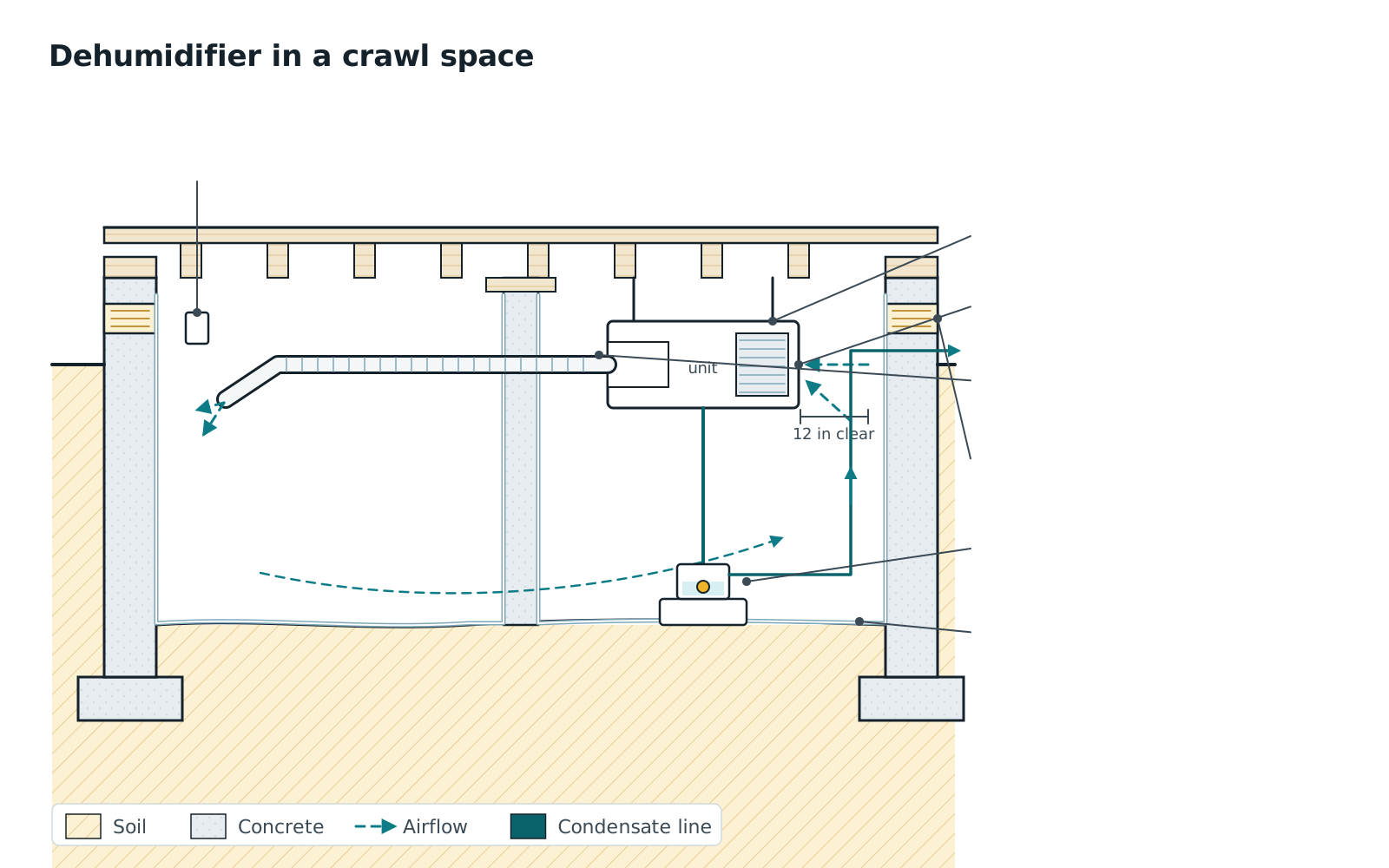
Tape poly over every foundation vent and seal the access door around the cords, so the equipment is drying the crawl space and not the neighborhood. Set the LGR on blocks or a scrap of plywood, roughly in the center or at the far end from the hatch, with its drain hose running to the outside or to a utility sink; an internal pump will lift it out through a vent. Give it its own circuit. Turn it on before the air movers, because the fans will put water into the air faster than you expect and the dehumidifier has to be ready for it. Hang the hygrometer sensor midway between the dehumidifier and the hatch, not in the airstream.
- 5
Place the air movers down the joist bays
Air has to move the length of the crawl space and come back. Set the first air mover near the hatch aimed down the length of the joists, the next 12 to 16 ft along the foundation wall aimed the same direction, and continue around the perimeter so the air circulates in a loop; in a wide crawl space add a row down the center beam. Angle each fan slightly upward so the stream washes the subfloor and the joist bays, not the dirt. Low-profile fans like the Velo Pro sit under 12 in of clearance; centrifugal fans want 18 in or more. Keep the total draw on each circuit under 12 A: a Velo Pro on high is 1.9 A, so five or six fit a 15 A circuit with headroom, and the dehumidifier is on another.
- 6
Meter the framing every 24 hours
Take a dry standard first: a pin reading on framing the water never reached, such as the rim joist at the high end of the crawl space or exposed joists in the garage, and write it down. Then mark reading points with tape on the sill plate every 8 ft, on the bottom of a joist in every third bay, on the beam, and on the underside of the subfloor at the wettest spot, and read them at the same time each day with the same meter. Readings should fall every day. Framing is dry when it matches the dry standard, typically in the single digits to low teens, and restoration practice treats 16 percent as the line it has to get under; the sill plates and the beam are the slowest. Readings that stall for two days mean an air mover is not reaching that bay or something wet is still in it.
- 7
Decide on day three to five, then put the liner back
With the vents closed and the equipment running, joists and subfloor in a crawl space that was pumped quickly usually meet the dry standard in three to five days; sill plates and a built-up beam can take a week or more. Run the dehumidifier a day past the last dry reading. Then lay the new vapor barrier over the whole floor: the IRC's unvented crawl space section (R408.3) calls for a continuous Class I vapor retarder with joints lapped 6 in and sealed or taped, run 6 in up the stem wall and sealed to it, and that is the right spec even if your crawl space keeps its vents. Reinstall insulation only when the framing meters dry, and consider closed-cell foam or rigid board on the walls instead of batts between the joists; batts are what you just carried out in bags.
How big a dehumidifier, and how many fans
The S500 method for sizing a dehumidifier divides the volume of the space in cubic feet by a factor set by the class of loss and the type of unit; for an LGR on a loss where most surfaces are wet, the factor is 40. A 1,200 sq ft crawl space with 3 ft of clearance is 3,600 cu ft, which is 90 pints per day at the AHAM 80°F/60% rating. That is one Revolution-class LGR working hard, or one larger unit; a consumer 50-pint dehumidifier, rated under the cooler DOE test, is a fraction of that and has no way to drain uphill. Crawl spaces also run cold, and refrigerant dehumidifiers lose capacity as the temperature drops: the Revolution is rated to operate down to 33°F, but it removes far less at 45°F than at 80°F, so in a cold-season flood expect the job to take longer or rent a second unit.
The planner below does the room math; enter the crawl space footprint and clearance height, call the wet wall length the full perimeter, and treat it as a Class 3 loss.
Drying planner: how many fans and how much dehumidifier
The same math our crews use on a water loss. It also tells you when to stop and call someone.
- Run 5 air movers aimed along the walls at 15–45°, one every 10–16 ft of wet wall, with a large dehumidifier rated at least 48 pints/day in the closed room.
- Pull the carpet pad if it is wet; pad does not dry in place. Lift carpet edges and float air under it.
- Check with a moisture meter daily; you are done when readings match an unaffected area, usually 3–5 days.
- Santa Fe Compact70Score 7.8 · 150 CFMCheck price
- Paid links.
- Santa Fe Compact70Score 7.8 · 70 pt/dayCheck price
- Paid links.
How long it takes, and why the soil matters
The framing dries in days; the dirt does not. Soil under a house that flooded holds water for weeks and evaporates it into the crawl space continuously, which is why a flooded crawl space without a vapor barrier reads 80 or 90 percent humidity long after the puddles are gone, and why the liner is part of the drying job, not the cleanup afterward. Once the framing meets the dry standard and the liner is down and sealed, the humidity under the house should fall into the 50s within a day or two with the dehumidifier running. If it does not, the liner has a gap or water is still coming in.
Two more things slow a crawl space down. Insulation left in place keeps the subfloor wet from below no matter how much air moves past it; if you can see sag or feel weight in a batt, it has to come out. And a crawl space with the vents open in summer in a humid climate pulls in outside air that condenses on the cold framing and ducts, so the dehumidifier runs against the weather instead of the flood; keep the vents sealed until the equipment comes out, then read our crawl space humidity guide before deciding whether they ever open again.
Then fix the cause
A crawl space that flooded once will flood again on the same weather. Work from outside in: downspouts extended at least 6 ft from the foundation, grade sloping away, vent wells with covers or vents raised above grade, and a sump pit at the low point with a pump that discharges well away from the house; a battery backup matters more here than in a basement because nobody notices a crawl space pump has failed. If the water was groundwater, a perimeter drain to the sump is the permanent answer. Then the liner, sealed vents and a permanent crawl space dehumidifier sized to the space, which is the encapsulation sequence in the humidity guide. The equipment below is the rental set for the flood and the permanent unit for afterward.
Dri-Eaz Revolution LGR Dehumidifier
The 60 lb LGR that fits through a crawl space hatch and runs on 5.5 amps.
Best for crawl spaces, small finished basements and single-room losses, or as a second unit beside a large LGR.
Score breakdown
| Moisture removal | 80 | 3.0 |
| Saturation capacity | 144 | 2.9 |
| Current draw | 5.5 | 9.0 |
| Warranty | n/a | — |
| Internal pump | true | 10.0 |
| Portability | 60 | 9.1 |
| Stackable | n/a | — |
| Drain hose length | n/a | — |
Stars are DryHomeLab's rating from the published rubric (score ÷ 2, to the half star). Not a customer rating.
- 80 pints/day AHAM in a 60 lb unit that fits through a crawl space hatch
- 5.5 A leaves room for air movers on the same circuit
- Operates down to 33°F for cold basements
- Internal pump
- Capacity suits one or two rooms, not a whole floor
- Spec page does not state drain hose length or warranty
- Priced like professional equipment
The Revolution is the compact LGR in the Dri-Eaz line, and the one we carry when the job is a crawl space, a bathroom or a single flooded bedroom. Dri-Eaz rates it at 80 pints per day at AHAM and 144 at saturation, with 121 to 180 CFM of airflow, in a 12.5 x 17.6 x 21.5 in cabinet that weighs 60 lb. It draws 5.5 A, which leaves room on a 15 A circuit for two or three low-profile air movers.
The footprint is the point. A full-size LGR will not go through most crawl space access hatches or stand in a 5 x 8 ft bathroom with the door closed; the Revolution does both. It operates from 33°F to 100°F, so a cold basement in March is inside its range. It has an internal pump so you can run the drain line to a sink.
Its limit is capacity. Eighty pints a day covers roughly a 15 x 20 ft room with wet carpet and drywall as a single Class 2 loss; for a whole finished basement you need two of these or one 7000XLi. The spec page we verified does not state hose length or warranty, so check both with the dealer.
Buy it if you have a crawl space or a cramped basement with recurring water problems, or as the second unit beside a large LGR. Homeowners dealing with a one-time flood should rent one.
Dri-Eaz Velo Pro Low Profile Air Mover
The fan restoration crews buy by the pallet, with an amp dial that fits ten on one circuit.
Best for anyone drying walls and floors who will run two or more fans at once, including landlords and repeat-flood basements.
Score breakdown
| Amps per fan | 1.9 | 9.4 |
| Daisy-chain outlets | true | 10.0 |
| Positioning options | 5 | 10.0 |
| Real air-mover airflow | 885 | 10.0 |
| Durability | plastic | 6.0 |
| Cord length | 18 | 5.9 |
| Warranty | n/a | — |
| Portability | 18.6 | 5.7 |
| Quietness | 69 | 7.3 |
| Stackable | true | 10.0 |
Stars are DryHomeLab's rating from the published rubric (score ÷ 2, to the half star). Not a customer rating.
- Adjustable 1.2–1.9 A draw lets you balance several fans on one 15 A circuit
- Five operating positions cover floors, walls, stairs and cabinets
- Daisy-chain dual outlet; Dri-Eaz says up to ten units per 15 A circuit
- 18.6 lb with a built-in handle, and they stack six high on a hand truck
- 69 dB average is quiet for a professional air mover
- 885 CFM maximum is far less than a centrifugal unit; it needs company on big carpet
- Priced for contractors, roughly three times a hardware-store utility fan
- Dri-Eaz does not publish the warranty term on the product page; check the warranty document before buying
The Velo Pro is a low-profile axial air mover built for structural drying rather than for blowing air across a room. Dri-Eaz rates it at 500 to 885 CFM on a variable-speed dial, and the dial also sets the current draw anywhere from 1.2 to 1.9 A in 0.1 A steps. That second number is why crews like it: on a 15 A household circuit you can run eight to ten of these through their daisy-chain outlets without tripping a breaker, where a full-size centrifugal fan limits you to three.
The five operating positions matter more than the airflow figure. Laid flat it sweeps a wide, low path across carpet and subfloor. Tilted on its kickstand it hits the lower 2 ft of a wall where water wicks into drywall. Stood on end it dries a stairway or the inside of a cabinet. An hour meter tracks runtime, which is useful when you are logging a job for an insurance claim.
Where it falls short: it is not cheap for a homeowner who will use it once, and 885 CFM is a third of what a snail-shell centrifugal moves, so a single Velo Pro on a soaked 20 x 20 ft carpet is slow. It wants to be one of several fans working with a dehumidifier. At 69 dB it is quieter than most centrifugals but still not something you sleep next to.
Buy it if you own rental property, manage a building, or have had water in the same basement twice. For a one-time loss, rent this exact model from an equipment yard instead; it is what they stock.
Santa Fe Compact70
The 12-inch-tall unit that fits where nothing else in this class does.
Best for sealed crawl spaces up to about 2,200 sq ft with under 18 in. of clearance and a gravity drain.
Score breakdown
| Right-sized moisture removal | 70 | 10.0 |
| Efficiency | 2.6 | 6.7 |
| Cold crawl space performance | 49 | 7.3 |
| Warranty | 6 | 10.0 |
| Fits a low crawl space | 12 | 10.0 |
| Quietness | 55 | 6.7 |
| Coverage | 2600 | 8.0 |
| Condensate pump included | false | 0.0 |
| Ductable | true | 10.0 |
| Airflow | 150 | 2.5 |
Stars are DryHomeLab's rating from the published rubric (score ÷ 2, to the half star). Not a customer rating.
- 12 in. tall and 55 lb: fits through a standard hatch and under low joists
- MERV-13 filter standard; most competitors ship MERV-1 or MERV-8
- 6-year warranty on the current (4044110) version
- Rotatable exhaust and optional duct kit for divided crawl spaces
- 49°F minimum operating temperature; cycles off in cold vented crawl spaces
- Condensate pump and duct kit are extra-cost accessories
- Onboard controls only; no remote or wall control listed
- 150 CFM is the lowest airflow of the full-size units here
The Compact70 is the unit we find already installed in more crawl spaces than any other, and the reason is the cabinet: 12 in. wide, 12 in. tall, 21 in. deep, 55 lb. It slides through a 16-by-24 access hatch and sits on a vapor barrier where an 18- or 19-inch-tall box will not. Santa Fe rates it at 70 pints per day at 80°F/60% RH and 2.6 L/kWh, with 150 CFM of airflow and a MERV-13 filter in front of the coil. The current version (part 4044110) carries a 6-year warranty.
Where it falls short: the published minimum operating temperature is 49°F, so in a cold, vented crawl space it will spend late fall through early spring cycling off. (Seal the space first; the roundup explains why.) Santa Fe also publishes the efficiency drop in cool air, 2.6 L/kWh at 80°F falling to 1.96 L/kWh at 65°F, which is the honest number to budget on in a crawl space. There is no condensate pump in the box; Santa Fe's pump kit (up to 12 ft of lift) is a separate purchase, as is the duct kit. Controls are on the unit, which matters when the unit is 40 ft from the hatch, so budget for a remote hygrometer so you are not crawling in to read the display.
Buy it for a sealed or encapsulated crawl space up to roughly 2,200 sq ft (Santa Fe says 2,600 sq ft if tightly sealed, 1,800 sq ft if loose), where height is the constraint and you can gravity-drain. If the space is larger, divided by footings, or you need a pump and remote control included, look at the AlorAir Sentinel HDi90 or the AprilAire E080.
Customer reviews: read them on Amazon (paid link). We link to them and never copy or score them.
When to call a pro
Call a restoration crew if the water is sewage or septic, or came in from outside and sat for more than a day or two; if the crawl space is more than a few hundred square feet of wet framing and soil; if the furnace, air handler, ductwork or water heater sat in the water; if you see or smell growth on the joists or subfloor; if the clearance is under 18 in and you cannot work in it; if the framing readings stall for two days; or if this is going through insurance and the adjuster wants a moisture map and daily logs. Call an electrician before power goes back on to anything that was submerged, a plumber for a sewer line or a split supply, and a structural engineer if a pier has shifted or a joist is soft. The form below reaches vetted local restoration contractors through HelpMeNow.com; the first 48 hours are the ones that decide whether this is a drying job or a mold job.
Frequently asked questions
How long does it take a crawl space to dry out after flooding?
With the water pumped out the first day, wet insulation and liner removed, the vents sealed and an LGR dehumidifier and air movers running, joists and subfloor usually meet the dry standard in three to five days; sill plates and a built-up beam can take a week or more. Without equipment, a crawl space does not reliably dry at all, because the soil keeps evaporating water into a closed space. Confirm with a pin moisture meter on the framing against a reading from dry framing elsewhere, not with a calendar.
Can I just pump out the water and leave it?
No. Pumping removes the standing water; it does nothing for the soaked insulation, the silted vapor barrier, or the water the soil will evaporate into the crawl space for weeks. Crawl spaces that were pumped and closed up are the ones where the joists are still in the twenties a month later with growth on the subfloor. Pump, strip what will not dry, get a dehumidifier under the house the same day, and meter the framing before you close the hatch.
Does wet crawl space insulation have to be replaced?
Fiberglass batts that touched water, or that are sagging and dripping, come out and are replaced once the framing meters dry. Wet batts hold water against the subfloor and will not dry inside a joist bay. Closed-cell spray foam and rigid foam board on the walls shed water and can usually stay; dry the framing around them and check it with a meter. If you are re-insulating, consider insulating the foundation walls and sealing the crawl space instead of putting batts back between the joists.
Can I use a regular dehumidifier in a flooded crawl space?
Not for the drying. A consumer dehumidifier is rated under the DOE test at cool, moderate conditions, removes a fraction of what a commercial LGR does on an active loss, cannot pump its water uphill and out a vent, and runs poorly in a cold crawl space. Rent an LGR with an internal pump for the flood. A consumer unit or a purpose-built crawl space dehumidifier is the right tool afterward, to hold the sealed space in the 50s once the framing is dry and the liner is down.
Should the crawl space vents be open or closed while it dries?
Closed, while the dehumidifier runs. Open vents let the unit pull in outside air instead of drying the space, and in humid weather that air condenses on cold framing and ducts and makes things worse. Tape poly over the vents and seal the access door around the cords until the framing meters dry. Whether the vents stay closed permanently is a separate decision covered in our crawl space humidity guide; in most of the country a sealed crawl space with a liner and a dehumidifier stays drier than a vented one.
Is water in the crawl space covered by insurance?
Usually for sudden, accidental water from inside the house, such as a burst supply line or a failed water heater in the crawl space, and usually not for groundwater, surface flooding or sewer backup unless the policy has a flood policy or a backup endorsement. Photograph the water line, the insulation and the source before you touch anything, call the insurer the same day, keep receipts for the pump, the equipment rental and the liner, and keep a daily log of framing moisture readings; policies require you to take reasonable steps to prevent further damage, and drying the crawl space is that step.
The seasonal checklist, by email
One email when the season changes — freeze week, spring thaw, hurricane season — with the checklist for that month. No weekly newsletter, no selling your address.
We send one confirmation link first. Every email has a one-click unsubscribe. Privacy.
Check your inbox for the confirmation link; the checklist follows as soon as you click it.
You are on the list. The next email arrives when the season changes.
That did not go through. Check the address and try again.
DryHomeLab is written and reviewed by the team behind HelpMeNow.com, a marketplace that connects homeowners with vetted local contractors for water-damage restoration, plumbing and waterproofing. Before HelpMeNow the same team ran a 24/7 water-damage restoration company in the Seattle area; the equipment on this site is what we specified, bought and ran on real water losses. We publish the rubric behind every score.
- Ran a 24/7 water-damage restoration company, Seattle area
- Operate HelpMeNow.com, a contractor marketplace
- Publishes its scoring rubric